

Enjoy the benefits of a premium membership!
Upgrade Account
-
TalkBass has been independent since 1998. Add your voice.
Create a free account to reply to discussions, view embedded media, and browse with fewer display ads.
Join free Log in
Want zero display ads or expanded classifieds tools? Compare plans.
You are using an out of date browser. It may not display this or other websites correctly.
You should upgrade or use an alternative browser.
You should upgrade or use an alternative browser.
Why so little discussion about bass pickups?
- Thread starter Peeved T-40
- Start date
More options
Who Replied?
"Capture" probably wasn't the right word. I guess my point is there is less of an audible difference with minor changes to pickup design for bass. Therefore, there's less discussion and application of pickup tinkering and swapping for bass than there is for guitar.
I'm sorry to keep picking, and I hate to do this, but I'm going to disagree again. I think understand the point you're trying to make (please corred me if I don't), I just don't think it's true in practice. Adding 10% more winds to either a guitar pickup or a bass pickup makes the same difference in the signal, and you would easily pick out the difference on both instruments. Changing from one magnet type to another makes the same difference, and it's just as easy to notice (or not) on each type of instrument. A single coil compared to a split coil "feels" like the same type of difference on each type of instrument. And so on.
There is no technical challenge that makes it harder to create distinct pickups for basses than for guitars. The common variables in pickup design are equally effective in both instruments.
To put it another way - if what you're after is a variety of pickups that have easy-to-notice differences in tone and output, that's equally possible with both instruments and would be done in similar ways. It's definitely not because basses are harder to create more distinct pickups for that we have these differences in the market.


That's a fair point but there's still stuff you could do with the wiring and in general, the wiring schemes in basses are pretty simple and to the point. I mean, there are active basses with full EQs and stuff in them but I've never seen anything that I might call a Stratocaster of basses for instance. Like a bass that's loaded out with pickups and wired to allow for all kinds of combinations. Maybe there's some high end, boutique stuff out there but certainly nothing off the shelf.
The new Stanley Clarke Strat type has the usual Strat pickup combos, plus extra options from the mini switch. The Music Man Big Al three pickup bass has a range of pickup options. There have been and are other similar basses, Godin for example and quite a few people have built their own, or had custom builders do various pickup and control combinations.
You are right in that the obsession, crazy or not in some cases, with pickups doesn't seem as generalized as within the guitar set, but there is still plenty of variation out there, maybe it's just a bit less "in your face" than the guitar related stuff?
While the ancestry of electric guitars and basses is the same their function and place within music is different and their development has been somewhat different. It wasn't that long ago that active electronics were almost entirely additions in basses, while much rarer in guitars. Can you imagine suggesting active electronics to tens of thousands of guitar players obsessed with replicating 50's Fender and Gibson tones and pickups? Likewise with ceramic and rare earth magnets, well accepted for bass pickups, but stilleneraly shunned and hated among many guitarists.
Hopefully some further searching will put you in contact with like minded people here, or posting your own thoughts and experiences should draw for specific responses. To para phrase an old movie title, Post it and they will come".

Ah! Now all the fuss finally makes sense!The DarkStar/BiSonic pickup is not a humbucker. It's a gloriously over-engineered big single-coil, with loads of output, wide frequency response, and otherworldly touch-sensitivity. And loads of chrome!
...Must follow a few of those links I referred to...

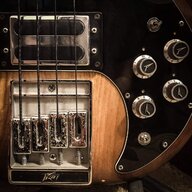
The new Stanley Clarke Strat type has the usual Strat pickup combos, plus extra options from the mini switch. The Music Man Big Al three pickup bass has a range of pickup options. There have been and are other similar basses, Godin for example and quite a few people have built their own, or had custom builders do various pickup and control combinations.
You are right in that the obsession, crazy or not in some cases, with pickups doesn't seem as generalized as within the guitar set, but there is still plenty of variation out there, maybe it's just a bit less "in your face" than the guitar related stuff?
While the ancestry of electric guitars and basses is the same their function and place within music is different and their development has been somewhat different. It wasn't that long ago that active electronics were almost entirely additions in basses, while much rarer in guitars. Can you imagine suggesting active electronics to tens of thousands of guitar players obsessed with replicating 50's Fender and Gibson tones and pickups? Likewise with ceramic and rare earth magnets, well accepted for bass pickups, but stilleneraly shunned and hated among many guitarists.
Hopefully some further searching will put you in contact with like minded people here, or posting your own thoughts and experiences should draw for specific responses. To para phrase an old movie title, Post it and they will come".
Some one else posted the Stanley Clarke bass and I'll say the same thing. My point wasn't that stuff like that DOESN'T exist, just that it's not normal. That's not the kind of thing you see hanging on the wall in your local guitar center.
And more to the point, there just doesn't seem to be the same kind of after market experimentation going on with basses. Most of the time when I see a crazy bass mod it was done by a guitar player. Bass players seem to treat their instruments the way acoustic guitar players or classical players do. You pick the one you like and then it just is what it is.

I'm sorry to keep picking, and I hate to do this, but I'm going to disagree again. I think understand the point you're trying to make (please corred me if I don't)
I don't believe it is "just as easy to notice". The average human ear doesn't hear lower frequencies as well. Therefore, there can be diminished returns when making changes to pickups installed in a bass.it's just as easy to notice (or not) on each type of instrument.

I think there's plenty of talk about pickups. But let's face it...the pool is smaller.
I don't believe it is "just as easy to notice". The average human ear doesn't hear lower frequencies as well. Therefore, there can be diminished returns when making changes to pickups installed in a bass.
I can't tell you what to believe, of course.
But the reason why I'm being persistent in this is that I have direct experience that I can speak to based on systematically making changes to pickups and listening to them. For me, this is not a theoretical discussion, it's very tangible and there is a very clear and obvious answer.
Looking at my notes, in the last month, I've had 14 different pickups in my test guitar, and 9 different pickups in my test bass. These have all been carefully designed variations to test changes in my baseline pickup designs in order to refine each design for it's intended purpose. Small changes like a 5% difference in turn count, up to large changes like swapping from an Alnico 3 to an oversized Ceramic 8 magnet.
Based on this experience, I can confirm that the possible differences are just as easy to notice for guitar and bass. I can point you to a handful of people who have helped me test pickups, if you think I'm making this up. Or, if you're in upstate NY, you can just come over and try a few pickups yourself, and do your own little blind experiment!
The simple fact I'm trying to state here is that it's trivial to make changes in bass pickups and end up with a huge variety of tones and outputs. And, those differences are very easy to detect when listening to them. There are no diminished returns when making changes to bass pickups, compared to guitar pickups. Bass pickups are no harder to control or to design for specific differences. The fact that all those various differences in bass pickups aren't present in the marketplace is not because they're not possible. It's because there's not enough interest in that kind of variability to make it worthwhile for anyone to market them.
There was an excellent interview that, of course, I can't find now, that went into great technical detail. One of the stated reasons for doing a stack instead of the traditional coil was reproducibility. Unlike wound coils where small differences exist pickup to pickup with the stack they claim that each one sounds identical.It's possible that the picture is too low resolution or too compressed to give an accurate count. The upper right section seems clear enough but there's a chance the "winding" breaks down smaller than what we can make out in the video. I could also be totally wrong though.
Maybe there's a preamp that operates in passive mode? it would be a little silly to call it passive at that point but I'm not exactly sure how else they get roughly normal volume out of it if your count is right.
after seeing the video, those pickups are actually much more "normal" than I had envisioned. I was picturing some kind of crazy, digital pickup or something but really it's still just a coil around a magnet. perhaps the better control over the coil in manufacturing is just enough to squeeze better volume out of fewer windings.
I agree with this to an extent, but there is a very large pool of bassists who feel as Slater does. I used to be one until I did a pickup change that completely revolutionized my thoughts about pickup changes. Up until them, all I cared about is if it worked. No longer the case.I can't tell you what to believe, of course.
But the reason why I'm being persistent in this is that I have direct experience that I can speak to based on systematically making changes to pickups and listening to them. For me, this is not a theoretical discussion, it's very tangible and there is a very clear and obvious answer.
Looking at my notes, in the last month, I've had 14 different pickups in my test guitar, and 9 different pickups in my test bass. These have all been carefully designed variations to test changes in my baseline pickup designs in order to refine each design for it's intended purpose. Small changes like a 5% difference in turn count, up to large changes like swapping from an Alnico 3 to an oversized Ceramic 8 magnet.
Based on this experience, I can confirm that the possible differences are just as easy to notice for guitar and bass. I can point you to a handful of people who have helped me test pickups, if you think I'm making this up. Or, if you're in upstate NY, you can just come over and try a few pickups yourself, and do your own little blind experiment!
The simple fact I'm trying to state here is that it's trivial to make changes in bass pickups and end up with a huge variety of tones and outputs. And, those differences are very easy to detect when listening to them. There are no diminished returns when making changes to bass pickups, compared to guitar pickups. Bass pickups are no harder to control or to design for specific differences. The fact that all those various differences in bass pickups aren't present in the marketplace is not because they're not possible. It's because there's not enough interest in that kind of variability to make it worthwhile for anyone to market them.
Also, if I recall correctly from that interview that passive mode still has a boost, it's just neutral. But they operate in the mode of any truly active pickup, with fewer winds of larger gauge wire (traces in the case) as a method to capture more detail, the trade off is less output, which of course is made up for by the active circuit. That's my basic understanding though, an actual expert here may prove me wrong.It's possible that the picture is too low resolution or too compressed to give an accurate count. The upper right section seems clear enough but there's a chance the "winding" breaks down smaller than what we can make out in the video. I could also be totally wrong though.
Maybe there's a preamp that operates in passive mode? it would be a little silly to call it passive at that point but I'm not exactly sure how else they get roughly normal volume out of it if your count is right.
after seeing the video, those pickups are actually much more "normal" than I had envisioned. I was picturing some kind of crazy, digital pickup or something but really it's still just a coil around a magnet. perhaps the better control over the coil in manufacturing is just enough to squeeze better volume out of fewer windings.
I agree with this to an extent, but there is a very large pool of bassists who feel as Slater does. I used to be one until I did a pickup change that completely revolutionized my thoughts about pickup changes. Up until them, all I cared about is if it worked. No longer the case.
Right! I think you're reinforcing what I was trying to say at the end of my last post. Bassists often either don't care, or just aren't aware of the variability that's possible. But, that (clearly!) does not mean that the variations aren't possible, or that they're hard to detect.

FTFYEven that early in the history of these instruments, it was clear that guitarists "needed" more attention than bassists.

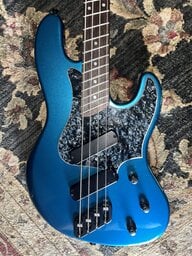
I've often asked myself the same question. I believe it's just a topic people don't really pickup on.
P and J basses are easier 'plug in and play' than some other basses and were designed when bass amps were little more than slightly 'beefed up' guitar amps.
With all of the great technology in bass amps and cabinets, the 'amplifier/speaker/cab' is by far the biggest advancement in the world of basses imo....no comparison really.
I have several P and J types and others but on the opposite end is my 65 Epiphone Newport w its lone neck 'mudbucker', let alone 30.5 scale and all mahogany set neck construction which i CAN get close to a P bass sound with careful EQ...Why? Because modern amp and speaker technology make it possible.....bass amps and speakers are the important thing imo along with advanced preamps into recording/PA systems..jmho.
With all of the great technology in bass amps and cabinets, the 'amplifier/speaker/cab' is by far the biggest advancement in the world of basses imo....no comparison really.
I have several P and J types and others but on the opposite end is my 65 Epiphone Newport w its lone neck 'mudbucker', let alone 30.5 scale and all mahogany set neck construction which i CAN get close to a P bass sound with careful EQ...Why? Because modern amp and speaker technology make it possible.....bass amps and speakers are the important thing imo along with advanced preamps into recording/PA systems..jmho.

Good question. I don't really care what the answer is. But it's still a good question.So....if I'm the one who built the bass, are the pickups I put it in "stock" pickups? If I change them after a while, is it only the first set that I installed that are "stock"?


I think I see your point. If I think back of conversations I've had in guitar stores or talking with bassists in the bar between sets I don't recall many conversations about pickups. But then if I think of conversations with my friend who is also a bassist we talk about them often.you know what? if it rubs you the wrong way, maybe that's your problem. There is not a single thing about my question that is in anyway rude, disrespectful or otherwise offensive unless you decide to deliberately take it as such. You in particular have been nothing but abrasive and defensive about what's an honest and reasonable question. "Why is there less discussion about pickups among bassists than there is with guitarists". leave it to the internet to punish someone for legitimate curiosity.
Sorry I asked
by the way, you know what else rubs people the wrong way? saying "a little friendly advice" because "a little friendly advice" is never friendly.


