Because Steve Jobs went back to Apple instead of Fender.

Seriously though Jobs would have had higher ups at Fender tarred and feathered for all of the product confusion and overlap.
Oh god imagine the horror that would create if Jobs ran Fender the way he ran Apple.
"Oh no, the patch cords and amp I bought for my last P-Bass don't work with my new P-Bass and I have to buy all new cords. My new bass also came with PlayerBuddy 2.0, which has been telling me what I should play/listen to based on my noodling choices."
If basses were phones then a flaw in the bass might email all your best licks to your friends and competitors. Or a different flaw would allow someone else to play your bass in the middle of your gig. Or your bass would tell you it had run out of space for new notes and would stop working. Or you'd find out your battery was running out halfway through a gig.... hold on.
In terms of offering limited choices, I guess the Apple of bass making is Rickenbacker. They pretty much offer one bass (variants of the 4000 model)...
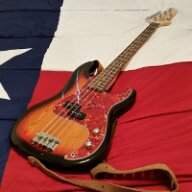
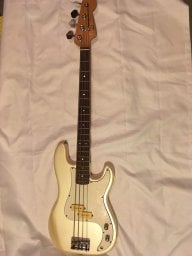
But I think if any guitar company was actually run like Apple, we'd have much better and cheaper instruments today. Assuming one could draw parallels between computer and guitar industries, the P bass is effectively a mainframe computer... Like mainframes, they are the child of the 50s. The mainframe, however, gave way to mini computers, then PC, then laptop, and finally smartphone. Your phone today is more powerful than a mainframe 50 years ago, but costs hundreds of dollars, not millions. Fender P-bass, however, is essentially the same thing as 50 years ago, and costs about the same (adjusting for inflation, see
Invalid Link Removedand
Invalid Link Removed).
So if Fender was like Apple, we actually might need to use different cables depending on build year, yes. However, not "just because", but arguably because new cables and connectors would be better, and would work with different onboard electronics (maybe like the 5 pin connector cables you sometimes see with Alembic), or maybe the amps on the other end would be better.
But more importantly, I think we'd see bigger and more important innovations than we do... The kind of jump that Leo brought us with the electric bass (and the new business model with it)... since then, the real innovation arguably mostly went towards keyboard/synth bass and computer processing. The electric bass in general, and Fender Precision in particular, have not really evolved much... what we got was a variety of colors, woods, and shapes. Electronics have evolved a bit, but use the same principles as 50 years ago. The biggest innovation, arguably, is moving the production overseas, thus greatly reducing cost, but not so much quality. A Squier P-bass may not be as good as Fender, but it's not that much worse either.