
Go to the grocery store- look at the coffee section- the pasta sauce section-
But the coffees and pastas selections in the grocery stores are all made by different companies. In this case, this bass is just by one company.

TalkBass has been independent since 1998. Add your voice.
Create a free account to reply to discussions, view embedded media, and browse with fewer display ads.
Join free Log in
Want zero display ads or expanded classifieds tools? Compare plans.
Go to the grocery store- look at the coffee section- the pasta sauce section-

In terms of offering limited choices, I guess the Apple of bass making is Rickenbacker. They pretty much offer one bass (variants of the 4000 model)...
But I think if any guitar company was actually run like Apple, we'd have much better and cheaper instruments today. Assuming one could draw parallels between computer and guitar industries, the P bass is effectively a mainframe computer... Like mainframes, they are the child of the 50s. The mainframe, however, gave way to mini computers, then PC, then laptop, and finally smartphone. Your phone today is more powerful than a mainframe 50 years ago, but costs hundreds of dollars, not millions. Fender P-bass, however, is essentially the same thing as 50 years ago, and costs about the same (adjusting for inflation, see Invalid Link Removedand Invalid Link Removed).
So if Fender was like Apple, we actually might need to use different cables depending on build year, yes. However, not "just because", but arguably because new cables and connectors would be better, and would work with different onboard electronics (maybe like the 5 pin connector cables you sometimes see with Alembic), or maybe the amps on the other end would be better.
But more importantly, I think we'd see bigger and more important innovations than we do... The kind of jump that Leo brought us with the electric bass (and the new business model with it)... since then, the real innovation arguably mostly went towards keyboard/synth bass and computer processing. The electric bass in general, and Fender Precision in particular, have not really evolved much... what we got was a variety of colors, woods, and shapes. Electronics have evolved a bit, but use the same principles as 50 years ago. The biggest innovation, arguably, is moving the production overseas, thus greatly reducing cost, but not so much quality. A Squier P-bass may not be as good as Fender, but it's not that much worse either.
Better? Maybe. Cheaper? Haha, no way.In terms of offering limited choices, I guess the Apple of bass making is Rickenbacker. They pretty much offer one bass (variants of the 4000 model)...
But I think if any guitar company was actually run like Apple, we'd have much better and cheaper instruments today. Assuming one could draw parallels between computer and guitar industries, the P bass is effectively a mainframe computer... Like mainframes, they are the child of the 50s. The mainframe, however, gave way to mini computers, then PC, then laptop, and finally smartphone. Your phone today is more powerful than a mainframe 50 years ago, but costs hundreds of dollars, not millions. Fender P-bass, however, is essentially the same thing as 50 years ago, and costs about the same (adjusting for inflation, see Invalid Link Removedand Invalid Link Removed).
So if Fender was like Apple, we actually might need to use different cables depending on build year, yes. However, not "just because", but arguably because new cables and connectors would be better, and would work with different onboard electronics (maybe like the 5 pin connector cables you sometimes see with Alembic), or maybe the amps on the other end would be better.
But more importantly, I think we'd see bigger and more important innovations than we do... The kind of jump that Leo brought us with the electric bass (and the new business model with it)... since then, the real innovation arguably mostly went towards keyboard/synth bass and computer processing. The electric bass in general, and Fender Precision in particular, have not really evolved much... what we got was a variety of colors, woods, and shapes. Electronics have evolved a bit, but use the same principles as 50 years ago. The biggest innovation, arguably, is moving the production overseas, thus greatly reducing cost, but not so much quality. A Squier P-bass may not be as good as Fender, but it's not that much worse either.
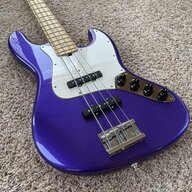

You can't compare mass production of computer components to guitar making. Much like any sort of wood work, it's an art. An art that must be respected as requiring time, mastery, and effort.
Mass production of guitars exists, yes, but quality suffers. For reference, play one production line Squier Affinity versus a masterbuilt Custom Shop'er.
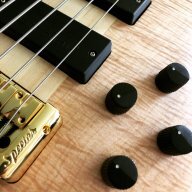


 ?
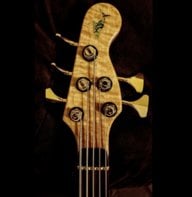
?


So many Precision Basses to choose from brand new, and yet they don't make even one that I would want. I have a 68 Precision bass and I love that one. They don't make one even remotely like it. The reissues don't quite get it, and they reissue years that don't make any sense to me. They don't seem to know their own customer bass at all these days.
Similarly, one could see a mainframe computer from 50 years ago (or even today!) being "art", as it required time, mastery and effort. Or perhaps a gamer's PC, with carefully selected components and fine-tuned for maximum performance. An iPhone cannot compare to either on those terms, but it's clearly a winner in the market.
So many Precision Basses to choose from brand new, and yet they don't make even one that I would want. I have a 68 Precision bass and I love that one. They don't make one even remotely like it. The reissues don't quite get it, and they reissue years that don't make any sense to me. They don't seem to know their own customer bass at all these days.
I suspect we'll see Fender offer up 1968 reissues in about three years, specifically in 2018. Fifty year olds will be buying themselves milestone "birth basses" that year.
Whether they will be any match for their predecessors is another story entirely, granted; but I think Fender DO know their audience, and work it pretty well. After all, guitars are hardly a "growth industry," so their ultimate task and challenge is to get preexisting consumers to buy multiples of what they already have.

They'll have to choose which 68 they reissue. For the first 3 months they were oddly unique. Oval tuners, 67 headstock logo and still had the threaded saddle bridge. Then, they changed the tuners, log and bridge to the 69 style. They won't get it right. Look at the MIJ 66 Mustang Bass reissue. I guess they never bothered to get neck measurements from a real 66, or put the right tuners on it.

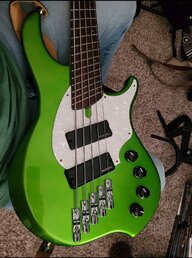
You can't compare mass production of computer components to guitar making. Much like any sort of wood work, it's an art. An art that must be respected as requiring time, mastery, and effort.
Mass production of guitars exists, yes, but quality suffers. For reference, play one production line Squier Affinity versus a masterbuilt Custom Shop'er.

But the coffees and pastas selections in the grocery stores are all made by different companies. In this case, this bass is just by one company.
Because apparently P-basses sell. "Why?" is completely beyond me.
For all the different variations of P-bass and Jazz basses, why in the world can Fender not make at least a 5-string version of their Jaguar jazz bass???? Why???? Again... beyond me. Fender just makes no sense to me sometimes. But they do make P-basses!
Now let my lynching at the hands of Fender freaks begin!!


