• TalkBass has been independent since 1998. Add your voice.
    Create a free account to reply to discussions, view embedded media, and browse with fewer display ads.
    Join freeLog in
    Want zero display ads or expanded classifieds tools? Compare plans.

Why So Many People Playing Fender Basses?

I was thinking the same way for a while since love my Yamaha so much but there is something special about Fenders/Squires and I am always pleasantly surprised when I choose to play my Squires. I’m sure there is a new Fender somewhere in my future. :)
 
  • Like
Reactions: Glenn Mac
I see a large majority of people playing Fender or Squire basses and always wondered if they were just following the pack. I had always chosen thin neck guitars thinking they must allow some extra finger "length". When I looked at Fender basses, I saw the thick side profile of the neck, figured they must need long fingers to play, never tried one and went for the thin necks.

I tried a C neck Squire today and found that I have the effect of having those longer fingers because the C neck is thicker but more narrow. It felt so much better than those thin wider necks. Now I'm going to have to buy one. Even the Squire pickups are pretty full and powerful sounding but with a bit more treble than a big fat humbucker pickup I was comparing it to. And by fiddling with the pickup balance and tone controls I could get a sound pretty close to those humbuckers.

I am definitely sold on Fender C necks now and sorry I didn't even try one until now.
Fender basically defined the electric bass category. Since the instrument first began, a majority of electric basses have been fender models.
 
I like to try any bass, regardless of "headstock" labels. However, my personal preference has always included American made Fender basses, and the odd active basses with preamps. I have an American Fender Pbass and Jazz because they are the gold standard. I am what millennials consider a geezer. I am confident that other geezers viewing this thread understand completely what I am saying. However, a good active bass is a great tool to have in your arsenal when needed in the mix. Live or for recording. To put things in perspective, I own a Squier Jimbo Signature Jazz that is totally awesome and I would put it up against any American Professional Fender Jazz any day of the week. An awesome instrument. So, forget shopping via headstock labels. Use your ear and playing skills to evaluate a bass. You will find that you will be better served and much more satisfied with your purchase. Have fun.
 
...I tried a C neck Squire today and found that I have the effect of having those longer fingers because the C neck is thicker but more narrow...
You are referring to neck profile, of course, right? C shape, D shape, U shape, etc.

Fender made/makes necks that are called A, B, or C necks; These refer to the width of the neck at the nut:

A - 1 1/2"
B - 1 5/8"
C - 1 3/4"

Hope this helps. :cool:
 
A lot people like them, I didn't buy a Fender until my 5th bass and it was because I liked the general sound of precisions and really wanted a natural finish one. When I bought it I kinda understood a lot of the hype (Which I didn't really read about till after I bought it lol). Versatile, good sounding basses but of course not for every style. Still not a fan of Fender J basses tbh but love the G&L JB's.
 
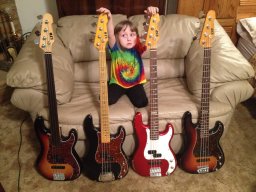
There are only about 170 Fender basses, total, in the whole world--each featuring a different color, neck, pick guard etc. Through a remarkably complicated, expensive and well-choreographed system an equal number of us bassists plays one and then immediately transfers the instrument to the next person in the secret network. We also constantly photoshop pictures of multiple Fender basses in TB posts to perpetuate the myth of ubiquity. This way, for the past 50 years, we've been able to fool the unsuspecting public into thinking there are so many when, in fact, there are so very few.
 
fenders have always been the ultimate workhorse basses. there's not much to go wrong with them so they take a licken' & keep on ticken'. in fact IMO fender is the only brand that actually looks cooler when they're beat to s@%#. oh, they also feel & sound great. I've tried many other basses thru the years but always come back to fender. they're like an old friend to me.
 
You are referring to neck profile, of course, right? C shape, D shape, U shape, etc.

Fender made/makes necks that are called A, B, or C necks; These refer to the width of the neck at the nut:

A - 1 1/2"
B - 1 5/8"
C - 1 3/4"

Hope this helps. :cool:

Did you know the nut width of the original J bass "A" neck was 1-7/16" and advertised as such? I've measured quite a few with that width through the mid '70s. Not sure when they widened it to 1-1/2".
 
  • Like
Reactions: Glenn Mac
There are only about 170 Fender basses, total, in the whole world--each featuring a different color, neck, pick guard etc. Through a remarkably complicated, expensive and well-choreographed system an equal number of us bassists plays one and then immediately transfers the instrument to the next person in the secret network. We also constantly photoshop pictures of multiple Fender basses in TB posts to perpetuate the myth of ubiquity. This way, for the past 50 years, we've been able to fool the unsuspecting public into thinking there are so many when, in fact, there are so very few.
how many of those 170 have a tort pick guard? :laugh:
 
  • Like
Reactions: InternetAlias
2/3rds of my stable are Fender.

One is a Squier Affinity Precision, with upgraded pup (SD QP), La Bella tapewound strings, MIA bridge (Squier on was flaking chrome, so I put a used MIA one on it- kept the Squier one to try and fume it and sell it as relic'd HW and make the cash back and then some).

The other is a jazz partsbass. Only Fender things on it are PG and some HW. Bartolini 18V pup system- used concentric knobs so I could have the 4 needed for the system and still retain a stock look- plus I wouldn't have to figure out how and where to mount a 4th pot.