• TalkBass has been independent since 1998. Add your voice.
    Create a free account to reply to discussions, view embedded media, and browse with fewer display ads.
    Join freeLog in
    Want zero display ads or expanded classifieds tools? Compare plans.

Why So Many People Playing Fender Basses?


:D

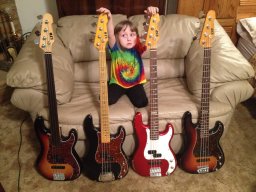
here you go! ;)

aluminium-57-chevy-belair-bass-guitar-1.jpg

drooldrooldrool


Wise(b)ass
 
  • Like
Reactions: S-Bigbottom
I see a large majority of people playing Fender or Squire basses and always wondered if they were just following the pack. I had always chosen thin neck guitars thinking they must allow some extra finger "length". When I looked at Fender basses, I saw the thick side profile of the neck, figured they must need long fingers to play, never tried one and went for the thin necks.

I tried a C neck Squire today and found that I have the effect of having those longer fingers because the C neck is thicker but more narrow. It felt so much better than those thin wider necks. Now I'm going to have to buy one. Even the Squire pickups are pretty full and powerful sounding but with a bit more treble than a big fat humbucker pickup I was comparing it to. And by fiddling with the pickup balance and tone controls I could get a sound pretty close to those humbuckers.

I am definitely sold on Fender C necks now and sorry I didn't even try one until now.

Because I like them.
 
Did you know the nut width of the original J bass "A" neck was 1-7/16" and advertised as such?...
Yes I do know that. My first bass I ever owned was a late '60s Jazz Bass with such a neck (1 7/16" width). I couldn't get rid of it fast enough for a bass with a normal feeling neck. I traded that jazz Bass straight up for the '67 4005WB (1 5/8" nut width) I had for 38 years.
 
I see a large majority of people playing Fender or Squire basses and always wondered if they were just following the pack. I had always chosen thin neck guitars thinking they must allow some extra finger "length". When I looked at Fender basses, I saw the thick side profile of the neck, figured they must need long fingers to play, never tried one and went for the thin necks.

I tried a C neck Squire today and found that I have the effect of having those longer fingers because the C neck is thicker but more narrow. It felt so much better than those thin wider necks. Now I'm going to have to buy one. Even the Squire pickups are pretty full and powerful sounding but with a bit more treble than a big fat humbucker pickup I was comparing it to. And by fiddling with the pickup balance and tone controls I could get a sound pretty close to those humbuckers.

I am definitely sold on Fender C necks now and sorry I didn't even try one until now.

This was my experience also - I thought that a smaller neck would 'of course' be more comfortable than a bigger one - not helped by marketing that talks about 'slim, fast' necks. After many years with a thin-necked Ibanez soundgear, I fell in love with a deep-necked '70s Fender Jazz that was much more comfortable for me to play.
 
  • Like
Reactions: Glenn Mac
And to answer to the title : the majority of basses ever built are either fender or Squiers. You see more simply because more of them exists.

View attachment 3117963

That’s a pretty funky-seeming chart. For one, the ‘Fender" portion shown in the pie chart takes up >90 degrees of the circle (so, greater than 25% of the total), but Fender market share is listed at about 11%. Meanwhile, a quick adding up in my head brings the total market share percentages for all brands, including "All other brands", to about 75%...

Unless the "Vintage Bass Market Share" included 25% non-branded basses in 2016, something doesn’t add up.

Or maybe the percentages shown don’t refer to market share as explained in some accompanying article?
 
  • Like
Reactions: Luigir
People will argue it, But Leo Fender made the standard sound. He wasn't the first but made the most popular bass, that were used at one time exclusively in the studio cranking out records that many millions heard daily. That was the sound of the bass guitar. It wasn't years of planning a 34" scale and pickups that would add certain frequencies louder than others or certain metal frets that would create a certain sound or what wood was available to make a certain sound (In fact he used woods that were easily available). . No it was a design to make a good sounding electric bass. It was a precision that marked a exact intonated note that an upright bassist needed years of practice to make. Which is why they called it a precision bass. He created a standard sound and all that came after was a replica of that in a different direction.
 
I see a large majority of people playing Fender or Squire basses and always wondered if they were just following the pack. I had always chosen thin neck guitars thinking they must allow some extra finger "length". When I looked at Fender basses, I saw the thick side profile of the neck, figured they must need long fingers to play, never tried one and went for the thin necks.

I tried a C neck Squire today and found that I have the effect of having those longer fingers because the C neck is thicker but more narrow. It felt so much better than those thin wider necks. Now I'm going to have to buy one. Even the Squire pickups are pretty full and powerful sounding but with a bit more treble than a big fat humbucker pickup I was comparing it to. And by fiddling with the pickup balance and tone controls I could get a sound pretty close to those humbuckers.

I am definitely sold on Fender C necks now and sorry I didn't even try one until now.


I went back to playing jazz basses about a year ago after playing an Alembic for a decade or so.

Honestly jazz basses just feel right and sound right to me, and since I play in a lot of G. Dead cover bands I think sub-consciously I was trying to get away from the perception that I was trying to be a Lesh clone.
 
It's simply the fact that a massive chunk of recorded music has Fender basses on it, and it's not entirely surprising that people who want to play similar music (or even cover some stuff) would use the same or at least similar equipment.

Personally I'm not going down that road, but I have a "take it or leave it" approach. If people like my sound I'm happy to play with them, if they don't they'll have to look for another bass player.

Needless to say that if I wanted to get an income out of bass playing I would own at least one or two Fenders.
 
  • Like
Reactions: Kice
I play Fenders because they sound right and feel right

I play Ibanez because they are lighter, feel amazing and I love thin necks

I have a Ric for the tone, It is as comfy as a boat anchor!

Sterling SUB Ray because it feels and sounds awesome

Cort Fretless because it's the only unlined fretless I could find for cheap, and it is light and plays really nice! Sound meh!

I have a Gibson EB 2017 it feels wonderful, plays awesome and will punch the :poop: out of a nun!!

The point is I play what I want, and I guess I am long winded :)
And you have good taste in instruments!
 
I play Fender because when I was a youngster my Dads friend said “get him a Fender” so he did, even though a BC Rich Mockingbird was calling my name. But now playing anything else feels weird, Fender is just home base for me. But still thinking about buying that Mockingbird. :bassist:
Wise dad friend - but go get that Mockingbird!! Past you deserves it.
 
My favorite basses are Leo designs or based on Leo designs.
I gave up on ACTUAL FMIC in the 1990s.
I had a Mexican made Urge. The electronics were shiiite.
Before that, my first FMIC was a 1975 bound blocked jazz maple/maple.
The neck was butter.
The electronics were shiiite.

I recognized the patterns.
I own one Leo based franken design and a 55 P style 5 string being built.

Funny after being burned twice I still love the designs but am not willing to go for 3rd degree burns.