
• TalkBass has been independent since 1998. Add your voice.
    Create a free account to reply to discussions, view embedded media, and browse with fewer display ads.
    Join freeLog in
    Want zero display ads or expanded classifieds tools? Compare plans.

Why String Fanning on Electrics?

I understand that violin-family instruments would need their strings to fan near the bridge for bowing technique, but why does this building technique continue with electric basses? The strings on slabs don't trace much of an arc and while there are probably a few who bow their electric, I've never heard it. Does anyone play or know of an electric that doesn't have fanned strings?

If the strings weren't fanned the neck would be a lot narrower, obviously. Wouldn't that be a desirable increase in speed? On the other hand, would the additional neck mass associated with 19mm spacing at the nut create added depth in first position play?

At first I thought plucking technique might be the reason this building practice continues. But 15 string basses prove that technique will evolve around existing circumstances. So what need is there to fan an electric basses strings as they travel from nut to bridge?
 
At first I thought plucking technique might be the reason this building practice continues.

I think you were right at first...

But 15 string basses prove that technique will evolve around existing circumstances. So what need is there to fan an electric basses strings as they travel from nut to bridge?


Are 15 string basses something common that everyone picks up and find easy to play? I think not...
 
Are 15 string basses something common that everyone picks up and find easy to play? I think not...

I agree with that, but if the string spacing stayed the same from the nut to the bridge as it does on a guitar, the techniques used to play would simply change. There would be shorter pulls but those who practiced would not find it troublesome.
 
I agree with that, but if the string spacing stayed the same from the nut to the bridge as it does on a guitar, the techniques used to play would simply change. There would be shorter pulls but those who practiced would not find it troublesome.

This isn't true at all. Look at a guitar - the string spacing at the nut is smaller than at the bridge.

The key is ergonomics. The fretting hand needs to be much more dextrous than the plucking hand, and bringing the strings closer together allows for tighter movements and alleviates uncomfortable stretching. Especially because most bassists play with fingers, the wider spacing at the bridge (between 16 and 20 millimeters) makes sense to allow for greater grip and pull of each string. True, classical guitarists play with their fingers, but the technique is different and when strings have half the amount of tension, the technique is justly suited and allows for easier change in dynamics.

For something with a straight neck (or at least nearly straight, by comparison), look at the Chapman stick. This has a straight neck because both hands need the micro-movements to tap the strings ergonomically, so there's really no reason to fan the strings.

In short, the answer is playing technique.
 
Indeed, the nut width is always narrower than the bridge on any guitar. Different companies will have different widths that allow for various string spacing options, but there is always a slight "fan" to them. It's just more pronounced on a bass, especially 5 and 6 ers.

As far as why... I always though it was to allow adequate room for fingerstyle playing.
 
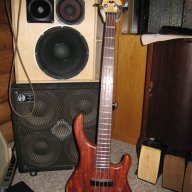
Got pics?
Not the best pic, but you can see the nut and bridge.
This was built in '82:
whole.jpg
 
I just measured three of my guitars to see the center-to-center distance between the two E strings at the nut and the bridge. The Strat (MIM Classic '60s) is 1.375" at the nut and 2.25" at the bridge. The Guild Starfire IV is 1.44" at the nut and 2.06" at the bridge. The Guild A-50 flat-top is 1.50" at the nut and 2.13" at the bridge. Didn't dig out the other acoustic.

Guitars fan out because that facilitates right-hand technique while have a comfortable spacing for the fretting hand. Same as basses.

John
 
Not the best pic, but you can see the nut and bridge.
This was built in '82:
whole.jpg

The angle of the picture may be accounting for it, but it really looks like there is a slight slant. Even my ruler confirms a few mm difference.

What was the spacing like at the bridge? I imagine 19mm fretting/14mm plucking would be uncomfortable.
 
I would actually prefer parallel strings on even a 6, wider at the nut and narrower at the bridge. Then I could get my fingers side by side for playing chords near the nut and have faster more comfortable technique at the bridge. But then i'm unconventional!
 

Latest posts