
Enjoy the benefits of a premium membership!
Upgrade Account
-
TalkBass has been independent since 1998. Add your voice.
Create a free account to reply to discussions, view embedded media, and browse with fewer display ads.
Join free Log in
Want zero display ads or expanded classifieds tools? Compare plans.
You are using an out of date browser. It may not display this or other websites correctly.
You should upgrade or use an alternative browser.
You should upgrade or use an alternative browser.
Why Use Anything But Hipshot Ultralites?
- Thread starter Icculus
- Start date
More options
Who Replied?

Has anybody received a bass with stock Hipshot Ultralites and replaced them with Gotoh GB7's or similar? If so, what was the outcome?
Riis
Riis
If you only have $35 instead of the retail price of Hipshots, I can see getting lesser expensive ones. Or do what I did: save up. They worth saving up for.
Some vintage instruments that have the traditional full sized tuners that have proven their worth I would leave alone. My Rickenbacker 4002 with factory stock Schaller minis fall into this category, as do rare Fenders with stock "Lollipop" tuners, early '70's Rickenbackers with wavy Grover tuners, and such. No, I'm not going to go putting Ultralites on a mint real '62 P-bass or similar.
For everything else, especially player instruments I earn gig money with, I systematically change out all my instruments to the Hipshot Ultralites. Not only are they lighter, but are smoother and more precise. Well worth the money, even on a $200 bass. A $100 bass? Unless it was a sleeper that is giggable, probably not, but you never know until you hear it on stage or in the studio.
Carvin puts those same Carvin tuners on their top of the line basses and I've never heard any complaints.I've found them to have very smooth action.I replaced one of the Shallers on my old aluminum neck Kramer with one and can't tell the difference.I also use them on my avatar bass and my Spector,I could afford more expensive tuners but can't justify paying twice as much or more when I can get quality tuners for much less. I don't know that they're not as good as the more expensive hipshots just more reasonably priced! I've read that they're made by Gotoh but don't know for sure.
Last edited:

I use HipShot on my customs & Gotoh [drop in replacement] on my Fenders. Both work well and save weight.
Last edited:

I have them on a Fender PJ and I love them. I have been threatening to put them on my G&L L2500 Tribute for years and just never got around to it. That bass is heavy and any weight savings would be great.

Means2nEnd
Supporting Member
I have on occasion had one in a set of 5 that was not smooth in the gears. In most cases I would rather go that route than not but there is tone associated with mass and weight in the headstock. They do bend pretty easy, the finish on the black ones are less than bulletproof, I am not a huge fan of just a long huge perfectly straight post I find I have to actually push the string down around the post to get any back tension on the nut on some basses. All that said I still love them.
For my Spector basses the heavy Schaller tuners are great. They last forever and are smooth and stay in tune and are pretty much bulletproof.
For my Spector basses the heavy Schaller tuners are great. They last forever and are smooth and stay in tune and are pretty much bulletproof.
Attachments

I don't because Sperzel are lighter, stay in tune better and the locking system allows you to change and tune a string within seconds.
I'm not going to force it on others though.
Didn't Sperzel have QC issues for awhile? I used them as well for a long time, but switched over to Hipshot a couple of years ago.


The better question is why won't Hipshot make Ultralites in chrome? Those gray Y-keys look like crap, IMO. And no, nickel is not a suitable replacement and even if it were then perhaps Hipshot should consider making some nickel bridges.

TITLE MAY BE MISLEADING:
I'm literally asking "Why?"... not claiming that they're unbeatable. I've got them on two basses now and it's so nice how light they are and my neck angle just sits wherever I leave it after letting go.
I guess aside from having a neck that's already drilled for a different size, are there any known caveats to these?
1) cosmetics 2) cost 3) you like neck dive/current balance 4) your bass has no prominent 'dead' spots 5) personal preference
other than that, can't really think of anything.

Hopkins
Commercial User
I only have one issue with Ultralites, and its a fairly substantial one. If using the 1/2" post Ultralites on a headstock with 11/16" holes drilled all the way through with out a step at the bottom of the head stock, the tuner can rock back and forth in the hole along the axis of the single screw that keeps it from rotating. So you have to torque down pretty hard on the 3/4" nut so it will stay in place. The nut is so thin that even when using a proper 6 point socket it can slip easily, and mar the finish on the nut. They could easily fix this issue by offering a tuner with a small shoulder on the casing that will fit snugly in an 11/16" hole.

Because my GB Rumour has Schaller machines with nice rosewood buttons that are specially made for it.
I like hipshot products, but I like having options more...
As others have said, Hipshot doesn't have a direct replacement for everything (like Schaller m4s's or Gotoh GB7's)...
As others have said, Hipshot doesn't have a direct replacement for everything (like Schaller m4s's or Gotoh GB7's)...

...The more appropriate question might be - why would any bass manufacturer not use ultralight tuners in the construction of their basses these days?...
This one is easy.
You are in a pre production meeting and the yearly production budget is being sussed out. You want to make a change from XYZ tuners to ultralites. You make your case for all their advantages and how much more your customers would appreciate them as OE, that they's gladly pay the difference in price, etc, etc.
When you are done your production manager asks, "What's the cost difference between XYZ and ultralites?" You check your numbers and tell him it's just a couple bucks per unit.
He replies "Well, this budget is for 2 million basses this year so switching from XYZ to ultralites will add 4 million dollars to our pre production outlay, and we just don't have the money so forget the ultralites and go ahead with the XYZ machine heads."
On a more personal note. All I use these days are Fender J basses and I have zero issues with anything machine head related. No difficulty tuning, not slipping, no neck dive, no nothing.
I'm no traditionalist by any means so I don't look for old basses to devalue by piddling with them. I stick pretty much to current production stuff then if I don't care for a certain aspect of it I can tinker with alternatives and not get chided for desecrating a sacred relic. I do sometimes get agita about "wasting" my money on aftermarket bridges, pickups, guards, the usual stuff, but other than cosmetic stuff, it pretty much needs to deliver sub par performance before I'll look for an alternative, and with Fender J basses the machine heads have never been an issue for me.
Last edited:

I keep saving up for 'em, then spending the $ on beer.

Yup. I personally have never had a problem with neck-dive or the like (must be my big fat protruding belly keeping it in check, LOL) . Since the big fat Fender type tuners I have work just fine otherwise, changing them out would be a total waste of effort and expense.Balance.
If your bass balances well with the existing tuners, why would you want to throw that off?

I had hipshots on my Warmoth. They worked for neck balance and gave the Fender look but they were a bit rough in operation.
I prefer the smooth action of gotoh GB7 tuners.
I prefer the smooth action of gotoh GB7 tuners.

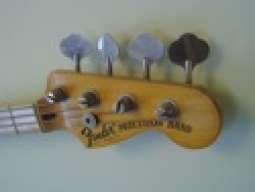
I love Hipshot products, but to me, it's not a Precision if the head doesn't look like this:

so I use the Hipshot Ultra-Heavies.
Reid
so I use the Hipshot Ultra-Heavies.
Reid

The screw hole for mounting the Ultalite is in the same place as a GB7 and all the copies.I like hipshot products, but I like having options more...
As others have said, Hipshot doesn't have a direct replacement for everything (like Schaller m4s's or Gotoh GB7's)...
Sometimes removing mass from your instrument can change the tone.
For me, on the several basses I have changed out so far, each bass acquired more fundamental tone and better sustain. No dead spots. Each bass acquired more of its signature tone since there was no extra weight to damp favored resonances, i.e. the inherent tone color of bass and its pickups.Loss of sustain and possible tone degradation??
Last edited:


