• TalkBass has been independent since 1998. Add your voice.
    Create a free account to reply to discussions, view embedded media, and browse with fewer display ads.
    Join freeLog in
    Want zero display ads or expanded classifieds tools? Compare plans.

Will I need a truss rod adjustment if I switch to flatwounds?

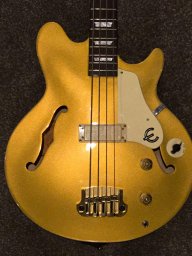
I have a Harley Benton Beatbass that came with round wound strings gauges .045 - .100.
I want to put LaBella Deeptalking Bass flat wound strings gauges .050 .065 .080 and .100. (Strings for Hoffner Beatle bass)

Will I need to adjust the truss rod if change to the LaBella strings?
I don't have experience adjusting the truss rod and don't want to damage my bass.
 
I have a Harley Benton Beatbass that came with round wound strings gauges .045 - .100.
I want to put LaBella Deeptalking Bass flat wound strings gauges .050 .065 .080 and .100. (Strings for Hoffner Beatle bass)

Will I need to adjust the truss rod if change to the LaBella strings?
I don't have experience adjusting the truss rod and don't want to damage my bass.
Possibly. They may be fine or maybe not. You won't know until you make the change.
 
  • Like
Reactions: iqi616
Differentiation is important: I didn't claim that a setup can't bring about an improvement or that one shouldn't do it. However, it's not absolutely necessary
Sometimes it is though. If the neck has back bow, the instrument can become literally unplayable. And very high action can seriously impact playability. I remember the first time I had my guitar set up when I was 16 or so, and it was a revelation. (It took me 10 years to realize that I could do it myself - and 5 more to realize that bass is the superior instrument.) Was it absolutely necessary? Strictly speaking, no. But it made playing so much more enjoyable.

I think I get what you're saying though. I agree that for a lot of people it isn't necessary to obsess over setup as long as it is within reasonable limits. I've certainly stopped obsessing over every minor change in neck relief. But on the other hand, it's good to know how to solve problems when they arise. It all depends on the situation. Some instruments are very stable, others can develop serious issues with time, changes in weather, string changes, etc. It depends on the player too, some are very sensitive to changes in setup, others won't notice unless it's extreme.
 
  • Like
Reactions: ra0ulduke
Will I need to adjust the truss rod if change to the LaBella strings?
It's a "maybe". What you need to do is learn how to determine your neck relief as it is now, and that's only if your bass plays exactly how you want it to play as it is.

Your truss rod might already need to be adjusted with your current strings. Many of us started playing long before the internet was around to tell us how to adjust anything that can be adjusted, so we played our basses (often several years) until we found out there was a thing called the truss rod that could make our bass play &/or sound much better.

The cheapest capo money can buy at the first fret and your finger holding down the largest diameter string at the fret closest to where the neck meets the body (usually 17th on Fender style basses) will allow you to measure / see / "tap the string against the fret" around the halfway point (around the 8th fret) which will give you an idea of what you have now.

Proper neck relief can make the difference in a bass guitar playing like an upright bass or playing exactly how you want it to play. Excessive neck relief makes a bass feel "stiff" when it can feel smooth & easy to play with the same strings once the relief is proper for you. I've played a bass or two belonging to players that doubled on upright, and their bass guitar was set up with ridiculous neck relief, but it was right for the owner.

Check your relief before and after the string change. You'll be able to tell if it changes much from that and the feel of how it plays. That's when you'll know if an adjustment is needed or not.
 
  • Like
Reactions: ra0ulduke
I regularly changed strings and had absolutely no problems.
I see that as you having one exceptional bass, multiple exceptional basses, or a very good tolerance of changes in playability.

I've changed strings on basses and the result was me being virtually unable to play the bass as I had played the bass before the string change. This was usually when making a significant gauge change between strings. It wasn't always that the bass became totally unplayable, but it became so difficult to play, I couldn't play some passages on the bass with the new strings without making adjustments.

I've changed from heavy gauge strings to light gauge strings on several basses through the years and nobody could play the bass afterwards because the strings were laying on the frets.

I have several basses and some are much more tolerant of string tension change than others. I have a Carvin 5 string that never needs the TR adjusted as long as I stay with same or similar strings. I have a Gibson TBird that needs the TR adjusted a 2 or 3 times a year with NO string change, unless a person is very tolerant of fret rattle or high action (it drifts between the two with humidity. change).

Due to the type of bass the OP has, (hollow body), and the notable high tension of LaBella flats, he or she might have a Frisbee practice target after installing the new strings (as in the ability to throw a Frisbee under the strings). In those cases, a setup isn't overrated, it's a requirement.
 
This might be a controversial opinion, but in my view, setups are generally overrated. That doesn't mean they don't offer any improvement, but for the first 15 years I played bass, I wasn't even aware that this option existed. I regularly changed strings and had absolutely no problems. I played concerts and made studio recordings. During that time, I also didn't use a single pedal - apart from the tuner. I think forums like this often give beginners the impression that they have to spend a lot of money before they can even begin. I consider that problematic.
I remember my nephew telling me that he was thinking of returning his new bass because he found it difficult to play.
He was dumbfounded when I set up his bass properly; he had no idea that his bass could change from unplayable to fun to play as the result of a few simple adjustments.
 
This might be a controversial opinion, but in my view, setups are generally overrated.
I strongly disagree, mainly since setup adjustments can greatly affect instrument playability.

Moreover, it's my opinion that the most underrated part of setting up a bass is tailoring the nut - for string spacing as well as height.

There is a range to what can be considered a well set up bass, and an ideal setup will vary based on player preferences and tolerances (which also tend to change over time).

For the OP - even tuning your bass changes the tension of the strings and neck relief a small amount, so changing to different strings will definitely affect neck relief, maybe just a little, maybe by a lot, but usually enough to necessitate at least a slight truss rod adjustment. Take the time to learn the aspects bass setup, then iterate/experiment to figure out what makes you happiest.
 
I was fortunate enough to have stable necks that tolerated some gauge changes and diff tension. All I really did in the beginning was adjust the action and intonation, Luthier set the relief once and cut the nut once and basically just used Roto 66, The bass was converted to fretless with a very dense ebony board and it was a fat precision neck to begin with. Stiff neck. The I also got a Pedulla buzz and between the epoxy coating and the thru neck, that neck also remained stiff. It was not until I got a jazz bass that I was affected by seasonal changes and fret sprout -- ouch. So i asked a friend to teach me how to set up. He thought me how to cut a nut, use bad-ass bridges, truss rod and the what I considered scary removing the neck to access the truss rod. It took even a while for me to learn how to file frets

I am not a low action guy though and slight relief changes are non issue for me so TR adjustments are far in between. Moving forward, I am going for light gauges and may mean adjusting the basses that have not been change to light gauge. Light garage and higher than normal action is where I am going
 
I see that as you having one exceptional bass, multiple exceptional basses, or a very good tolerance of changes in playability.

I've changed strings on basses and the result was me being virtually unable to play the bass as I had played the bass before the string change. This was usually when making a significant gauge change between strings. It wasn't always that the bass became totally unplayable, but it became so difficult to play, I couldn't play some passages on the bass with the new strings without making adjustments.

I've changed from heavy gauge strings to light gauge strings on several basses through the years and nobody could play the bass afterwards because the strings were laying on the frets.

I have several basses and some are much more tolerant of string tension change than others. I have a Carvin 5 string that never needs the TR adjusted as long as I stay with same or similar strings. I have a Gibson TBird that needs the TR adjusted a 2 or 3 times a year with NO string change, unless a person is very tolerant of fret rattle or high action (it drifts between the two with humidity. change).

Due to the type of bass the OP has, (hollow body), and the notable high tension of LaBella flats, he or she might have a Frisbee practice target after installing the new strings (as in the ability to throw a Frisbee under the strings). In those cases, a setup isn't overrated, it's a requirement.


Then you've had different experiences than me and therefore have a different opinion. A good example of why anecdotal evidence is worthless. Incidentally, it wasn't just me who got along perfectly well without a setup for the first 15 years. That was true for all the other musicians around me: nobody - whether bassist or guitarist - to my knowledge made a setup during that time. Of course, that proves absolutely nothing, but I never claimed that setups are superfluous. They're simply not absolutely necessary.
 
If you can find the specs or I should say "string pull" in lbs, you could see what the current "pull" is on your bass with it's strings and then see what the LaBellas string pull is. If there is much of a difference, yes!.......you'll have to adjust your t rod.

Since you don't know how to do it, it would be a good idea to learn how. Many bass necks change with humidity and temps and need adjustment.

When I went with TI Flats, I had to loosen my t rod. I think that the TIs are like only 144 lbs pull. Some strings are 200 lbs and even more.

Good luck.
 
If you had read my post in its entirety, you would know what I meant. Taking a sentence out of context is not conducive to a factual discussion.

I'm confused by your response. You recognized your statement as opinion, you supported that opinion with valid but anecdotal experience, and you even stated your opinion was controversial; so you are clearly aware that other folks disagree with that opinion.

I don't believe I misstated any facts in my reply, but if so I welcome correction.