
Hahaha! No, the bridge will be $130. The strings will be $35.If you can get the Hipshot bridge for $35 do it. The worst thing that happens is you buy new strings.

TalkBass has been independent since 1998. Add your voice.
Create a free account to reply to discussions, view embedded media, and browse with fewer display ads.
Join free Log in
Want zero display ads or expanded classifieds tools? Compare plans.
Hahaha! No, the bridge will be $130. The strings will be $35.If you can get the Hipshot bridge for $35 do it. The worst thing that happens is you buy new strings.

Hahaha! No, the bridge will be $130. The strings will be $35.

Yeah, if that were the case I’d already have done it.That's more like it. I was like "holy ****, do it!".
Yeah, if that were the case I’d already have done it.

Just noticed your pic. Out of curiosity how many people really understand that? (Note: I taught AP Physics, so….)Do it anyway. I never liked those Gibson/Epiphone 3 point bridges.
Yeah, when I bought the Rumblekat I had to wait for them to set it up. The tech pulled out a bushing. Or it came out. Getting a replacement was a horror story.The stock bridge isn’t elegant, but it works just fine. Remember to adjust the nose slightly higher than the two posts at the rear, to avoid pulling the bushings out.
Just noticed your pic. Out of curiosity how many people really understand that? (Note: I taught AP Physics, so….)
But you understand the truly funny thing about that schematic, right?I think you're the first to even notice it. I never took physics.
But you understand the truly funny thing about that schematic, right?
There is also that the piece of wire is not an absolute conductor and is some resistance at least, hence some of that current will still go thru the actual resistor and by then in a miniscule way it improves the conductivity through that particular construction. Resistance is not useless, but rather useless in approximation. And every useless resistance is noticed and learned from which in itself caries another dimension to the equation and can have a dramatic effect at some point in the future.Hehehe, passing physics, especially in one on my classes, requires a bit more knowledge than this.
But I did like how you used ‘showed resistance’, thus emphasizing the somewhat idiomatic nature of the diagram.
Since squiggly line is the symbol for a resistor it isn’t a matter of ‘if it showed resistance’, bc it definitely does. Thing is, electrical current takes the path of least resistance so it just flows around the resistor, making it ‘useless’. Or “It’s useless to resist.” Or “Resistance is useless.”
Thing is, and what I would have liked, and somewhat expected, one of my students to point out would be that…
In this case resistance may or may not be futile, or without purpose. If you assume that the purpose of the resistor is to “cause resistance” to the flow of electricity then said purpose was indeed accomplished. If you note in the diagram that by-passing this resistor was accomplished by adding two vertical portions of conductor to the circuit. These two vertical portions increase the length of conductor from the point immediately before the resistor to the point immediately after the resistor. By increasing the distance the electrical current must travel from the point before to the resistor to the point after the resistor the amount of resistance in the conductor itself has increased. This can be calculated by R=ρ(L/A), which clearly shows that the resistance is directly proportional to the length(L) of the conductor. From this it can be said that resistance was, indeed, created.
Additionally, perhaps the resistor had another purpose. Suppose that the resistor was actually a small green light and it’s ‘purpose’ was to indicate the presence of an electrical current flowing through the wire. If so, was the resistance ‘futile/useless’.
If you have that on a t-shirt and someone comments on it you could be ready with the above response. If your name was Sheldon.
On the other hand, that resistance could be a huge, long wall. Any resistance it offers could be said to be futile due to the existence of ladders, ropes, catapults and the thoroughly documented expertise demonstrated by some humans to dig tunnels.
1- Resistance is not useless, but rather useless in approximation.
2- But think about, it is a useless picture of a useless contraption,
3- yet we have just successfully wasted few minutes of few people's lives and perhaps collectively have learned something... Hence neither the contraption nor the picture of it is useless.

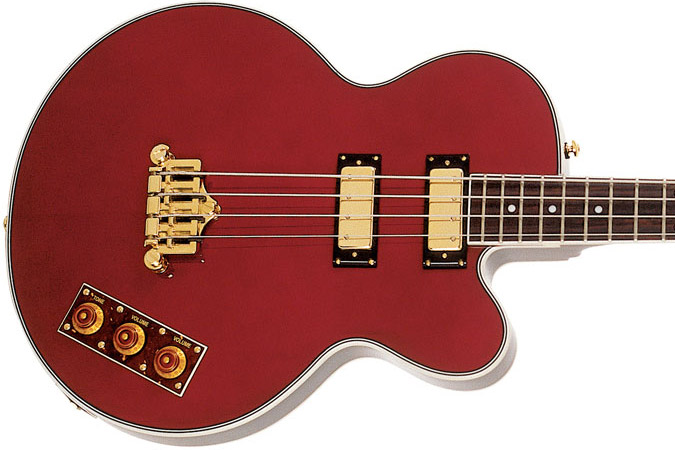
I put new nylon-wrapped strings on my Epiphone Rumblekat. I had the recommended 2 wraps on the E string but I let them wrap pretty much to the bottom of the peg on the others. No problems so far.
then, what would the good exchange rate, I decided to put some Gotoh tuners on. The pegs have a slightly larger diameter than the original ones. But I still ended up with one and a half wraps around the E peg. Still no problems.
Now I found the HipShot Sure Tone and the exchange rate is still good. But according to the measurements for the HipShot the ends of the strings will be moved back by 10mm. That means I will have to take the straight portion of the E string that sticking down inside the peg straighten it out and re-bend it 10 mm closer to the end of the string, giving me steel one and a half wraps on the tuner peg.
Question…. Will I be risking a problem if I try this?
If you can get the Hipshot bridge for $35 do it. The worst thing that happens is you buy new strings.
I personally will NEVER mod an acoustic, specially the bridge.
I wouldnt do that.Neither would I, but this isn't an acoustic bass. It's an electric bass with a bridge that has a better engineered direct replacement.


