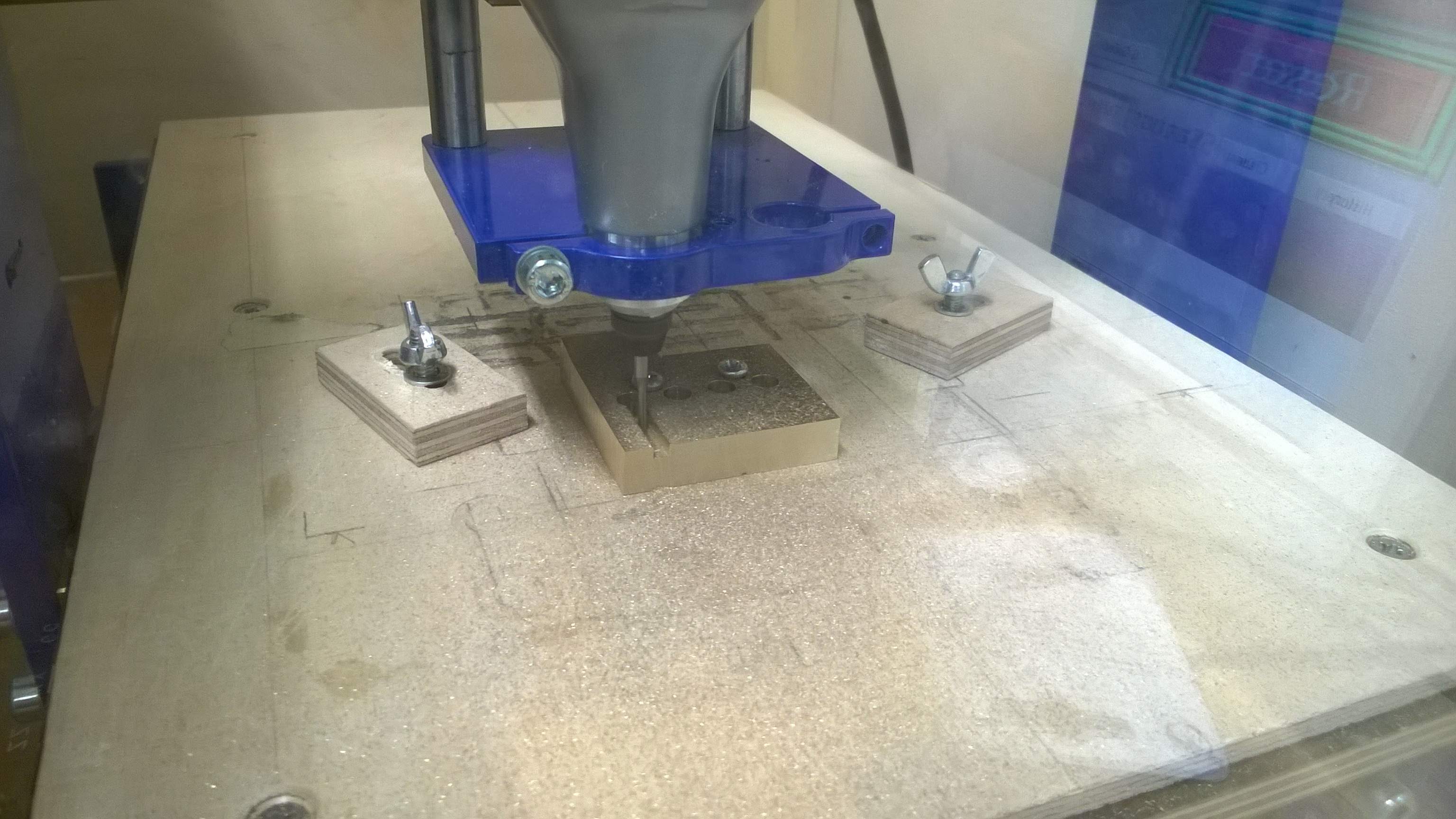
CNC running. I drilled the ball end holes with smaller than final dimension to help my little CNC mill.

TalkBass has been independent since 1998. Add your voice.
Create a free account to reply to discussions, view embedded media, and browse with fewer display ads.
Join free Log in
Want zero display ads or expanded classifieds tools? Compare plans.
 Check them out if you haven't seen one. Invalid Link Removed
Pretty much like you said. If I made a 6mm thick cf fterboard there would be no need or use to have a truss rod. The neck would be rock solid with no way to adjust relief. I added glass fiber to the body to get a bit more weight and thickness to the body. Structurally there is no need for those layers.Thanks. So I assume you left the two layers of glass out of the neck so that it would be flexible enough to respond to truss rod adjustments? The Luis and Clark CF orchestra instruments, like normal orchestra instruments don't have truss rods. Their fingerboards are CF. On the other hand, the neck length on a double bass is much shorter so they can get by without one. I think another factor is that since DB fingerboards are usually more than twice as thick as BG fingerboards, a lot of the adjustment that is done with a truss rod on BG's is done with a plane on DB's ebony fingerboards. A couple cello players in the Auburn Symphony I play in have them. I would love to have one but that's not going to happen until the kids are out of college.


This kind of "body" is so small that it needs some added weight. Otherwise it will feel like an inflatable bass. This bass will be featherweight anyway.It's funny to hear you say you use glass fibre for added mass and weight ..... I'm the guy who uses glass fibre to make ridiculously light speaker cabs
I guess it just goes to show the versatility of composites.

Every shape is possible with carbon fiber, I see no reasons for any shape being better for cf. Status has made both headless and headed conventional looking cf basses. Steinberger is the only paddle shape cf bass I know. Material, shape and headless were all something new when Steinberger introduced their L series. I think for most bassists Steinberger is what they think when they hear words carbon fiber bass.Is it possible to make a standard shape, like a Precision, out of carbon fiber? Or is there a reason why so many carbon fiber instruments have that trapezoidal shape?
Is it possible to make a standard shape, like a Precision, out of carbon fiber? Or is there a reason why so many carbon fiber instruments have that trapezoidal shape?

Let the Transatlantic journey begin!Hi MPU, Greetings from 8,871 km away!
Your blanks are cut and ready to make the journey. Thanks again for the mention.
Just the raw fingerboard blank. On last page there was some discussion about the reason why.So given you made so much of the bass yourself, I assume you ordered the finger board because it requires some machinery you don't have?
 And I don't want to explode my hobby shop.


