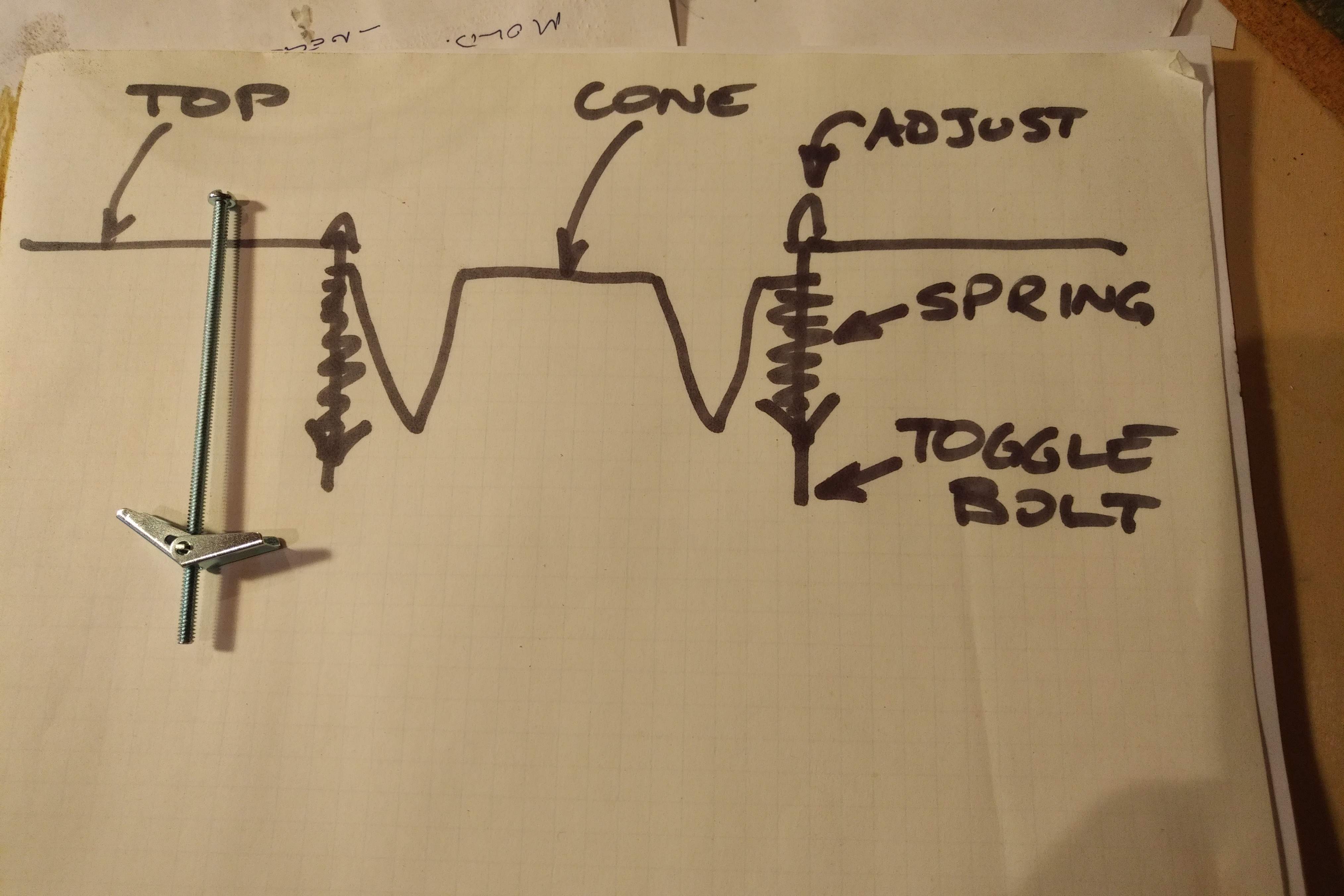
Here's a quick sketch. BTW what I called "butterfly bolts" are actually called "toggle bolts"

TalkBass has been independent since 1998. Add your voice.
Create a free account to reply to discussions, view embedded media, and browse with fewer display ads.
Join free Log in
Want zero display ads or expanded classifieds tools? Compare plans.

Here's a quick sketch. BTW what I called "butterfly bolts" are actually called "toggle bolts"

Probably not. I'm thinking that I may need to make up a lower ring with threaded holes instead of the toggles.Looks like a winner. Will the friction from the spring be enough to keep the nut on toggle bolt from just rotating with the screw?

I got that from one of your earlier posts. Thanks for all of your help.... Put the foam weatherstrip ring between the flange of the dog dish and the underside of the wood top. Now you've got a full flexible seal that allows the dish to move, with adjustable springs to balance the load...
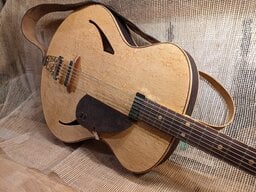
I read this yesterday and boy did that take me down a mental rabbit hole. My fingers are tired from all the googling. Sounds like an amazing concept!In case you are wondering why I seem to know a lot about this subject, I have an ongoing project here in my shop called the Acoustic Scroll Bass. It's an all acoustic version of my Scroll Basses. No pickups or electronics, all mechanical acoustic. A completely different construction and operation from a standard acoustic guitar. It has moving parts, precision bearings, and custom seals inside. I've been working on it for a long time, and I hope to have the first prototype done soon. I intend to make it into a production instrument that I can build and sell for many years. I'm not going to reveal yet exactly how it works, but I've written some about the project over on the Love Of Ampegs thread. Search Acoustic Scroll Bass and my name, and you'll find it.
This is probably the best post about it:
love of Ampeg and other Scroll Basses, Part 2
Anyway, my project is not like what you are doing here. A whole different internal arrangement. But, I've been dealing with many of the same technical issues: pumping air, spring loads, flexible seals, sound phasing, etc.
This is a fun project you have going here. Off in a different direction from mine, but with the same goal. This is the fun part of being a Luthier!


yes it does! you guys are amazing with your 'stuff'! Bruce Johnson always amazes, delights, and entertains!I read this yesterday and boy did that take me down a mental rabbit hole. My fingers are tired from all the googling. Sounds like an amazing concept!
yes it does! you guys are amazing with your 'stuff'! Bruce Johnson always amazes, delights, and entertains!
 ing.
ing.
Not sure why you'd be amazed.....What also amazes me is that even though there is a limited number of people building, there are many more contributing, watching, and
 .....
..... .... to all of you!......
I agree, I really enjoy following the builds, seeing the creativity, the engineering and design, as well as the functional art which is produced. To quote @Fat Freddy "Not sure why you'd be amazed.....
Speaking for myself, the Winter Build-Off is the highlight of the year.....
All of that skill, so generously shared.....The wonderful works of art that are being produced right in front of my eyes......Last, but not least, the generosity of our Luthiers for putting up with idiots like me.....
A general
"

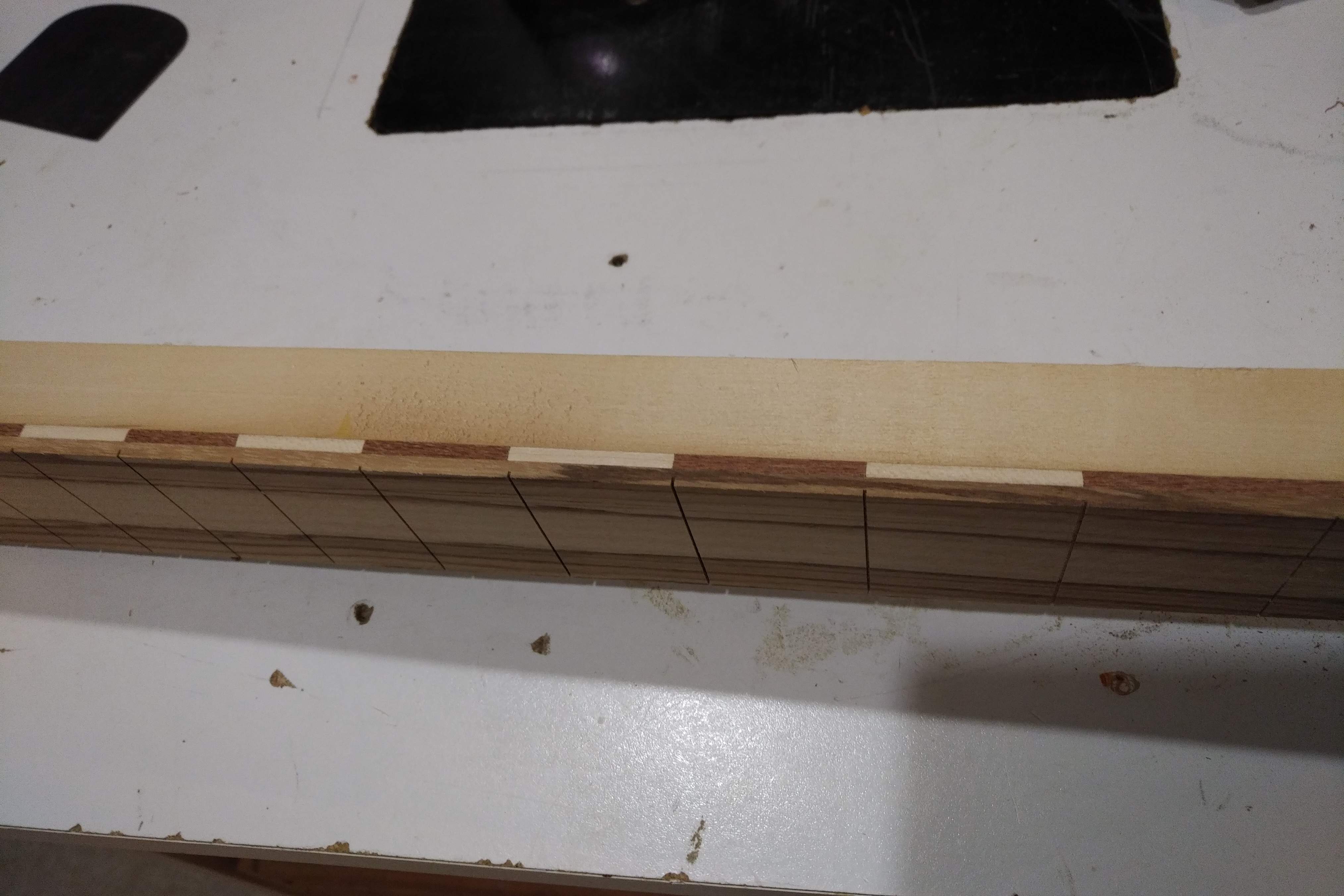
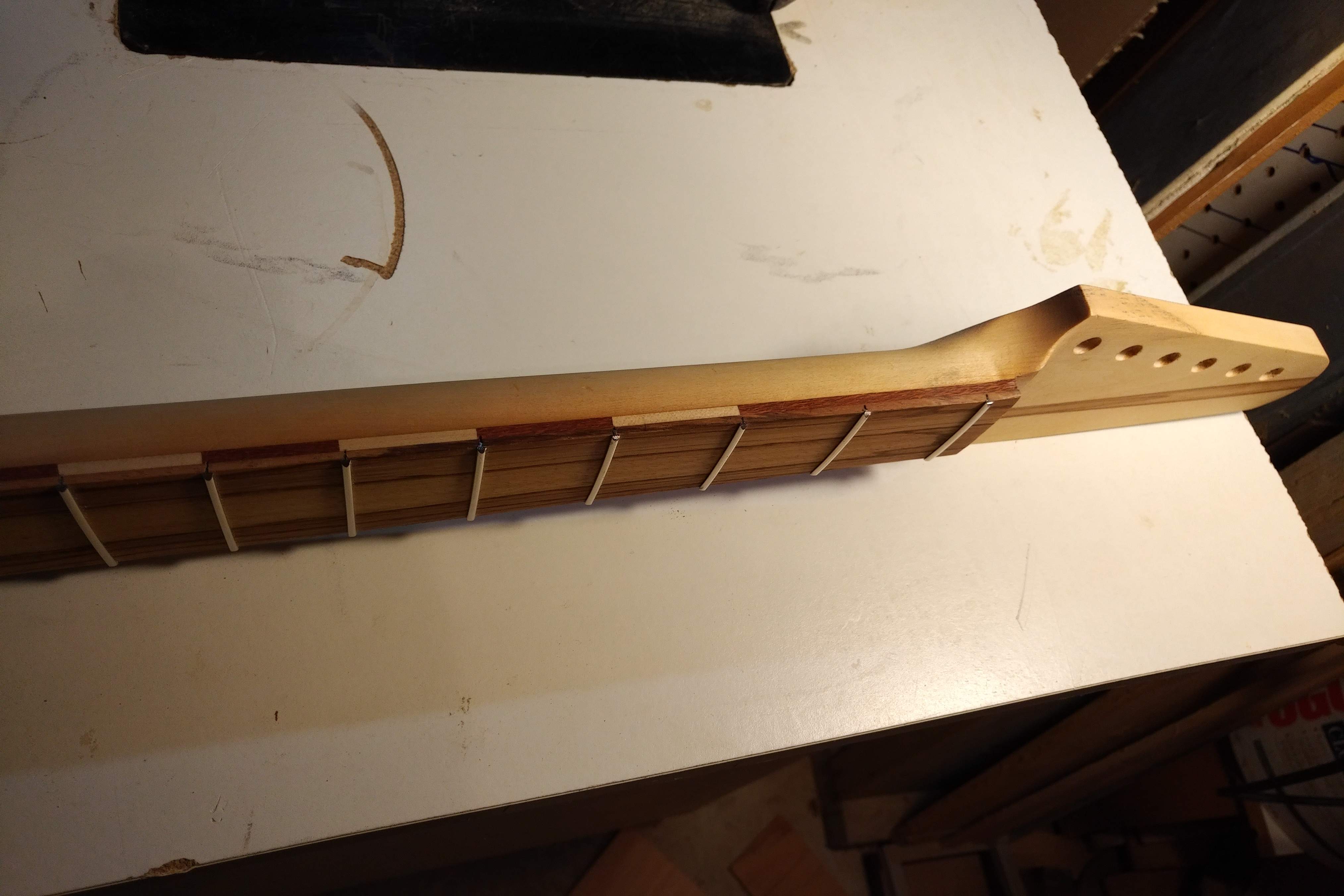
Thanks. Truth be told, I tried this because I've never been satisfied with the accuracy of my drilling the holes for the side dots.Great idea with the contrasting blocks!
I hear yaThanks. Truth be told, I tried this because I've never been satisfied with the accuracy of my drilling the holes for the side dots.

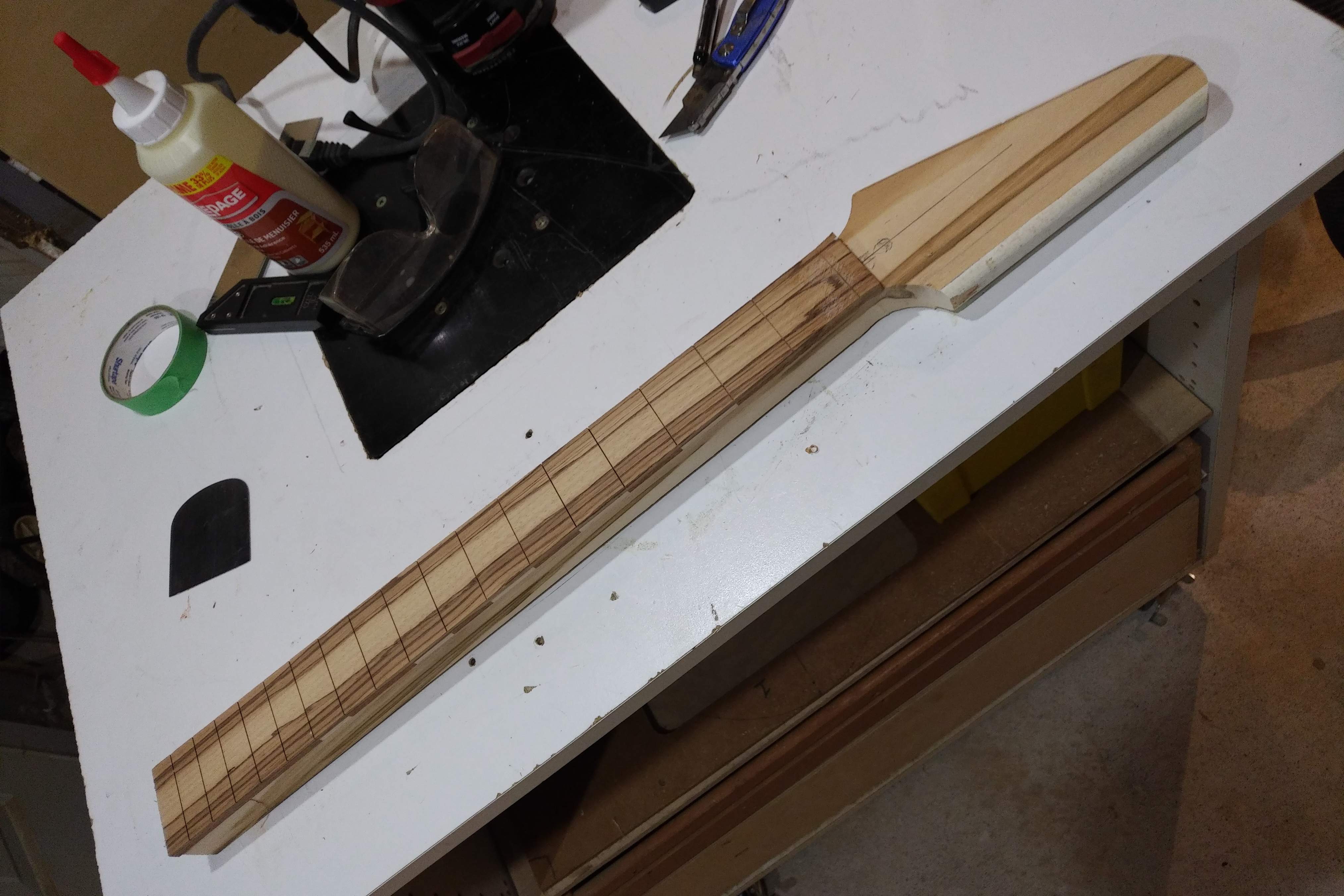
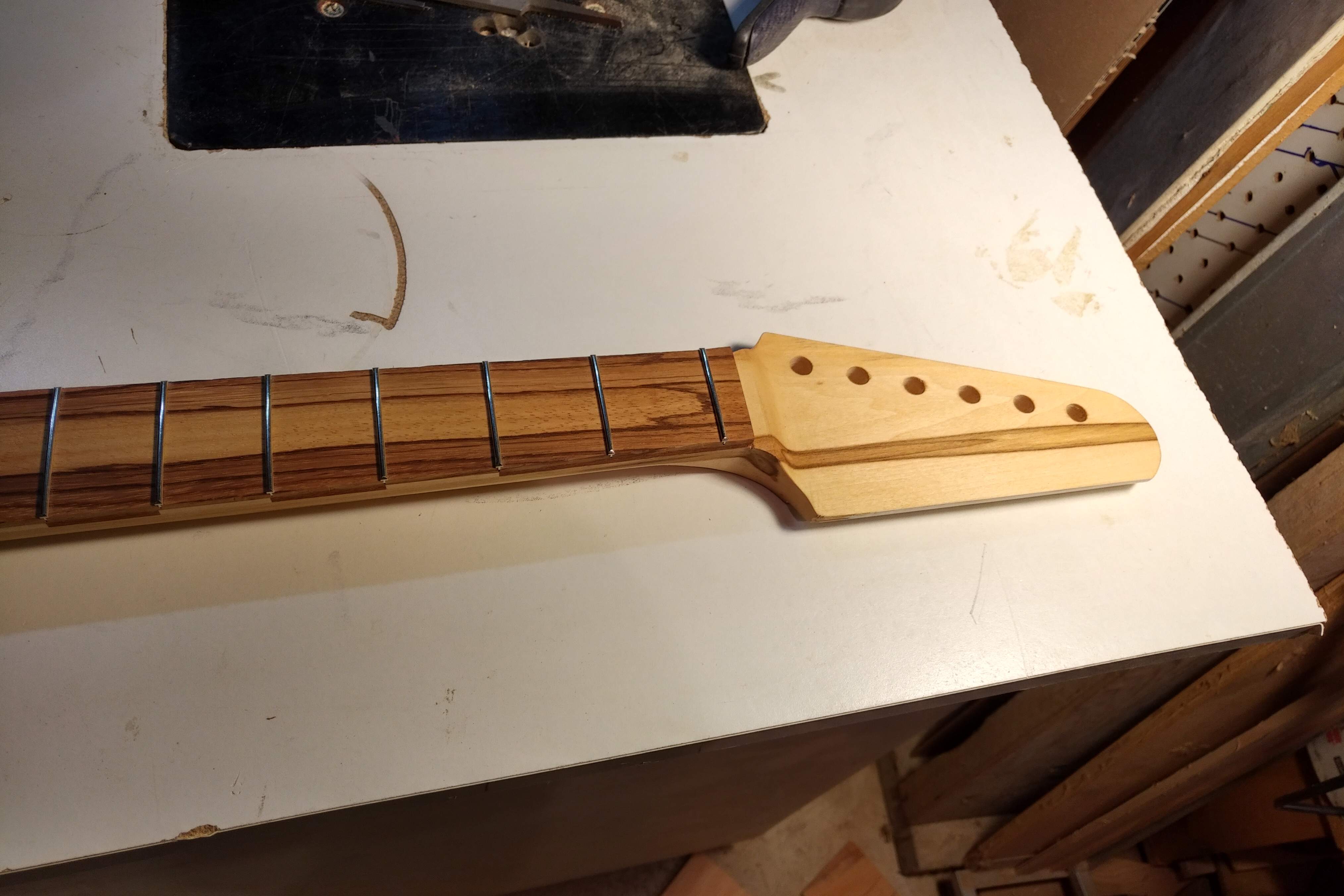
Me?.....I'd keep it.....Neck attempt 2 is now shaped and the finger board has been radiused.
I still need to deal with the head stock. By now, you shouldn't be surprised that I have abnormal, I mean unusual... I mean unconventional design ideas. What do people think about the idea of leaving a little bit of the original shape and paint from the reclaimed window sill of when the house was built in 1952? I like the historical context. Am I already far enough outside the box that this would be too much? I could keep the white bull nose in the top right corner of this picture.
The carbon fibre look might not make it to the end of the build. I tried building panels with a foam core and they just seemed too soft. I will build at least two different fronts with different resonators to compare the sound, but I am running short of carbon fibre cloth, so I will likely resort to fibre glass cloth, which wets out clear, showing the core below.The look of the reclaimed wood headstock is cool, but I dont know if it fits this project. It's the contrast with the composite top that I dont think jives. I'd suggest a matching composite overlay.