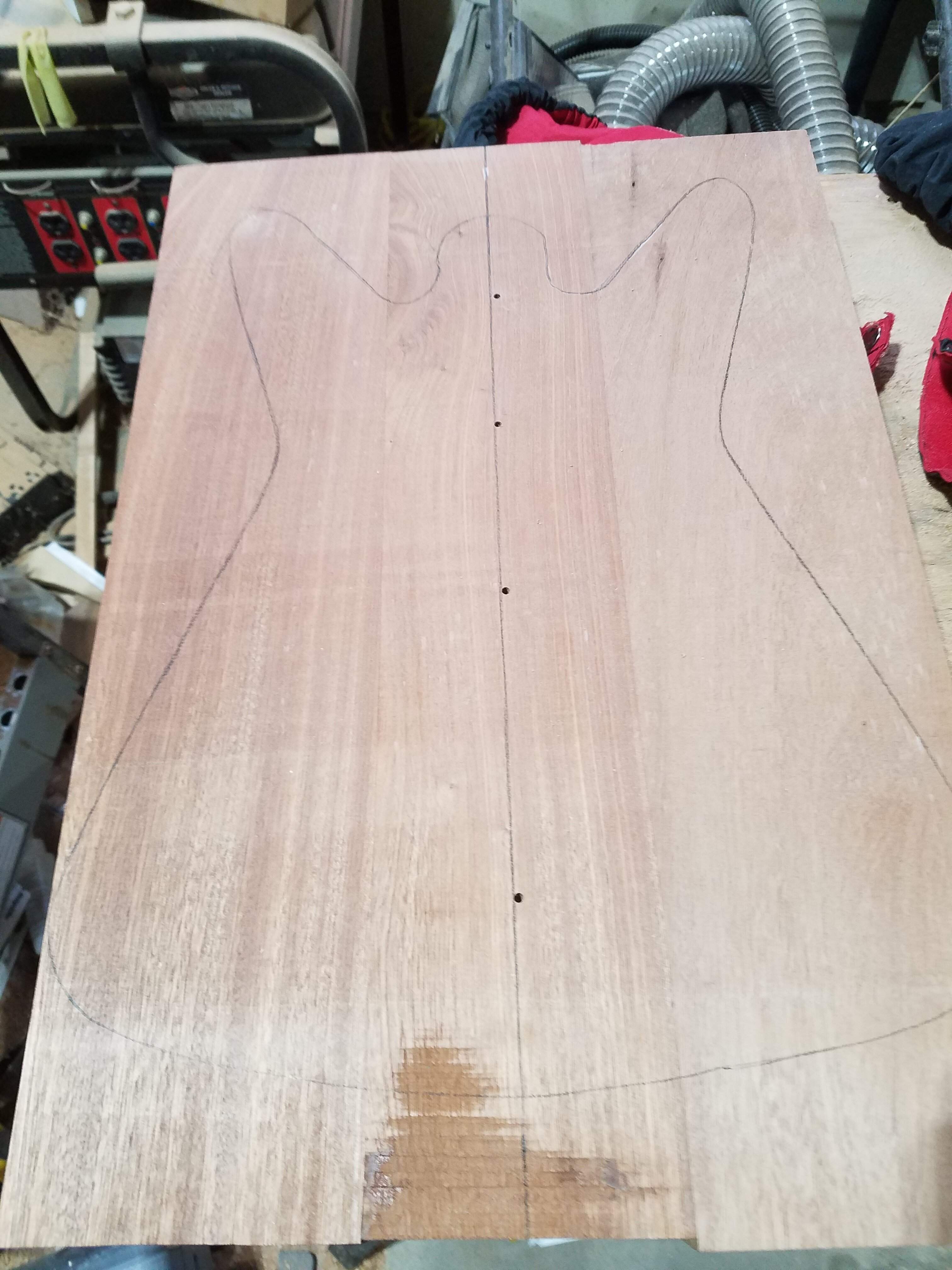
Body blank all marked up for cutting to shape:
And roughly cut to shape:
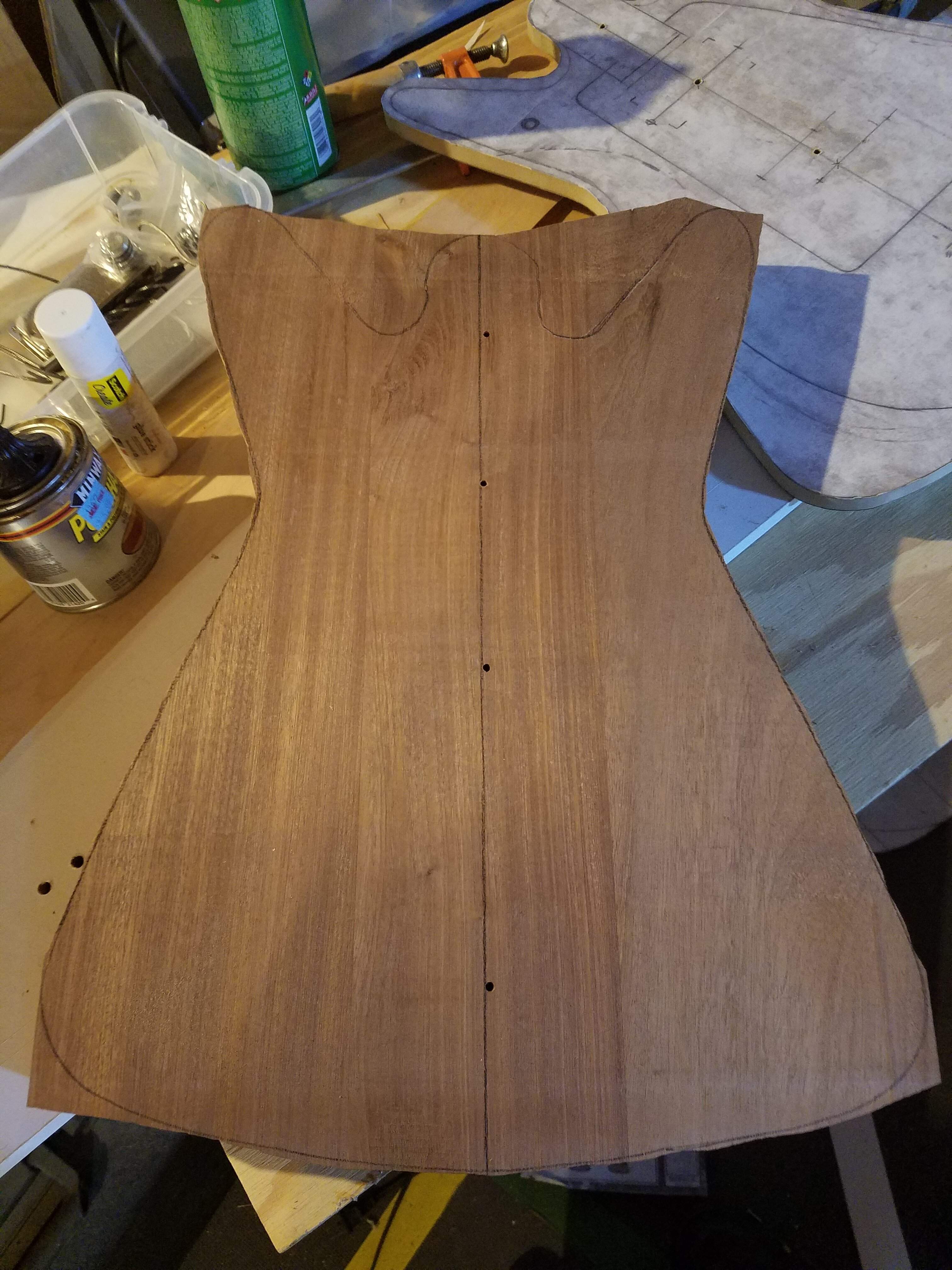
Right now the body at 1.75" thick, weighs about 9.3 lbs I'm going to shave off 1/4" of thickness which should lighten it a bit. It will have a spacious control cavity and some additional chambering under the PG.
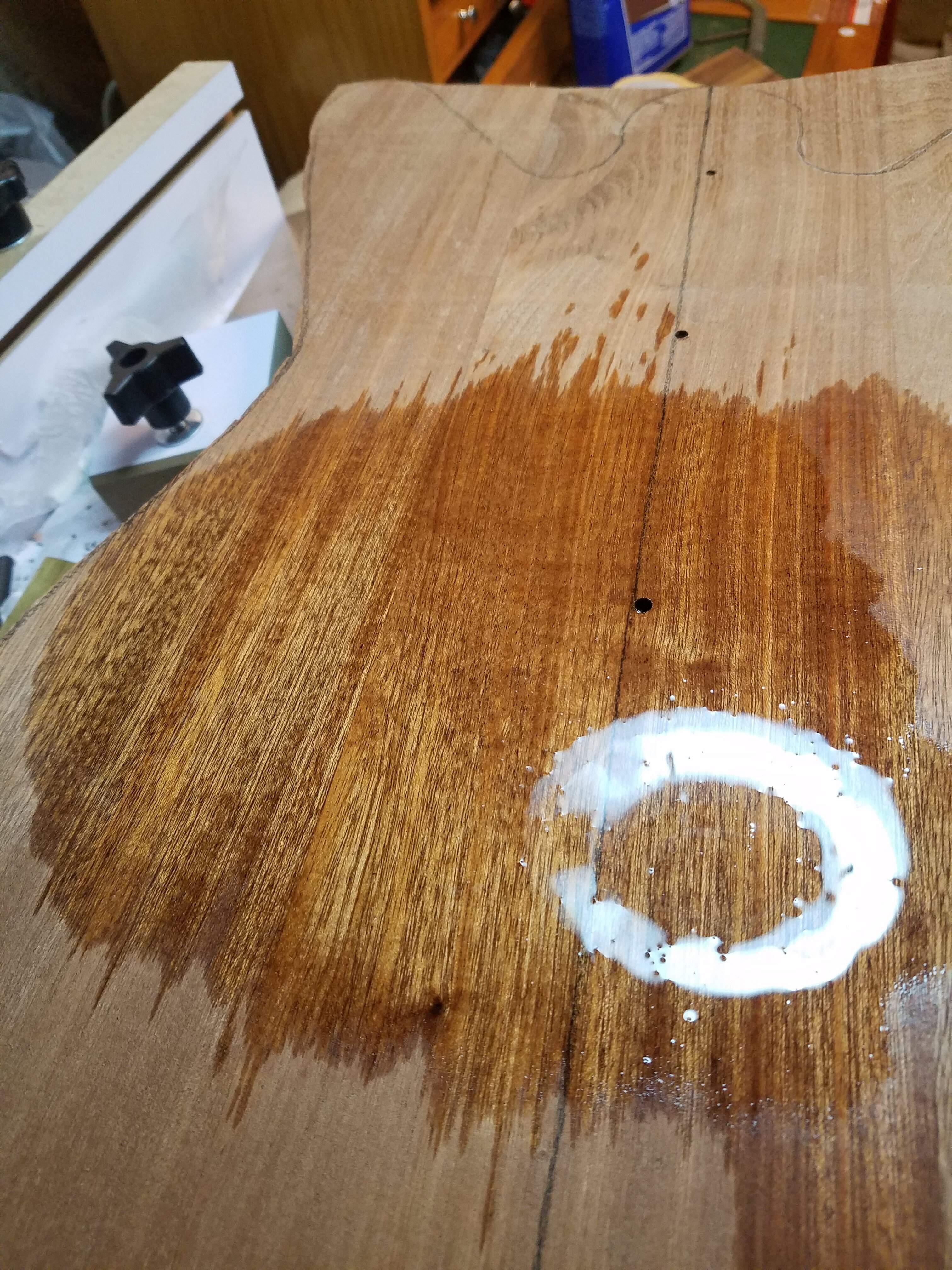
Here's how things look with a bit of Naptha:
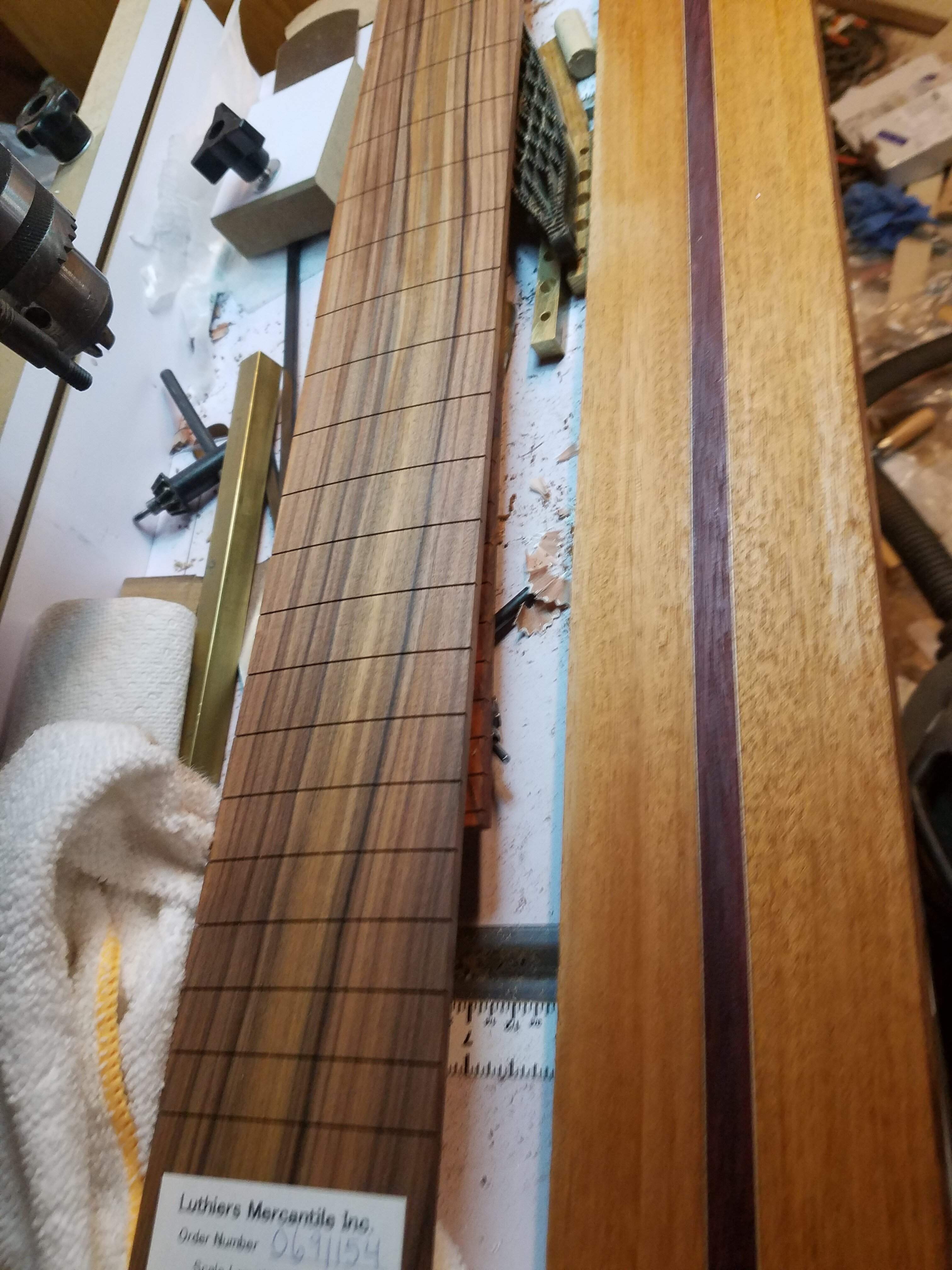 I've been spit-balling a few ideas for control configuration:
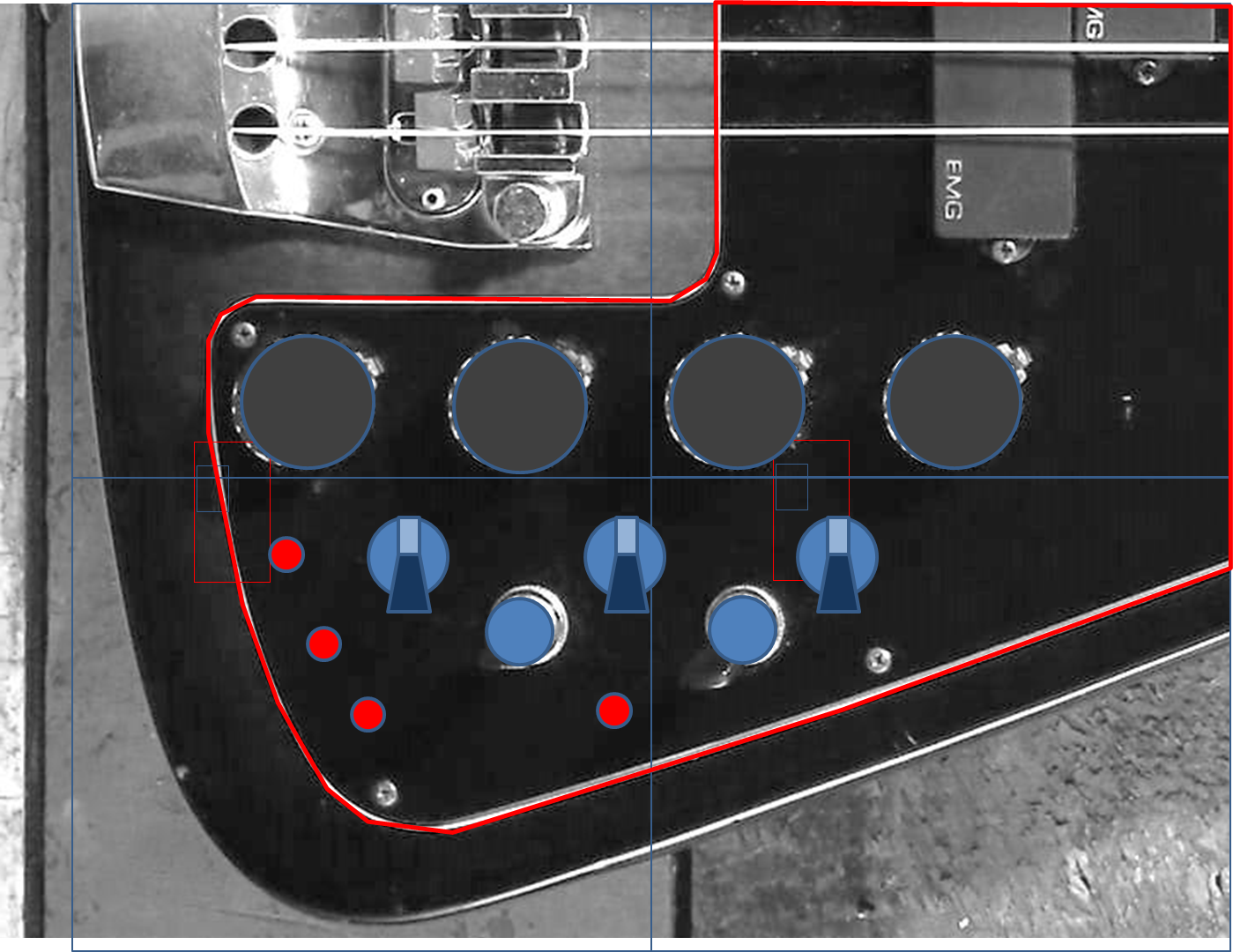
The front two knobs are pots for volume and tone, the rear two knobs would be rotary encoders. One of the toggles is to true-bypass the effects processor while the other two control in/out for each slot, there are also 2 pushbuttons, one of which could be used for tap-tempo for modulation effects
As for feedback, the Pollen synth module uses RGB LED's to indicate menus, etc, workable but would require memorizing what the colors mean. Another idea is to follow the example of the Illumine effects box and use a small LCD, but set in the upper arm.
And roughly cut to shape:
Right now the body at 1.75" thick, weighs about 9.3 lbs
I'm going to shave off 1/4" of thickness which should lighten it a bit. It will have a spacious control cavity and some additional chambering under the PG.Here's how things look with a bit of Naptha:
The front two knobs are pots for volume and tone, the rear two knobs would be rotary encoders. One of the toggles is to true-bypass the effects processor while the other two control in/out for each slot, there are also 2 pushbuttons, one of which could be used for tap-tempo for modulation effects
As for feedback, the Pollen synth module uses RGB LED's to indicate menus, etc, workable but would require memorizing what the colors mean. Another idea is to follow the example of the Illumine effects box and use a small LCD, but set in the upper arm.

 ) For ~8 degrees of tilt-back use 1:7. I drew a line across the MDF at the desired angle and attached the rail. Note that the ancient Delta (made by Ryobi) saw that I use doesn't have a std width T-Track mitre slot, so I use a piece fo 5/8" x 3/8" aluminum stock.

 Well why didn't you just say that in the first place!