• TalkBass has been independent since 1998. Add your voice.
    Create a free account to reply to discussions, view embedded media, and browse with fewer display ads.
    Join freeLog in
    Want zero display ads or expanded classifieds tools? Compare plans.

Wishbass Club pt. 2

Status
Not open for further replies.
3stringpete, have you tried the Stude body style? Opinions? Body style you liked the most?

Thanks,
=wr=

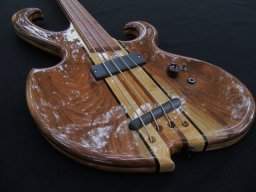
I think the Stude is one of the Wish's more balanced models, but the lower horn isn't the easiest to get around when playing high on the neck...as compared to the Hyper. I personally like the Hyper model the best. It's Wish's trademark shape and it balances perfectly due to the upper horn extending beyond the 12th fret position, and it has a cool look without being too crazy. Some people worry about the upper horn being fragile, but I think it really depends on the wood you use. Here are a few photos for comparison (I sold both a while ago):
 

Attachments

  • IMG_4587.jpg
    IMG_4587.jpg
    58.1 KB · Views: 113
  • IMG_4595.jpg
    IMG_4595.jpg
    55.4 KB · Views: 105
WR: Perhaps 3-StringPete and others can weigh in on other issues such as tone, sustain, volume, etc. ...

I have found poplar, mahogany, walnut, and spalted or ambrosia maple to be more mellow, or warm sounding. Ash, pear, purpleheart, zebrawood, hard maple, and mulberry seem to bring out the growl...an aggressive, mid-range tone. But, I truly believe that pickup placement is the most important element for good bass tone. A hot Kent Armstrong pickup placed about 5 inches in front of the bridge will sound killer. It is also important that his string holes are not too far away from the bridge. More than an inch and you'll lose the string angle necessary to vibrate the strings properly. I've set up a few Wishbasses that had the bridge very close to the holes, but when measuring the distance from the nut to the bridge, it was much greater than 34" and the intonation was incorrect. (That's when people say that his position markers being off, when it's usually the bridge.) After moving the bridge forward, the strings no longer bend over the bridge like they should and the tone is compromised. The photo of the Stude below is an example of a bridge I had to more forward (less bend in the string over the bridge, and the PU is very close to the bridge).

I really like Thomastik-Infeld Powerbass (roundwound) or TI Jazz Flatwound strings due to their high iron content (more magnetic with greater output). They are more expensive than most, but they will last 3-4 times longer.
 

Attachments

  • IMG_4595.jpg
    IMG_4595.jpg
    55.4 KB · Views: 68
3-string; You bring up really good points and stuff I know nothing about. What is your opinion about bridge materials? More specifically, I made bridges for both the Banana and Hyper basses out of Brazilian ebony thinking this material would be hard enough and also because it would look better, but I am wondering if I am way off-base using a hardwood instead of corian or bone, etc. Also, what happens to tone if one carves small grooves into the top of the corian bridge to lessen the sharpness of the point of contact between bridge and strings? I've been using this method to lower my strings a tiny bit but I am re-thinking this after reading your post. Thanx ...

I also agree with you about the Hyper - it is just a great design (& shape) and feels good sitting or standing. I personally love the long upper horn and with the back of mine mahogany, I don't worry about it not being strong enough. Those 2 guitars you sold really look like nice ones - how many left do you have?
 
3-string; You bring up really good points and stuff I know nothing about. What is your opinion about bridge materials? More specifically, I made bridges for both the Banana and Hyper basses out of Brazilian ebony thinking this material would be hard enough and also because it would look better, but I am wondering if I am way off-base using a hardwood instead of corian or bone, etc. Also, what happens to tone if one carves small grooves into the top of the corian bridge to lessen the sharpness of the point of contact between bridge and strings? I've been using this method to lower my strings a tiny bit but I am re-thinking this after reading your post. Thanx ...

I think any dense wood like ebony, purpleheart, or jatoba would work very well as a bridge. There probably would not be a noticeable difference in tone compared to corian or bone.

I would avoid filing grooves in the top of the bridge as a way to lower your bridge and action. It will increase the strings' contact area which will lead to loss of tone and intonation. (I've tried it several times, and have never been satisfied with the results.) It's always better to gradually sand the bottom of the bridge until you reach the desired height.

I used to buy unfinished Wishbasses, install all hardware and pickups, and sell them. Wish gave his "blessing" knowing that I was only interested in learning more about his techniques. I guess he would say that I was his only "authorized" dealer. After a while, I just couldn't find the time and would end up losing money, especially when he sells Wishbasses for under $300 on eBay. Now, I only make a few Wishboxes and custom control units when I have the time. I have also designed a few body shapes for Wish in the past year or so.
 
I think the Stude is one of the Wish's more balanced models, but the lower horn isn't the easiest to get around when playing high on the neck...as compared to the Hyper. I personally like the Hyper model the best. It's Wish's trademark shape and it balances perfectly due to the upper horn extending beyond the 12th fret position, and it has a cool look without being too crazy. Some people worry about the upper horn being fragile, but I think it really depends on the wood you use. Here are a few photos for comparison (I sold both a while ago):

Which woods would be good for that hyper upper horn? Which to avoid?

The purpleheart FB/sapele (African mahogany) body fantasy model I have has very nice tone but just a little thin on the bottom, probably pickup placement as you suggest. The "punch" button on my amp seems to be voiced exactly right for this bit of thinness and gives the bass great bottom without being boomy. I'd still like to try a model with the p/u closer to the neck...

Thanks for everyones advice!
=wr=
 
Which woods would be good for that hyper upper horn? Which to avoid?

The purpleheart FB/sapele (African mahogany) body fantasy model I have has very nice tone but just a little thin on the bottom, probably pickup placement as you suggest. The "punch" button on my amp seems to be voiced exactly right for this bit of thinness and gives the bass great bottom without being boomy. I'd still like to try a model with the p/u closer to the neck...

Thanks for everyones advice!
=wr=

I would only avoid woods with soft areas. Some of the ambrosia maple he uses is too soft and fragile. But if it is paired with a dense wood, it would be fine.
 
"I would only avoid woods with soft areas. Some of the ambrosia maple he uses is too soft and fragile. But if it is paired with a dense wood, it would be fine "...

Amen to that! My Hyper has an ambrosia maple top and I had a dickens of a time stabilizing a couple of areas where the wood was so soft it was literally crumbling away (body to neck joins). I ended up just scraping it away and filled it with 2 blond colored fillers that stabilized these areas and blended nicely too since the wood is so multi-colored. Wish had actually used Liquid Plumber on one spot and that stuff is dark grey in color - not exactly very wood-like! Since this weaker ambrosia wood is grafted to a mahogany back, I wasn't worried about structural issues, but getting into that was scary at first. It took a lot of time to make it look half-way right and shape it properly. I am sure it is one of the main reasons the guy was selling it on Ebay. - Not for the faint of heart ...
 
3StringPete; You seem to have a lot of experience with Wishbasses and I was wondering what your opinion is about flat vs. radioused fingerboards. I am considering radiousing one or more of my Wishbass fingerboards and have sanding blocks for 12", 16" & 20". (The 12" sanding block is 8 inches long while the 16"/20" block is 12 inches long.) Could you share your thoughts on this topic before I plunge in and do something I might regret? Thanks a lot!
 
3StringPete; You seem to have a lot of experience with Wishbasses and I was wondering what your opinion is about flat vs. radioused fingerboards. I am considering radiousing one or more of my Wishbass fingerboards and have sanding blocks for 12", 16" & 20". (The 12" sanding block is 8 inches long while the 16"/20" block is 12 inches long.) Could you share your thoughts on this topic before I plunge in and do something I might regret? Thanks a lot!

I don't have any experience with sanding blocks to add a slight radius to a fingerboard. However, it certainly has been done before. Just be sure that the fingerboard is level along its entire length when sanding.

The only negative might be the shape of the bridge in relation to the radius of the fingerboard. You'll probably need to reshape the bridge along its top to match the same radius as the fingerboard. That may be difficult with a Corian bridge. Adjustable bridges allow you to change the height of each individual string to match the radius.

I personally prefer a flat fretboard with sanded edges for a smooth feel.
 
In case anyone cares, I haven't updated lately about my Wishnevsky Instrument, so here goes ... The Banana bass is finally finished! I finally installed the K&K pup, apparently successfully. It was a little nerve wracking since I did not have very easy access on one side due to how I positioned the access hole (duh). Anyway, I have been pleasantly surprised at how it sounds! With the black nylons and the K&K, it is giving off a very nice, warm, bassy, almost upright sort of tone, which I really like. It tends to feedback easily, so I am still adjusting to that, but it is so easy to play now and sounds good to boot - I really look forward to picking it up. The short scale and black nylon strings also assure very little stress on the top and it practically frets itself. Now I just got to learn how to play better!

Not much else is happening with my current work load, but hopefully the Stude and Hyper will get wired back together soon (I await a friend to help me with the soldering). Have a good weekend, everyone ...
 
In case anyone cares, I haven't updated lately about my Wishnevsky Instrument, so here goes ... The Banana bass is finally finished! I finally installed the K&K pup, apparently successfully. It was a little nerve wracking since I did not have very easy access on one side due to how I positioned the access hole (duh). Anyway, I have been pleasantly surprised at how it sounds! With the black nylons and the K&K, it is giving off a very nice, warm, bassy, almost upright sort of tone, which I really like. It tends to feedback easily, so I am still adjusting to that, but it is so easy to play now and sounds good to boot - I really look forward to picking it up. The short scale and black nylon strings also assure very little stress on the top and it practically frets itself. Now I just got to learn how to play better!

Not much else is happening with my current work load, but hopefully the Stude and Hyper will get wired back together soon (I await a friend to help me with the soldering). Have a good weekend, everyone ...

Please post some photos of your Banana Bass when you get a chance.
 
Status
Not open for further replies.