• TalkBass has been independent since 1998. Add your voice.
    Create a free account to reply to discussions, view embedded media, and browse with fewer display ads.
    Join freeLog in
    Want zero display ads or expanded classifieds tools? Compare plans.

Double Bass wooden endpins

Labravajazz,
I'll be turning the pin in the next few weeks and as time permits, will post the results. The trick is getting the right piece of Lignum. Hopefully a piece where the grain is continuous from top to bottom and does not run out anywhere along the pin. It is the only wood I would trust, even moreso than ebony which has had a tendency to crack or shatter. The lignum was used as bearing blocks on propeller shafts of submarines as I understand. So we'll see how this pans out.
Jim
 
Labravajazz,
I'll be turning the pin in the next few weeks and as time permits, will post the results. The trick is getting the right piece of Lignum. Hopefully a piece where the grain is continuous from top to bottom and does not run out anywhere along the pin. It is the only wood I would trust, even moreso than ebony which has had a tendency to crack or shatter. The lignum was used as bearing blocks on propeller shafts of submarines as I understand. So we'll see how this pans out.
Jim

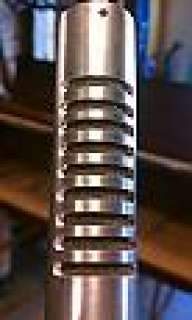
I have an old American Standard which I bought in 2001. It was from the late 30's very eary 40's and came with the original wooden endpin. It was a short, tapered ebony stick maybe 6"-7" long. I replaced it due to the fact hat I'm 6"5" and needed the bass to be higher off the floor for it to be comfortable for me.

I said all that to say this. The original endpin had survived
60+ years with no cracks. The Lignum will be a durable endpin and a good grade of ebony probably would be as well.
 
Ive been using the setup detailed in the Treager book, an ebony plug with a hickory drumstick and a nice crutch tip. It did make a small but noticeable sonic difference over the tubular steel pin that came with the plug. The system is easily adjustable, BUT!!! the hickory is soft enough to develop an impression from the brass "brake shoe" that crates the friction against the pin. This means that it had the tendency to slip until the impression was established enough to act like a notch in the pin. Now it works great without slipping.
 
I finished the lignum vitae 10mm end pin and installed it in the Juzek. It's awefully thin. I spaced a few detents along the pin for adjustment and graduated the end to receive a 1/2" crutch tip. It worked just fine but I could detect no discernable sonic difference between it and the solid steel pin that was installed previously. You never know unless you try, I guess.
Jim
 
Lignum Vitae is very dense, correct? The theory as I understand it is to reduce the mass of the endpin. This hinders the transmission of vibration through the rib less, because there is less mass to set in motion. Just my understanding of whats in the Treager book. It really made a small difference on my bass, just barely discernible. It could be placebo effect......
 
I just visited KC Strings where Anton showed me the new wooden endpin they are perfecting. Richard was busily working away on other new ideas; a virtual Beehive of activity.

Anyway, it looks like a neat idea that would surely eliminate any concern regarding drilling another hole in the block as is necessary with the Laborie pin. A new plug to hold the tailpiece wire replaces the existing endpin for a clean look. A nicely shaped maple block is mounted on the outside of the lower ribs running from the saddle to the back rib. Made to accept a pin at about a 45 degre angle it looks to me to be an improvement over the Laborie design based on what I know. Admittedly, my Laborie experience is limited to what I've seen on the net. Unfortunately, the design is too long to work for my playing style, as I sit on a low stool, but they will have a carbon fiber pin in a couple of weeks that can be cut to length. It certainly shows promise.
 
I've been using a Laborie-style oak pin, and it seems to sound a little better than carbon fiber, and definitely better than the straight metal pin.

Nicholas Walker, the professor at Ithaca, has been experimenting a lot with different woods. He seems to have found some woods that sound much better than others. His preference seems to be toward pernambuco and oak pins. He's also trying this Australian hard wood that seems to work well.

This is all for Laborie pins, but I would think these woods would work well for straight pins as well.
 
Here are some pictures of a custom wooden end pin made for the Bradetich Guadagnini. It was made by 2 other colleagues and myself last year. We turned a socket from Lignum Vitae and attached a brass ring for security. This socket is installed with a 17 - 1 taper. The idea was that if the wooden end pin idea is abandoned in the future, the socket can be removed and a standard ebony plug will fit the bass with out any refilling.
Then we turned a piece of maple for the actual end pin itself. This end pin is also tapered with a 17-1 ratio which is received by the Lignum socket. The tapered fit is always superior. Its always tight and there is never any play or wiggle if it is dome correctly. A combo of bass and cello end pin reamers were used here.
We fitted another brass ring around end of the maple end pin to strengthen the bottom. A mettle spike is threaded into the bottom. This spike is adjustable for subtle hieght changes and can be removed for sharpening. The choice for maple was acoustic. It was stained a dark walnut color to match the bass.
The owners first reaction to the new installation was that it felt more grounded and resonated better than the wiggly broom stick he was using before. I agree that wooden end pins sound better than the steel 10mm rod. At the same time this project took way more time than we had anticipated but the result was rewarding.
 
I'm using a 1/2" dogwood pin with a crutch tip in the old Kay currently. I have also been thinking of turning a 10mm pin with a crutch tip for the carved Juzek. That's a very skinny pin for the Juzek and about the only wood I would trust for that narrow a diameter would be straight grained lignum vitae. Definitely gonna try it though.
Jim

have you turned it yet? I'm interested in how stable your skinney pin is and what your basses responce has been
 
R.C.,
I turned the 10 mm lignum pin and I could hardly notice any difference at all, so I put the metal pin back in. It was stable enough but I'd rather not chance the pin breaking since Arnold just finished restoring the bass (carved Juzek) that I had it on. To the TB'er that said "lighter or less dense wood in the pin would free up the ability of the the bass to vibrate" or something to that effect, that might be so. I just haven't heard a lot of difference between oak, cherry, walnut (which is what I used for the compensated tail piece on the Juzek), hickory, dogwood (which is what I currently have as an end pin on the Kay),lignum or ebony. I can only guess that it is the combination of doing a thousand little things correctly that gives you a quantum leap in terms of improved sound . That's why I just sent the thing to Arnold and he made it sing. Sorry that there is no magic potion (as far as I havebeen able to determine) in relation to the end pin.
:rollno:
Jim
 
I tested this last night with Arnold. One in an old Viennese type Bass with a regular 3/8ths rod changing it to the fixed wood insert. The other was in my Hart Bass which has the Graphite endpin. Although the endpin tip into the Bass from the Wood model was too big, I did hear a difference overall. I am waiting on more to come in so Arnold can get me one for each type Endpin socket I have.