• TalkBass has been independent since 1998. Add your voice.
    Create a free account to reply to discussions, view embedded media, and browse with fewer display ads.
    Join freeLog in
    Want zero display ads or expanded classifieds tools? Compare plans.

Worst shielding ever?

I'm not an electrical engineer. My understanding is that shielding the control cavity does not really add much value (juice is not worth the squeeze). Sheilding the pickup cavaties - most definitely. But again, my understanding is that pots, output jacks etc. do not pickup extra noise. In fact, if anything critical in the control cavity touches the shielding it can cause unwanted results.
Ran across this article a while back when I was reading up on shielding, might be of interest as an alternative perspective on the subject: I Was Wrong About Guitar Shielding
 
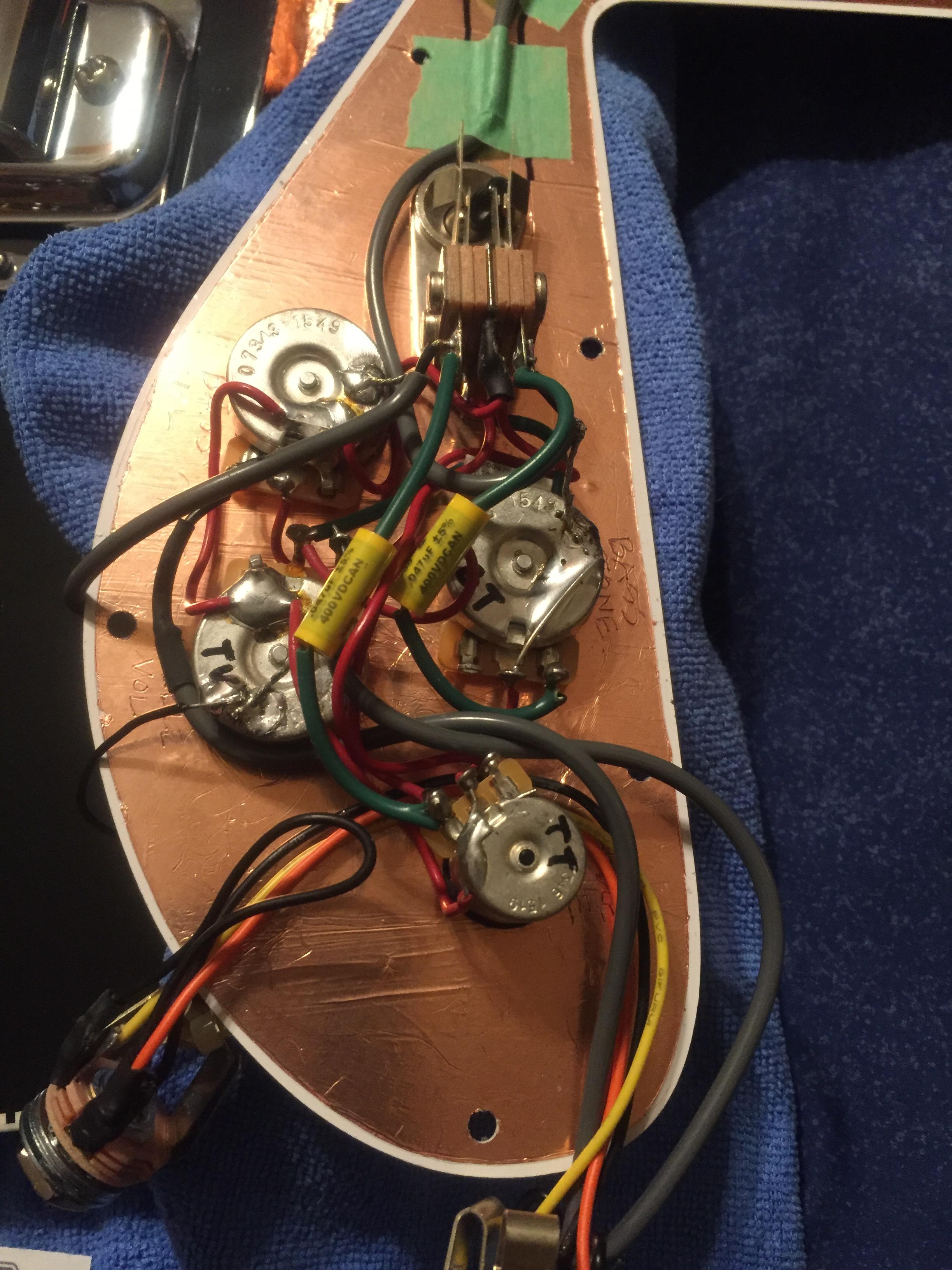
Yeah, the battery pack was a bit of a conundrum for me. I couldn't figure out a way to encapsulate it within the shielding.

So instead I ensured that there was no connection between the copper tape and the leads to the battery, using electrical tape as an insulator, then applied the copper tape to the outside of the battery pack. The battery is outside of the Faraday cage.
A Faraday cage doesn't need to fully encpasulate to be effective, the gaps just need to be arranged in manner that prevents electric signals entering the protected area. I think that battery IS in the cage.
 
Last I checked, Ric basses with a new price of $2k + come with… a strip of foil tape behind the pots, grounded to nothing. Or maybe that IS somebody’s pathetic attempt at shielding. I don’t get it.
maybe they used the foil tape as a ground "bus"? the entire chassis of the pot is electrically equivalent, so rather than using a wire to jump between the pots for a ground point, you could rely on the connection between the foil tape and the bottom (in this respect) of the pot for your common/ground. this is just an educated guess since i've never seen the inside of a Ric's control space. but that would be the thing that makes sense to me.
 
  • Like
Reactions: mcnach
maybe they used the foil tape as a ground "bus"? the entire chassis of the pot is electrically equivalent, so rather than using a wire to jump between the pots for a ground point, you could rely on the connection between the foil tape and the bottom (in this respect) of the pot for your common/ground. this is just an educated guess since i've never seen the inside of a Ric's control space. but that would be the thing that makes sense to me.
Yeah, Fender was doing that for awhile on some Jazz basses, worked fine until the pot nuts loosened a little.
 
I wish I still had pictures, but a jazz bass I had years ago had been shielded by a previous owner painting the back of the control plate. Pots, wires, jack, everything just coated in the stuff. The bass still had all the normal hum and the pots were stiff and scratchy. I replaced it with a clean plate and new harness and most of the noise issues went away.
 
interesting take

you don't know about electronics or electricity, but you have a strong enough opinion to post it here.

you would be the first person i have ever heard say that shielding doesn't do anything. you might actually have a stronger argument about the pickup cavities not needing shielding since many modern pickup manufacturers shield the pickups themselves.

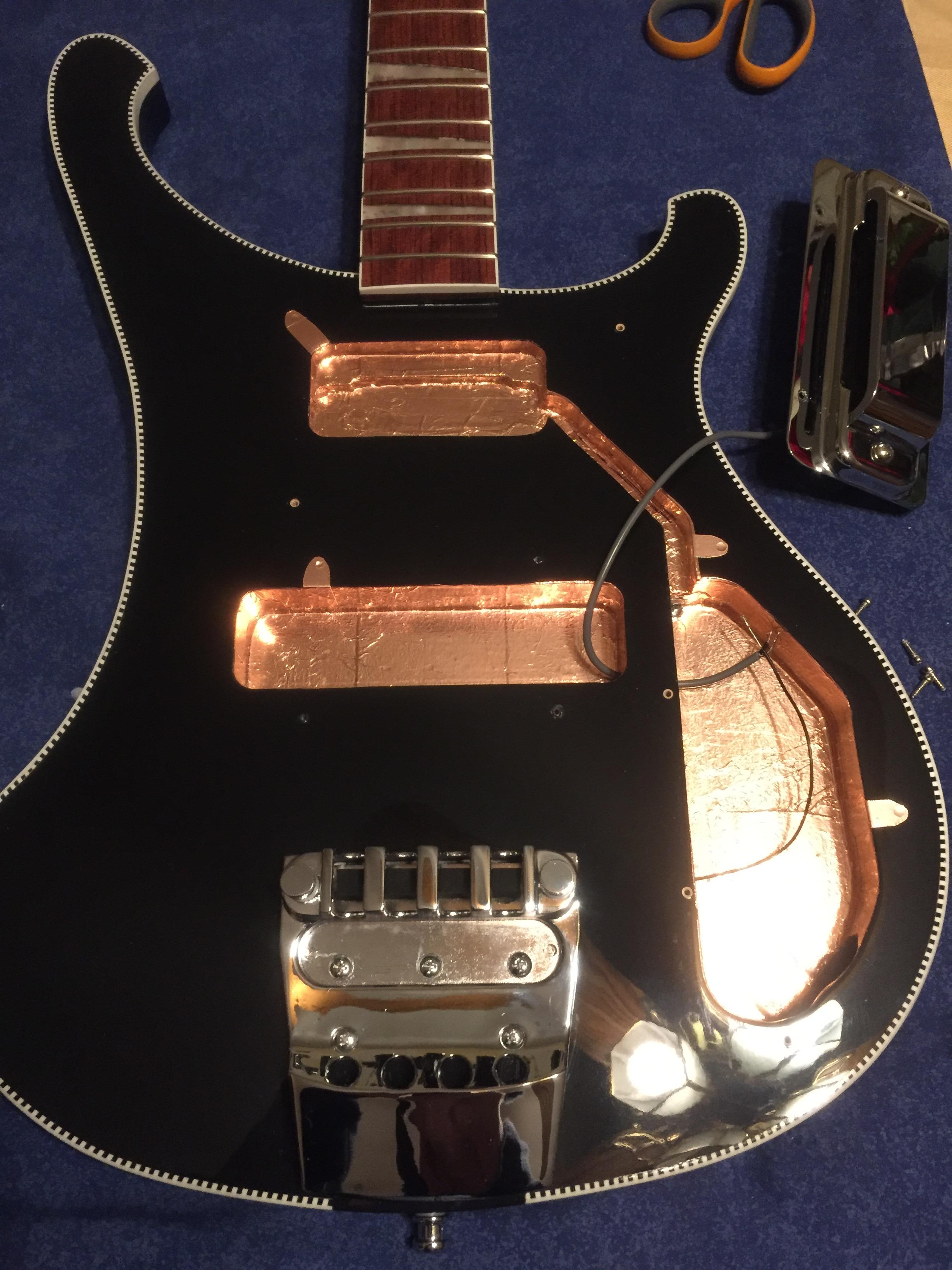
simple question for you though. if, like you state, shielding the control cavity "does not really add much value" then why do manufacturers go through the trouble of using the conductive paint in there? surely if there was no "juice" to be squeezed, they would simply skip this step and save the material and labor costs involved. as you can see from the pictures i took, this particular manufacturer chose to only paint the control cavity and did nothing to the pickup cavities.

you were misinformed about the effectiveness of shielding the various components of the instrument. your lack of understanding of some basic electronic principals allowed you to take this information and treat it like actual fact, then regurgitate it here as an alternate viewpoint. albeit one with no factual basis.

fwiw, i am an Electronics Technician and i understand how electrical interference works and how shielding low voltage systems that carry low current signals will help to shunt any unwanted induced signals to ground thus allowing a cleaner signal to propagate through the circuit.

kgb
Interesting reply. Let's start by addressing what I actually wrote:

"... shielding the control cavity does not really add much value" does not equal "... shielding doesn't do anything".

I got this from at least one source, and shared what I read here. I also made it clear what my credentials are (or are not, as it were) from the start. Correcting me without the condenscension and false quotes would have been a more appropriate response.

When grounded shielding of any kind (with a separate wire to the output jack), touches something that is already grounded (the back of a pot for example), a closed loop occurs thereby removing the desired hum cancelling effect. Granted, I left this out but my intent was not to write a dissertation. The point of which, since my comment was more of an editorial than a statement of fact, goes back to the juice not being worth the squeeze.
 
  • Sad
Reactions: mcnach
I'm not an electrical engineer. My understanding is that shielding the control cavity does not really add much value (juice is not worth the squeeze). Sheilding the pickup cavaties - most definitely. But again, my understanding is that pots, output jacks etc. do not pickup extra noise. In fact, if anything critical in the control cavity touches the shielding it can cause unwanted results.

Coinicidentally, I recently brought one of my electric guitars into the shop to have copper shielding tape installed, and all the folks over on the guitar forum were trying to tell me the exact opposite: "Shielding the pickup cavities isn't necessary, just shield the control cavity!"

Fortunately I didn't listen to them.

And every bass or guitar I own that is shielded has shielding in both the pickup and control cavities.
 
Interesting reply. Let's start by addressing what I actually wrote:

"... shielding the control cavity does not really add much value" does not equal "... shielding doesn't do anything".

I got this from at least one source, and shared what I read here. I also made it clear what my credentials are (or are not, as it were) from the start. Correcting me without the condenscension and false quotes would have been a more appropriate response.

When grounded shielding of any kind (with a separate wire to the output jack), touches something that is already grounded (the back of a pot for example), a closed loop occurs thereby removing the desired hum cancelling effect. Granted, I left this out but my intent was not to write a dissertation. The point of which, since my comment was more of an editorial than a statement of fact, goes back to the juice not being worth the squeeze.
When grounded shielding touches something already grounded, like the back of a pot, it does not automatically create a closed loop, and it does not remove the shielding’s hum-reduction effect.

In a passive electric guitar, the shielding works by acting as a Faraday shield: it intercepts electrostatic noise and drains it to ground. For that to work, the shielding must be connected to ground somehow. If copper foil in the control cavity touches the back of a grounded pot, that is usually fine. In fact, many shielding jobs intentionally rely on contact between the foil and grounded pots, switch frames, jack sleeve, or a common ground wire.

In a passive guitar, those loops are usually very small, carry tiny currents, and are rarely the main source of hum. The bigger issues are usually:

Incomplete shielding coverage
  1. Shielding not actually connected to ground
  2. Poor continuity between shielded cavities
  3. Single-coil pickup hum, which shielding cannot fully eliminate
  4. Bad solder joints or loose grounds
  5. A shield accidentally touching a hot signal lug, which can kill or load the signal
 
I use the copper foil with the conductive adhesive, the MG Supershield paint is absurdly overpriced, and seems to dry up in the bottle pretty quick, but I can see why Pros would use the spray cans of it when Time is literally money. It doesn't kill 100% of the hum with single-coils, I have a couple old LED lights that still seem to cause it, but it's minor enough, and barely audible.
w8toVmC.jpg


OhS9ytg.jpg
 
Last edited:
I'm not an electrical engineer. My understanding is that shielding the control cavity does not really add much value (juice is not worth the squeeze). Sheilding the pickup cavaties - most definitely. But again, my understanding is that pots, output jacks etc. do not pickup extra noise. In fact, if anything critical in the control cavity touches the shielding it can cause unwanted results.
The control cavity shielding is grounded (or should be, at least) and the pots are also grounded, so if they touch nothing of consequence happens. I do see the value in shielding the control cavity as I have found that input/hot wires are very prone to electro-magnetic "shenanigans".
 
I use the copper foil with the conductive adhesive, the MG Supershield paint is absurdly overpriced, and seems to dry up in the bottle pretty quick, but I can see why Pros would use the spray cans of it when Time is literally money. It doesn't kill 100% of the hum with single-coils, I have a couple old LED lights that still seem to cause it, but it's minor enough, and barely audible.
w8toVmC.jpg


OhS9ytg.jpg
I see your "tabs" for the pickguard outside the pickup cavities (I do this too). Also, we have the same taste in Mallory caps.
 
"worst shielding ever" might be what i see in lots of new mid-price instruments, where they paint the cavities with what is in fact shielding paint, but then don't bother to ground it

they've basically installed "antenna paint" at that point, it could add noise 😑

as for shielding control cavities vs pickup cavities, there's an argument for avoiding shielding that's "too good" (i.e., too conductive, like copper foil) right near the pickups themselves; if that shielding is within the magnetic field of the pickups then it can induce eddy currents in the shielding, and said eddy currents can dull the sound of the pickups a little

so yeah, shield the control cavity definitely, shield the pickup cavities with something no more conductive than the graphite paint
 
"worst shielding ever" might be what i see in lots of new mid-price instruments, where they paint the cavities with what is in fact shielding paint, but then don't bother to ground it

they've basically installed "antenna paint" at that point, it could add noise 😑

as for shielding control cavities vs pickup cavities, there's an argument for avoiding shielding that's "too good" (i.e., too conductive, like copper foil) right near the pickups themselves; if that shielding is within the magnetic field of the pickups then it can induce eddy currents in the shielding, and said eddy currents can dull the sound of the pickups a little

so yeah, shield the control cavity definitely, shield the pickup cavities with something no more conductive than the graphite paint

If the pots are secured to it, then the shield is grounded.
 
How many coats of MG super shield does it take to get adequate shielding and continuity? I have had no luck with this stuff. I typically only use it on the “shelf” edges of a control cavity so copper doesn’t show through around the opening, and I can’t get continuity to the copper foil I use inside the cavity. Those tiny little jars only have enough paint to shield (1) cavity with (1) coat. What am I doing wrong? I pull “tabs” of foil up onto the cavity “shelf” at the screw holes, and line the back of the cavity cover with foil as well.
 
How many coats of MG super shield does it take to get adequate shielding and continuity? I have had no luck with this stuff. I typically only use it on the “shelf” edges of a control cavity so copper doesn’t show through around the opening, and I can’t get continuity to the copper foil I use inside the cavity. Those tiny little jars only have enough paint to shield (1) cavity with (1) coat. What am I doing wrong? I pull “tabs” of foil up onto the cavity “shelf” at the screw holes, and line the back of the cavity cover with foil as well.
Can't speak to the specific brand but generally three heavy coats with a thorough mixing before each coat and stirring to keep things mixed while applying. That is the minimum but is typically up to the task
 

Latest posts