
• TalkBass has been independent since 1998. Add your voice.
    Create a free account to reply to discussions, view embedded media, and browse with fewer display ads.
    Join freeLog in
    Want zero display ads or expanded classifieds tools? Compare plans.

Worst shielding ever?

Over the past year I've been collecting Godin basses. They have great bones, but Godin doesn't shield them, so I learned how to shield an instrument.

Today I finally got around to shielding the first Godin I bought, a BG5. A previous owner made a thoroughly half-assed attempt to shield it, and I thought that some of you might find it entertaining:
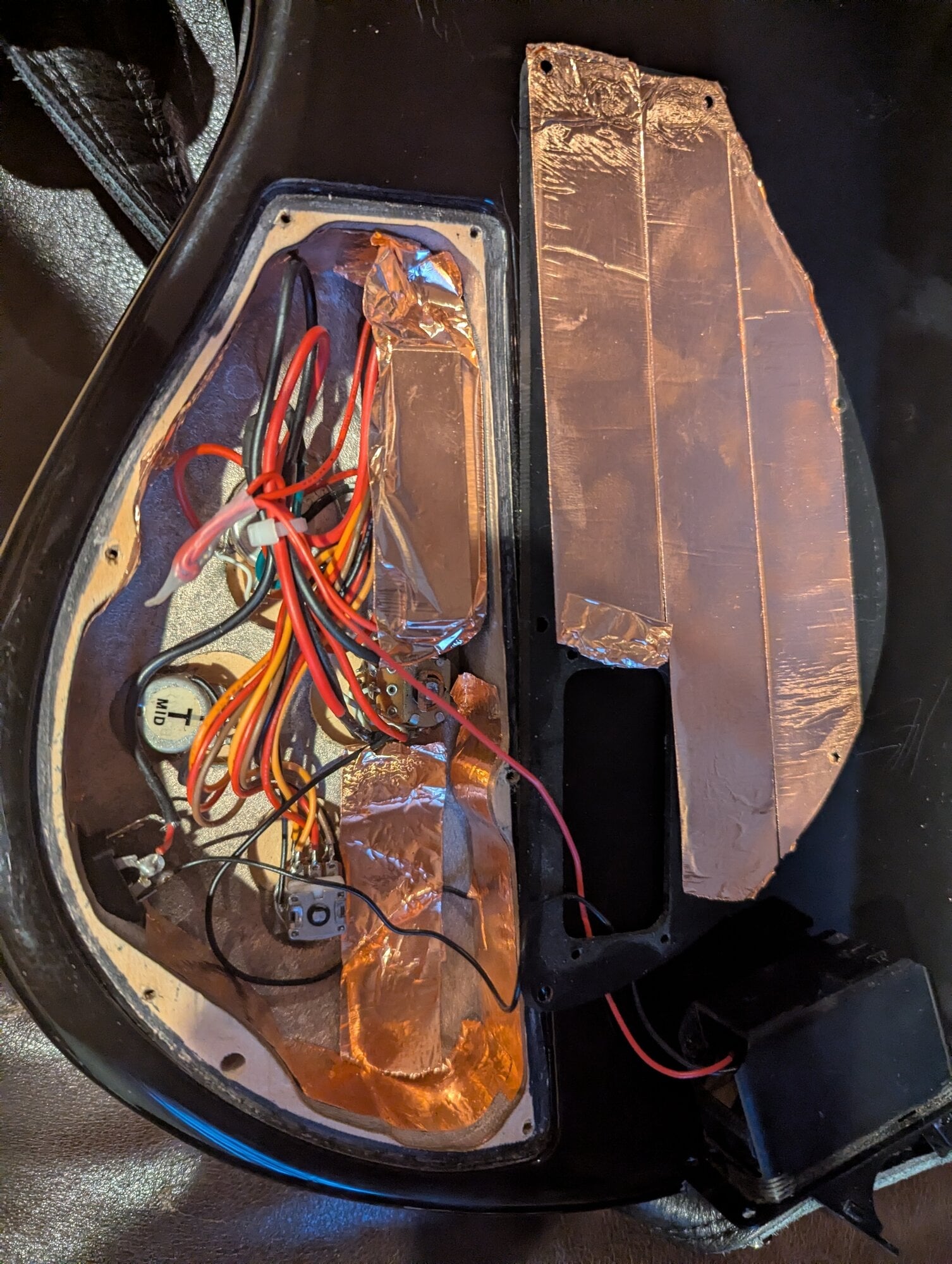
1000005348.jpg

Whoever did this didn't even bother to take out the pots, just jammed some copper tape in the easiest to reach spots and called it a day. No wonder the noise floor on this bass was through the roof, they pretty much created an antenna!

After about an hour of work, it's now properly shielded. But it got me wondering if anyone has examples of even worse shielding attempts... I'd get a kick out of seeing your pics , or reading your descriptions!
 
Over the past year I've been collecting Godin basses. They have great bones, but Godin doesn't shield them, so I learned how to shield an instrument.

Today I finally got around to shielding the first Godin I bought, a BG5. A previous owner made a thoroughly half-assed attempt to shield it, and I thought that some of you might find it entertaining: View attachment 7503343
Whoever did this didn't even bother to take out the pots, just jammed some copper tape in the easiest to reach spots and called it a day. No wonder the noise floor on this bass was through the roof, they pretty much created an antenna!

After about an hour of work, it's now properly shielded. But it got me wondering if anyone has examples of even worse shielding attempts... I'd get a kick out of seeing your pics , or reading your descriptions!
Yeah, that mess is not stopping anything. Possibly creating issues as you say.
 
  • Like
Reactions: tindrum
i recently did some work on my backup bass, a Chineese made Peavey Grind BXP. the pickups were bland and the pots were not at all linear in response, more like a digital volume knob...

the pup cavities needed to have the routing finished. there was a ramp in the neck cavity and just a mess in the bridge one. but they used that black "conductive" shielding paint in the controls cavity...nope. that stuff was just black paint. worthless. i also found that the grounding wire from the bridge was sitting, free-air , in the G string through hole. it had never been in contact with the bridge.

it is now properly grounded/shielded. i installed a new solderless pre-wired harness from Fat Bass Tone (V/B/T/T, original was V/V/T/T) along with the Bartolini pups that i took out of my BTB 740. (that's got some new Nordstrand Big Splits now) also put a set of GHS Precision Flats and some new knobs on. it's like a new bass.

From this:
IMG_5535.JPGIMG_5536.JPG

to this:
IMG_5538.JPGIMG_5539.JPGIMG_5600.JPGIMG_5601.JPGIMG_5602.JPG

i ran a wire from each pup cavity to the controls cavity and soldered them to the shielding. tied that into the ground on the pots along with the bridge wire. it's dead quiet, has good continuity between every metal part and the ground bus and sounds 100% better with the Barts. The pups sound better in this one than they did in the BTB. i want to find someone with a 3D printer to make some vanity rings for the pups as they are a bit smaller than the originals, but that's purely cosmetic and really not needed.
 
Last edited:
I'm not an electrical engineer. My understanding is that shielding the control cavity does not really add much value (juice is not worth the squeeze). Sheilding the pickup cavaties - most definitely. But again, my understanding is that pots, output jacks etc. do not pickup extra noise. In fact, if anything critical in the control cavity touches the shielding it can cause unwanted results.
 
I'm not an electrical engineer. My understanding is that shielding the control cavity does not really add much value (juice is not worth the squeeze). Sheilding the pickup cavaties - most definitely. But again, my understanding is that pots, output jacks etc. do not pickup extra noise. In fact, if anything critical in the control cavity touches the shielding it can cause unwanted results.
Not correct in my opinion.
 
Glad to see you finished the job and I'm guessing your battery pack is under that rectangular shielded object, but I'm not sure if that's a good idea and hope someone else will weigh in. I've never grounded a battery pack except to connect the two leads. My thought would be not to introduce any grounding to the area of the electric charge and the negative lead of the battery pack would go to the jack and any other grounding would be from there.
 
  • Like
Reactions: DJ Bebop
Over the past year I've been collecting Godin basses. They have great bones, but Godin doesn't shield them, so I learned how to shield an instrument.

Today I finally got around to shielding the first Godin I bought, a BG5. A previous owner made a thoroughly half-assed attempt to shield it, and I thought that some of you might find it entertaining: View attachment 7503343
Whoever did this didn't even bother to take out the pots, just jammed some copper tape in the easiest to reach spots and called it a day. No wonder the noise floor on this bass was through the roof, they pretty much created an antenna!

After about an hour of work, it's now properly shielded. But it got me wondering if anyone has examples of even worse shielding attempts... I'd get a kick out of seeing your pics , or reading your descriptions!


7u59op-1327561665.jpg
 
I'm not an electrical engineer. My understanding is that shielding the control cavity does not really add much value (juice is not worth the squeeze). Sheilding the pickup cavaties - most definitely. But again, my understanding is that pots, output jacks etc. do not pickup extra noise. In fact, if anything critical in the control cavity touches the shielding it can cause unwanted results.
interesting take

you don't know about electronics or electricity, but you have a strong enough opinion to post it here.

you would be the first person i have ever heard say that shielding doesn't do anything. you might actually have a stronger argument about the pickup cavities not needing shielding since many modern pickup manufacturers shield the pickups themselves.

simple question for you though. if, like you state, shielding the control cavity "does not really add much value" then why do manufacturers go through the trouble of using the conductive paint in there? surely if there was no "juice" to be squeezed, they would simply skip this step and save the material and labor costs involved. as you can see from the pictures i took, this particular manufacturer chose to only paint the control cavity and did nothing to the pickup cavities.

you were misinformed about the effectiveness of shielding the various components of the instrument. your lack of understanding of some basic electronic principals allowed you to take this information and treat it like actual fact, then regurgitate it here as an alternate viewpoint. albeit one with no factual basis.

fwiw, i am an Electronics Technician and i understand how electrical interference works and how shielding low voltage systems that carry low current signals will help to shunt any unwanted induced signals to ground thus allowing a cleaner signal to propagate through the circuit.

kgb
 
Glad to see you finished the job and I'm guessing your battery pack is under that rectangular shielded object, but I'm not sure if that's a good idea and hope someone else will weigh in. I've never grounded a battery pack except to connect the two leads. My thought would be not to introduce any grounding to the area of the electric charge and the negative lead of the battery pack would go to the jack and any other grounding would be from there.
Yeah, the battery pack was a bit of a conundrum for me. I couldn't figure out a way to encapsulate it within the shielding.

So instead I ensured that there was no connection between the copper tape and the leads to the battery, using electrical tape as an insulator, then applied the copper tape to the outside of the battery pack. The battery is outside of the Faraday cage.