• TalkBass has been independent since 1998. Add your voice.
    Create a free account to reply to discussions, view embedded media, and browse with fewer display ads.
    Join freeLog in
    Want zero display ads or expanded classifieds tools? Compare plans.

Double Bass Would You Move This Bridge?

Steve Freides

Former Mannes College Theory Faculty
Supporting Member
Dec 11, 2007
2,576
1,508
Ridgewood, NJ
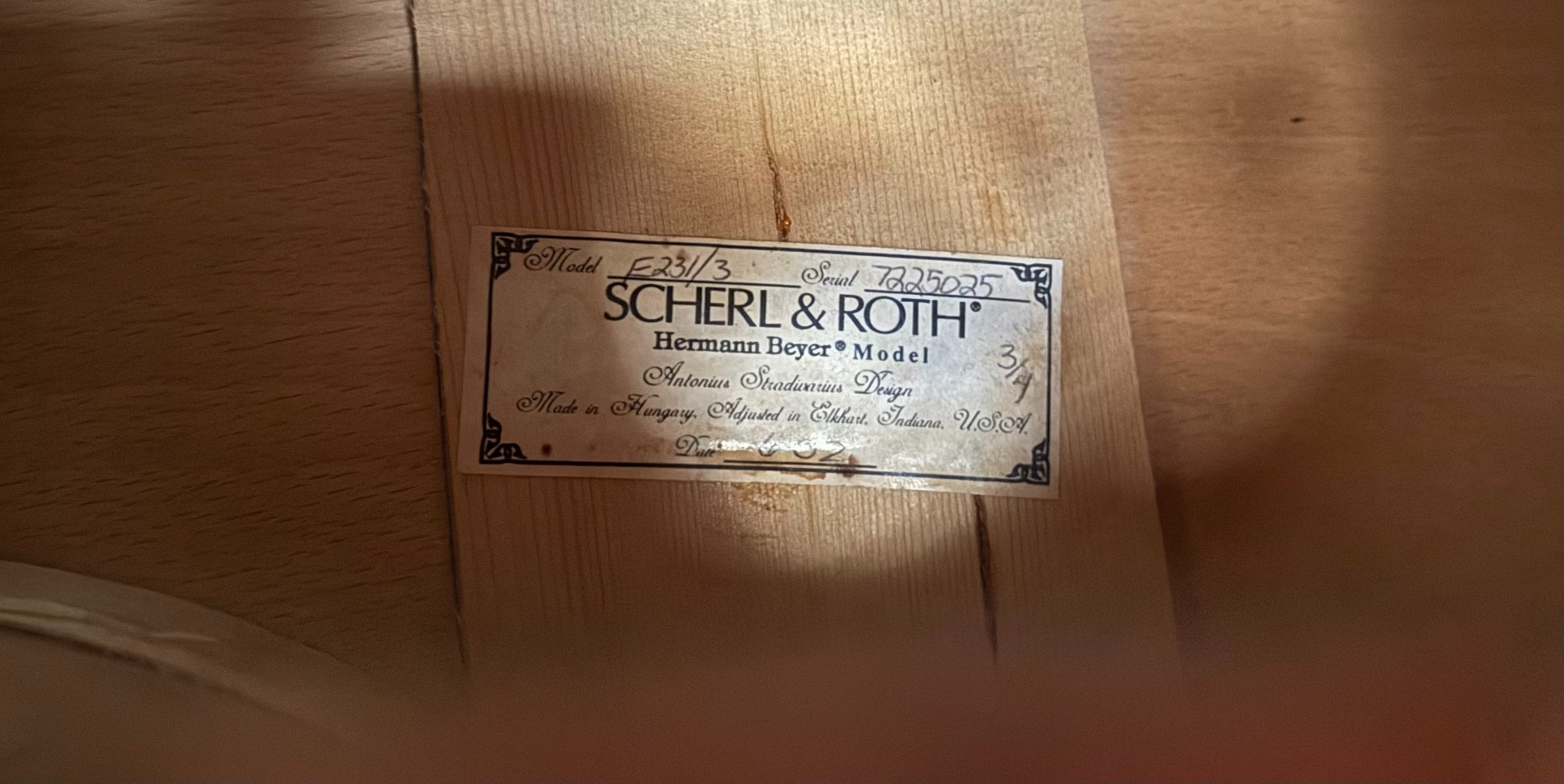
I bought this bass recently to keep in my teaching studio for those students who can't bring their own bass to their lessons. Plays pretty OK. Strings are a motley crew and I'm about to change them. My questions are about bridge position and should I leave change it.

The bridge feet's bottom edges line up with the inner F-hole notches. The bridge feet measure 2 cm so I'm talking about moving the bridge 1 cm South so that the bridge is centered North-South on the notches. NB: I have seen crappy rental basses with the bridge further North then it should be to raise an unplayable low action. This is doesn't seem to be that, I don't think.

I measured the action, at the end of the fingerboard, to be 10 mm on the G and 11 mm the E side.

I looked at the bass head on and the strings are further away from the edge of the fingerboard on the E side, and the bridge measures 50 mm from the E-side foot to the f-hole and 53 mm on the G-side, so moving the bridge towards the G side by 1.5 mm would center it but would probably make the G string closer to the edge of the fingerboard, so maybe where it is now is a good solution overall. Perhaps the fingerboard is curved in the left-right plane - that's not something I can see.

I feel like I know enough to do something stupid. 1.5 mm to the side seems not a good idea, and 1 cm towards the tailpiece seems like it could be a good idea but then why didn't anyone do this before?

I could take the bass to a luthier and have a setup done, but I'm interested to understand more and possibly to small things like this myself if that's not terribly stupid of me. Eventually this bass will get an adjustable bridge, which it doesn't have now, but, well, I need to pay off a few bills first - you know how that is ...

Thanks in advance for your replies.

-S-
IMG_7701.jpg
 
Non-luthier disclaimer
I encounter many basses in my school district that were once set up fine, but end up getting bumped around and not corrected over time. When you sight down the length of the neck from the nut, does the bridge appear to be centered relative to the fingerboard edges, and are the strings where you would expect them to be relative to the edges of the FB? Could you share a photo from above the nut to the bridge? If it appears centered, the neck may be set in at a slight angle relative to the center of the body- in that case, I would leave its left/right position alone and focus on getting the north/south placement. When you move the bridge toward the tailpiece, you will effectively lower the string height at the end of the fingerboard. I would do this first.

Then your soundpost placement relative to the G foot needs to be taken into account.
 
There are several moving parts to this, not just the bridge.

If it plays okay, as you say, you'll want to be clear on what problem you hope to solve before you get into setup changes. A shorter mensure may be the right thing for your next student, after all, at least in the short term. Does it bow as well as pizz?

Ideal mensure for a 3/4 is in the 42"-41-1/2" range. As you move the bridge south, you'll lower the strings relative to the fingerboard. If you have bridge height adjusters, you have options there. More important, you'll also be changing the relationship between the bridge and soundpost, which can make a big difference, and random change rarely makes that difference positive. The thing is, we don't know whether the bridge is still in the position it was last set up for. The good news is that you can move it, tune it up, try it out, see whether it's better or worse, and put it right back, if you prefer.

You're correct that centering the bridge is ideal, but we don't know how the bridge was set up in terms of slot positions and heights. If the strings work for the player, the exact centering of the bridge won't matter much. New strings will change the feel, and you may find it needs setup adjustments then.
 
Could you share a photo from above the nut to the bridge?
Please see below.

Ideal mensure for a 3/4 is in the 42"-41-1/2" range
It's currently about 40-1/2" or 103 cm.

The action is high, but my student isn't playing anything further up than D on the G string yet and the action feels OK that far, gets to feel a little high above that, and gets to feel a lot too high in the second octave..

Does it bow as well as pizz?
Seems fine for both. We mostly bow here.

Action plan:
See if anyone responds to what's below and why, modify if necessary. Assuming this is OK, then:
  • Loosen the strings some.
  • Move the bridge 1 cm South to where it's centered on the notches.
  • Tune it back up and see what differences I notice, and decide which bridge position to use based on that.
  • Not move the bridge side to side because that would make the position of the strings over the fingerboard worse, not better.
  • Live with that for a day or two.
  • Restring the bass.

IMG_7705.JPGIMG_7706.JPGIMG_7707.JPGIMG_7708.JPG

-S-
 
Last edited:
I bought this bass recently to keep in my teaching studio for those students who can't bring their own bass to their lessons. Plays pretty OK. Strings are a motley crew and I'm about to change them. My questions are about bridge position and should I leave change it.

The bridge feet's bottom edges line up with the inner F-hole notches. The bridge feet measure 2 cm so I'm talking about moving the bridge 1 cm South so that the bridge is centered North-South on the notches. NB: I have seen crappy rental basses with the bridge further North then it should be to raise an unplayable low action. This is doesn't seem to be that, I don't think.

I measured the action, at the end of the fingerboard, to be 10 mm on the G and 11 mm the E side.

I looked at the bass head on and the strings are further away from the edge of the fingerboard on the E side, and the bridge measures 50 mm from the E-side foot to the f-hole and 53 mm on the G-side, so moving the bridge towards the G side by 1.5 mm would center it but would probably make the G string closer to the edge of the fingerboard, so maybe where it is now is a good solution overall. Perhaps the fingerboard is curved in the left-right plane - that's not something I can see.

I feel like I know enough to do something stupid. 1.5 mm to the side seems not a good idea, and 1 cm towards the tailpiece seems like it could be a good idea but then why didn't anyone do this before?

I could take the bass to a luthier and have a setup done, but I'm interested to understand more and possibly to small things like this myself if that's not terribly stupid of me. Eventually this bass will get an adjustable bridge, which it doesn't have now, but, well, I need to pay off a few bills first - you know how that is ...

Thanks in advance for your replies.

-S-
View attachment 7165092
Is the bridge adjustable? It sounds like the E side of the bridge is way too high with the feet pushed to the E side and the strings aligning to the G side.
 
Before you move the bridge, check for relative neck heel position. If it's, for example, almost a D-neck and after the movement it becomes a D-neck, then you can be quite sure the "new" position is the originally intended one. In my limited experience, you'll know the difference immediately if you find the right spot.
 
  • Like
Reactions: RSBBass
Quoting myself here:

Action plan:
See if anyone responds to what's below and why, modify if necessary. Assuming this is OK, then:
  • Loosen the strings some.
  • Move the bridge 1 cm South to where it's centered on the notches.
  • Tune it back up and see what differences I notice, and decide which bridge position to use based on that.
  • Not move the bridge side to side because that would make the position of the strings over the fingerboard worse, not better.

I've just done all the above - I notice no difference. I'd say the bridge is a little warped but I've seen worse - should be OK for a while.

  • Live with that for a day or two.
  • Restring the bass.

Take it to Jay.
That will happen but I'm enjoying learning here. Probably take it to Jay a couple of months from now.

-S-
 
  • Like
Reactions: Earl
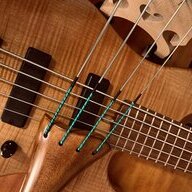
What are these strings?
Chinese cheese cutters?
Unusual colors at the tuners.

I just changed the strings and posted the old one - the ones in the pictures - for $1 plus shipping. IDK what they are, but they didn't sound bad. The Bel Canto's I just put on there sound better, but the old ones were OK. The D is from another set but didn't sound mismatched to my ears.

EDIT: https://www.talkbass.com/classifieds/old-but-working-strings-for-a-dollar-plus-postage.1665986/

-S-
 
Last edited:
  • Like
Reactions: Francois Blais
About moving the bridge side to side, I'm not a luthier, but... my old student cello had a crooked neck, and the bridge had to be moved to the side, just to make it playable. As a result, the bridge foot was not directly above the bass bar. My teacher was OK with that, and I played that cello through high school.

A few years ago I decided on an experiment, to cut a bridge with one leg longer than the other, to get the strings into a playable position while also letting the bass side foot sit over the bass bar. The experiment worked. It's still not a super great cello, but playable. I described it to my luthier, and he told me that while my cello is a rather extreme case, using the bridge to take care of minor alignment issues is preferable to disassembling an instrument that might not be worth the cost of a full restoration.
 
@fdeck, great minds think alike and so do yours and mine. :) I ended up moving the bridge down towards the tailpiece a little, 1 cm if memory serves, and for side-to-side, I decided that having the strings in the right place over the fingerboard was the higher priority so I basically left that aspect of things as they were. It looks centered left-to-right until you measure it, and then the two measurements differ only by a couple of mm. The bass works, it sounds pretty nice with a set of used Bel Canto's I bought for $100 here on TB, and it's performing in its intended role beautifully. It turns out to be on the short-ish side in terms of string length, so that extra 1 cm is a welcomed addition.

Saturday, I bought two used guitars for $100 for the pair, a Fender acoustic 3/4 and a MIM Tele. Both need some setup work, and I'm considering making - likely buying partially made - a nut from Stew-Mac and replacing the nut myself. That and truss rod adjustments are about as much lutherie as I'm up for - cutting a double bass or cello bridge is something I consider out of my league.

-S-
 
  • Like
Reactions: fdeck
A $50 MIM Tele? That may be a better deal than my $300 non-Formica Martin.
Yup. I was responding to a FB Marketplace ad for the 3/4 size acoustic, and when I got there, the person selling also had this, was into downsizing, and said she'd be happy with $100 for the pair. I just looked it up on Fender's site: FENDER STD HSS STRAT MN BLK 05/2007 - website says it's an upgraded model with a humbucker in the bridge position, but I though they were all like that.

Anyway, back to basses.
 
  • Like
Reactions: KUNGfuSHERIFF