
Enjoy the benefits of a premium membership!
Upgrade Account
-
TalkBass has been independent since 1998. Add your voice.
Create a free account to reply to discussions, view embedded media, and browse with fewer display ads.
Join free Log in
Want zero display ads or expanded classifieds tools? Compare plans.
You are using an out of date browser. It may not display this or other websites correctly.
You should upgrade or use an alternative browser.
You should upgrade or use an alternative browser.
You Can Build It
- Thread starter alder
- Start date
More options
Who Replied?
I've never understood mounting screws at the front of a bridge plate. Given that the tension of the strings is applied at the back of the bridge, and also the downward force of the string at the saddles, there should be no uplift at the front of the bridge. There should actually be a downward force pressing the bridge into the body. Similar to how you don't really need rack screws in the top two holes of a rackmount piece of equipment. The force of the piece hanging in the rack presses it against the rack rails... now if you were to store your rack upside down, that'd be another story... but I digress.
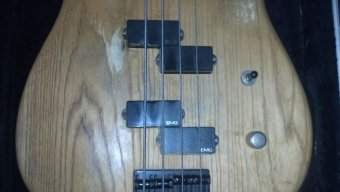
Anyway, nice build! Glad it sounds as good as it looks. Dual-P is one of my favorite pickup configs. It's a shame it's not more common. I can only imagine how many great sounds you'd be able to get in an active setup with your fat and skinny switches.
Anyway, nice build! Glad it sounds as good as it looks. Dual-P is one of my favorite pickup configs. It's a shame it's not more common. I can only imagine how many great sounds you'd be able to get in an active setup with your fat and skinny switches.

Years ago I had a can of real Tung oil. It was great stuff, smelled horrible. Nowadays you can't even buy real Tung oil. Thanks for the head's-up on that. So far the teak is taking in the oil pretty well. If it appears that I have over-oiled it, a rag with mineral spirits should clean things up. One time I tried Danish oil on a rosewood fretboard. Don't. I ended up scraping the gunk out from between the frets with a razor. I like linseed oil for fretboards - a thin coat will last a long time. Lemon oil is junk, and it is hilarious that GC will sell you a perfume bottle of it for $15.
The body is looking better and better. The oil is not disappearing as fast into the grain, and it is starting to shine. That makes the edge contours stand out a lot better. I think this wood may have been extra-dried or de-oiled somehow before gluing. This is one of the prettiest pieces of woodwork I've ever done, especially considering its lowly origin.
Tung Oil is still available, mostly at Unfinished Furniture stores like Simply Woods, Wood You, etc...
some carry the real thing AND the modified Tung Oil Finishes...know which you are getting.
Tung Oil - Woodwork Details
Also, Oil has to be re-applied periodically...unless covered with wax or other Finishing product

Yes, there should be a downward force on the front edge of the plate. But do the math - it is going to be pretty small. If your body wood is soft, like most of them, the screws at the back are going to crush the back of the bridge into the wood, and the front edge is going to lift. Not always, but often, and it bugs me. You're also forgetting the shear force -- the straight pull -- which is much greater. So ... not absolutely necessary, but nice to have. I'd rather have four screws, one in each corner, than five across the back.
I don't have my textbooks handy, but I'd bet money that the shear capacity on even two screws is more than enough. But yes, you're technically correct, which is always the best kind of correct.

Anyway.... sorry for the derail! On with the show!
Last edited:

Update:
View attachment 2835036
Here is the blank with the faces sanded smooth. I used half a sheet of 80 on the pad of a broken pole sander, you can see it at the right. You can get the same effect with a thin mousepad glued to a piece of wood. For the most part, I held the 'sander' across the grain (as it is in the picture), occasionally aligning it along a ridge to carefully work it down. You have to look hard to see the joints now; the back looks even better. Next time I will make the blank symmetrical, so that I can select either side for the front. The loss of thickness is hardly noticeable, and as I run my hands over it, it just feels smooth and flat - no ridges, hills or valleys. And this is just the rough-in.
It took a good bit of elbow grease, especially the back, since in aligning the front I pushed all the defects to the back. I did not want to use a belt sander, because the power tool can easily dig away more than you'd want and leave gouges. Hand sanding took longer, but came out perfect, with the absolute minimum removal of material. Between the gluing and the sanding, this is really not all that much work. And not too much mess either - the sawdust didn't fly much, and will be easy to vacuum up. This blank right now weighs 5.6 pounds.
I have redrawn the outline and applied some mineral spirits to see the grain. This blank is beautiful, and I made no attempt at grain matching, the pieces in the store were selected strictly for straightness. The grain is nicer than Alder, and the color is nicer than Poplar, and as I said, the wood itself is noticeably harder than either of those. I think this is at least as nice as what you can buy, at a fraction of the cost. You can also see how little waste there is with this method. Next up for this project is to route the neck pocket.
If this works, and I don't see why it won't, it is revolutionary. A really nice, if not superior, easy-to-build solid wood guitar body blank from Home Depot, for less than $20 !!! I say revolutionary because, although I have seen people do this with white pine, the result of that is pretty crappy, while the result of this is better than standard expensive 'luthiery' materials. And while the teak cutting board worked out great, that is a $90 item, I only used it because I got it for free. I much prefer the 1-1/2" thickness of either of these solutions to the 1-3/4" or more of many 'proper' guitar blanks. For my next trick, maybe I'll build a guitar out of popsicle sticks.
Ok, at risk of being dumb, school me on radiata. If it's not labeled as such, what am I looking for when I wander into Home Depot?

- Jun 30, 2010
- 49,636
- 222,260
- Disclosures
- musician/artist/owner - Gildaxe

Here in the Northeast ( and probably everywhere ) Home Depot sells two grades of wood: Number 1, which they label as 'Select', and Number 2. Number 1 costs about twice as much as Number 2. Lowes is similar. Both grades are pine, not hardwood.
Number 2 wood is very light colored and lightweight, and soft - you can make a mark with your fingernail without even trying. I assume this is ordinary Eastern White Pine, Invalid Link Removed. Apart from the qualities of the wood, the boards themselves are lesser quality, often with with large knots, voids, and warping, although if you pick through you can usually find better ones. However, the softness makes this material a non-starter for a guitar body.
Number 1 wood is much more expensive, equal to what they charge for hardwoods like oak. Compared to Number 2 wood, it is noticeably heavier and harder, with a slightly darker color. The 'fingernail test' takes a good deal of effort to make a mark. The boards themselves are also of much higher quality - straight grain, no knots or voids, and very little if any warping. In every case, I have found this material to be Radiata Pine, Pinus radiata, although in the south it could turn out to be some kind of locally grown 'Yellow Pine'.
Here are some relevant stats for several woods, all of which can be found at the hardware store:
White Pine:
Janka Hardness: 380 lb
Density: 25 lb/cuft
Poplar:
Janka Hardness: 540
Density: 29
Radiata Pine:
Janka Hardness: 710
Density: 32
Maple (hard):
Janka Hardness: 1450
Density: 44
Red Oak:
Janka Hardness: 1220
Density: 44
Teak (cutting board):
Janka Hardness: 1070
Density: 41
Masonite:
Janka Hardness: 1200
Density: 75
Plywood (Baltic Birch):
Janka Hardness: 1260
Density: 43
Also not hard to get, but not at Home Depot:
Walnut:
Janka Hardness: 1010
Density: 38
Compare to typical 'luthiery' woods:
Red Alder (California firewood):
Janka Hardness: 590
Density: 28
Black Ash:
Janka Hardness: 850
Density: 34
African Mahogany:
Janka Hardness: 1070
Density: 40
Basswood:
Janka Hardness: 410
Density: 26
Koa (African construction timber, cheap and common):
Janka Hardness: 1170
Density: 38
Brazilian Rosewood (now illegal):
Janka Hardness: 2790
Density: 52
For fun, here are the two extremes:
Balsa:
Janka Hardness: 67 ( styrofoam = 40 !!! )
Density: 9
Lignum Vitae:
Janka Hardness: 4390
Density: 79
And finally, my favorite fretboard woods, which you can mail-order online in convenient sizes at reasonable prices:
Jatoba (Brazilian Cherry, flooring):
Janka Hardness: 2690
Density: 57
Bocote:
Janka Hardness: 2010
Density: 53
Purpleheart:
Janka Hardness: 2520
Density: 56
Pau Ferro ('rosewood' substitute):
Janka Hardness: 1960
Density: 54
Wow, this list has expanded to cover all the woods I would consider using in an electric guitar or bass. Of all these woods, there is one that you could conceivably build an entire guitar out of - body, neck, and fretboard: Hard Maple. The other major factor for wood is strength or stiffness, but all of these woods are strong enough for their usual purposes, so it doesn't matter. Of these woods, I would only build a neck out of maple.
What you want in a body wood is something that is hard enough to work and wear well, but not too heavy. Poplar turns out to be a good stand-in for alder, and you can find large pieces of it at some lumberyards, sometimes wide enough for a smaller one-piece body. However, Radiata is even better than Poplar - it is harder and better looking. Using the glue-up method, you can build a nice blank of any size. Those large poplar pieces have also turned out to have problems of their own, especially cracking. A laminated board like this should be much more resistant to that.
Note that Radiata is harder than both Alder and Poplar, which are 'hardwoods'. It is somewhat heavier, but not excessively so. Also, note just how soft Basswood is - unless you put it under a hard protective coat of polyurethane, it is going to wear very badly. Paulonia is even softer - stay away! In terms of weight, maple and oak are much too heavy for a full-thickness guitar body, that is why Rics are all thin or chambered. Mahogany ( and Teak ) are on the border of too heavy. Put a Maple cap on a thick Mahogany body, and you get a boat anchor, I mean Les Paul. Oak has nothing to recommend it except possibly as a fretboard wood.
Radiata pine is native to Southern California, where it was well on the way to extinction ( with no help from us ) until somebody realized that this stuff is frickin' awesome. The trees are now farmed all around the world, much of what I have used came all the way from New Zealand. The farmed trees are carefully pruned and tended, and as a result the wood is straight and free of knots. It is some of the finest wood I have ever seen, and you can get it at Home Depot.
The Radiata story is not unique. The best way to save a species is to work out some good recipes for it. How many chickens and cows are there in the world now? Coincidentally, the best way to exterminate a species is also to work out some good recipes for it. South Korea had a plague of Bullfrogs brought in by the GIs as pets and released. The South Koreans started eating them, and now they are hard to find. I'm sure some enterprising Koreans are now farming them. North Korea wishes they had bullfrogs.
So it comes down to one final matter for Radiata: the all-important "tap test." When I tap it, it sounds like wood. Clearly I am not qualified to perform this test. Perhaps some day enough 'luthiers' will tap this wood to pronounce it "tone". Until then, I'm just going to use it and hope for the best.
Thank you sir. I will look into it next time I'm in HD. Hopefully, they will have it. I know the Home Depot's and Lowe's here do not have maple although the ones in Idaho did. They do have walnut and cherry, however. Could be laminated up for a neck.
For the "tap test" you just need to tap the board on your forehead. Tap hard enough and it will have a "bell like" or "ringing" tone.


Maple (hard):
Janka Hardness: 1450
Density: 44
[...]
Plywood (Baltic Birch):
Janka Hardness: 1260
Density: 43
[...]
Of these woods, I would only build a neck out of maple.
First, I don't know anything. But going by the numbers those don't seem that far off. So if you laminated void-free ply with the plies perpendicular to the fretboard, and IF the ply glue is good enough, why wouldn't that be a reasonable alternative to one piece of hard maple? If there isn't something else wrong with my thinking, it seems like the ply version would be less likely to twist. The ply glue seems like a reasonable point of failure, but I've never seen it discussed, and I did search a few times. There has to be a good reason people don't already do this, and I'm holding my breath hoping you're the one to explain it once and for all!
First, I don't know anything. But going by the numbers those don't seem that far off. So if you laminated void-free ply with the plies perpendicular to the fretboard, and IF the ply glue is good enough, why wouldn't that be a reasonable alternative to one piece of hard maple? If there isn't something else wrong with my thinking, it seems like the ply version would be less likely to twist. The ply glue seems like a reasonable point of failure, but I've never seen it discussed, and I did search a few times. There has to be a good reason people don't already do this, and I'm holding my breath hoping you're the one to explain it once and for all!
Aesthetics?
one problem: it is very difficult to hide the edge grain of plywood. No matter how you fill it, it eventually pulls through, a glass finish is impossible.
Since I clearly don't care about aesthetics, are you also saying the physical surface will become uneven over time? Does that also mean that gluing a fretboard to ply end-"grain" will eventually de-laminate? Or that the lamination structure is unstable over time? If there aren't big structural problems with this, I want to try it for my first neck build, because I have HAD IT with what's left of my sanity. I expect to fail and learn.
I have another project in mind for which the Radiata laminate body would be perfect, so thanks for the research!
I like maple too, but I like stability more!
I have my eye on Rocklite. I'm also terrified of finishing and will likely pay for it.
Your feedback is awesome and appreciated!
Don't use plywood for the fretboard!
I have my eye on Rocklite. I'm also terrified of finishing and will likely pay for it.
Your feedback is awesome and appreciated!
Last edited:
I like where you're going with this. It's quite inspiring to see what can be done with what measly tools I have on hand.
You spoke earlier about not being able to use this method with 2x4s due to the rounded edges. Just wanted to note that sharp edges could be achieved if one had access to a table saw or a router with a fence/guide.
You spoke earlier about not being able to use this method with 2x4s due to the rounded edges. Just wanted to note that sharp edges could be achieved if one had access to a table saw or a router with a fence/guide.

- Mar 8, 2011
- 12,232
- 51,187
- Disclosures
- Authorized greenboy designs builder/Owner of BNA Audio
If it won't affect the balance, the top horn is a bit long for my tastes, but it's a good looking body layout!
I once bought a bridge like that but never used it. It was just a piece of crap. It had very poor build quality and tolerances. I recommend Hohner Steinberger licenced bridge/tuners as cheaper end alternative.
[Invalid or Expired Link Removed]
Invalid Link Removed
I don't have the bridge anymore. I've used a few Hohners and they are well made.
Invalid Link Removed
I don't have the bridge anymore. I've used a few Hohners and they are well made.
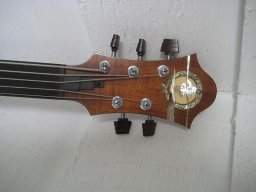
Thanks Alder for this long, interesting and entertaining build thread! It's been really fun watching your progress on these builds and I love the way the Osprey turned out. I also really appreciate how generous you've been with both the knowledge you already possessed and the additional knowledge you're picking up along the way. Any would-be builder who reads this thread - if they are paying attention - will be spared quite a few pitfalls thanks to your freely sharing your experience.
This thread started out as a primer for those who wanted to obtain top-notch results using only the simplest of tools and materials - and it reached and exceeded that goal IMO. It's still reaching that goal, but there seems to be a lot more emphasis now on mocking established lutherie techniques and beliefs as hogwash, mumbo-jumbo, snake oil, etc...
Yeah, there's a lot of marketing hype in lutherie. There's a lot of marketing hype in just about anything that's being marketed for that matter. And yeah, the "tonewood" and "tap test" ideas (which actually mean something in the building of acoustic instruments) have been taken much too far and much too literally in many cases. I'm not saying you're wrong to call them out on this stuff, but if you're not careful you just might find that you've beaten a dead horse into the very hide glue you can't think of a good reason to use! It's nothing personal; I'd just hate to see such a really informative thread degenerate into a(nother) tonewood rant.
Please keep up this great thread - I've learned a lot already! Thanks!
This almost made me choke on my coffee.StewMac even copied this design.
Well, I wasn't going to, but since you asked....Comments? Suggestions?
This thread started out as a primer for those who wanted to obtain top-notch results using only the simplest of tools and materials - and it reached and exceeded that goal IMO. It's still reaching that goal, but there seems to be a lot more emphasis now on mocking established lutherie techniques and beliefs as hogwash, mumbo-jumbo, snake oil, etc...
Yeah, there's a lot of marketing hype in lutherie. There's a lot of marketing hype in just about anything that's being marketed for that matter. And yeah, the "tonewood" and "tap test" ideas (which actually mean something in the building of acoustic instruments) have been taken much too far and much too literally in many cases. I'm not saying you're wrong to call them out on this stuff, but if you're not careful you just might find that you've beaten a dead horse into the very hide glue you can't think of a good reason to use!
It's nothing personal; I'd just hate to see such a really informative thread degenerate into a(nother) tonewood rant.Please keep up this great thread - I've learned a lot already! Thanks!
Sorry, I shouldn't have assumed. I've copied so many of their tools I just figured everybody did!I had my design posted up here long before they came out with their product. Either they copied it, or it is quite a coincidence.
Latest posts
-
 Selling a member that is not new, but only has 1 post?
- Latest: monsterthompson
-

-

-

-
