
Enjoy the benefits of a premium membership!
Upgrade Account
-
TalkBass has been independent since 1998. Add your voice.
Create a free account to reply to discussions, view embedded media, and browse with fewer display ads.
Join free Log in
Want zero display ads or expanded classifieds tools? Compare plans.
You are using an out of date browser. It may not display this or other websites correctly.
You should upgrade or use an alternative browser.
You should upgrade or use an alternative browser.
You Can Build It
- Thread starter alder
- Start date
More options
Who Replied?

We'll, since you mentioned tone woods.... just kidding 
I'm actually really excited to see how this goes. Looks like a good job so far, an interesting shape(love 80's guitars), and a good looking piece of wood.
Keep us posted.
-Jake
I'm actually really excited to see how this goes. Looks like a good job so far, an interesting shape(love 80's guitars), and a good looking piece of wood.
Keep us posted.
-Jake

I've like the Eagle for a long time. That's a nice looking piece of umm..... cutting board? 

I'll be watching this one.
I'll be watching this one.

Not about tone woods, but I am sure that board will help the bass cut through the mix!
Seriously though, thanks for doing this detailed write up with pics. We can never have enough documented build threads!
Seriously though, thanks for doing this detailed write up with pics. We can never have enough documented build threads!
Looks great. I'd go buy a teak cutting board if they weren't so expensive.
I agree on the spindle sander. For body outlines, I've started to really like using a pattern and a Robosander. A little more effort than the router but no tear out.
I agree on the spindle sander. For body outlines, I've started to really like using a pattern and a Robosander. A little more effort than the router but no tear out.

Subbed.
I'm with you on a the chuck key leash.
I share a car restoration workshop with 5 other guys and anything that can go astray does. The first thing I did was tether a tea spoon near the kettle, we have several but at least you can always find one now (even if it does need wire brushing). Next up was the chuck key to the pillar drill and the mains electric drill has the chuck key zip tied to the cable.
I'm with you on a the chuck key leash.
I share a car restoration workshop with 5 other guys and anything that can go astray does. The first thing I did was tether a tea spoon near the kettle, we have several but at least you can always find one now (even if it does need wire brushing). Next up was the chuck key to the pillar drill and the mains electric drill has the chuck key zip tied to the cable.

So far so good. Have you thrown that thing on a scale yet? Curious to see what it weighs in the white...
B.C. Rich
from Wikipedia:
B.C. Rich is an American brand of acoustic and electric guitars and bass guitars founded by Bernardo Chavez Rico in 1969. The company started to make electric guitars in the 1970s that were notable for their atypical body shapes. In the following decade B.C. Rich gained a broader exposure with the popularity of heavy metal and has since often been linked to that music scene.
View attachment 2778090
Bernardo Chavez Rico ( born October 13, 1941 – December 3, 1999 heart attack ) was an American luthier specializing in guitars. Known as Bernie Rico Sr. or simply B.C., Rico was born in East Los Angeles, California. Working with his father, Rico began his career building Flamenco, Classical guitars, banjos, and ukuleles in the 1950s. Rico's original instruments were acoustic guitars made under the name B.C. Rico. These acoustic guitars are very rare, with about 300 surviving.
In 1967 the company name was changed to its present form, B.C. Rich. Also a motorcycle enthusiast, Rico's work on his motorcycle paint jobs inspired him to create unusual finishes for his guitars. Rico and his company went on to create several models of guitars and the company prospered.
View attachment 2778092
catalog page 1978
I've never had a chance to play with one of these, but from the description, the controls seem kind of wacky. Mine will have master volume - pickup selector - bass - treble, with two little switches for pickup options. The "Dual Sound" pickup switches on the real thing must be internal series/parallel. I'll use one 4pdt switch for both pickups together. A phase switch on a bass is silly - that must be a holdover from the guitar wiring. Instead, I will install another series/parallel switch between the pickups. I don't see the point of having a master volume and a separate preamp volume; in place of the Varitone I will have bass and treble controls, and the preamp power switch will be hidden on the master volume. So I will have fewer controls that do more - that's what you get from 40 years of progress. And I will still have a couple of little silver switches for that 80s "overdo everything" vibe.
I believe they used Dimarzio pickups in the early days and "dual sound"is, I believe, what their wiring instructions still call series/parallel switching on the humbuckers.
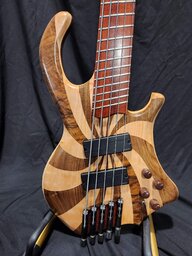
I've found that oily woods can mess with oil finishes. I used cocobolo for a fretboard and continued it with a laminate on the headstock. I finished the bass with Formby's Tung oil (which is not really tung oil). The tung oil on the headstock never dried, it just turned into a sticky mess. I finally wiped it off, polished it up as best I could then put some wax on it, the finish on the headstock wasn't quite the same luster as the body, but it was close.
If you don't want a sticky mess with Danish oil, don't let it dry on the surface. The idea is to wipe it on and keep the wood wet with the oil, adding more as it is absorbed into the wood. When it stops absorbing into the wood, wipe off the excess. After letting it dry sufficiently you can apply more. Doing it this way I've never had any stickiness at all.
Edit: forgot to add ... as it is drying, some oil may seep out, make sure to wipe that oil of the surface.
Edit: forgot to add ... as it is drying, some oil may seep out, make sure to wipe that oil of the surface.
Last edited:

You may have to be crazy but it looks wonderful.....Yes, those are the instructions on the can, and for this project I will probably do it that way. For many things, though, that's kind of useless. For furniture and even a couple of other guitars, I wanted to build a layer on the surface. That means multiple coats, letting them dry in between. Takes patience. This is Danish oil over walnut:
View attachment 2779229
You can see it shines like lacquer. That is the result of many many coats of Danish oil built up over weeks, and also wet-sanding in the oil to fill the grain. When the oil has dried out completely, you are left with a hard varnish surface. You have to be kind of crazy to do this, and I will never try it again.


If You're Going to Build a Guitar on Your Kitchen Table ...
View attachment 2780158
... you don't want to ruin the table !!!
The big brown rectangle is a piece of 3/16" Masonite. This makes a very inexpensive sacrificial top. I just wiped it down with linseed oil to make it purty again; a light sanding once in a while doesn't hurt either. And when it gets too grody, throw it out and get another. It's like a giant placemat. Here, I have a placemat on top of a placemat. What does that say about me? Probably nothing very good. On the screen you can see my favorite luthier's supply outlet. Here is the website:
www.HomeDepot.com
They're really great, they have all kinds of useful stuff, from tools to wood to fasteners. Eat your heart out, AllParts and StewMac. ( Just kidding, I love them too. )
What's that? You're asking "But Alder, what else can I do with Masonite?" That's an excellent question. You can do this:
View attachment 2780171
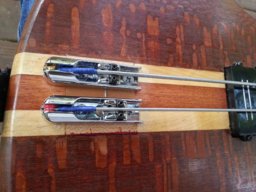
That is a real Danelectro Silvertone 1452 from the 1960s. When I got it, it was a sad box pf parts. Some hillbilly had stripped it, by rubbing it on the sidewalk, I think. The the fretboard had delaminated, and the old repair had simply made the problem permanent. I repaired the neck and fixed all the other issues, replaced the lipstick tubes, which had split, and clear-coated the whole thing in modern poly. What you're looking at is old-growth Masonite. There are very few of the big old Masonite trees left, and they are mostly in preserves. Modern Masonite is made from farmed trees. It is not the same, tone-wise, but you can still make a very nice guitar out of it. I was not able to fully repair the neck, there's just not enough wood left, so I don't keep it under tension. The pickguard is stained dark for contrast. I cleaned tarnish off the old metal bits with oven cleaner, and replaced all the corroded fasteners with shiny new stainless ones.



Fun fact:What you're looking at is old-growth Masonite. There are very few of the big old Masonite trees left, and they are mostly in preserves. Modern Masonite is made from farmed trees. It is not the same, tone-wise, but you can still make a very nice guitar out of it.
From a tradition of free Masoniters since George A. Washington. George (or honest Abe, as his friends came to call him after an incident with a cherry SG,) used to build his Danelectros from the old growth Masonite trees that were hewn to make way for his namesake city, Lincoln, NE.
:End fun fact.
You said that oak is a non-starter for building instruments. Out of curiosity, why is that? The weight, or ?
Or did it do REALLY bad on it's tap test?
Thanks,
Jake
Or did it do REALLY bad on it's tap test?
Thanks,
Jake
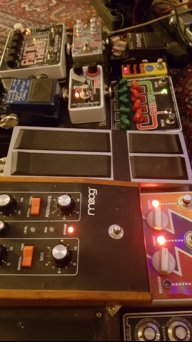

great work. Looks beautiful!
Want to hear some clips, now
Want to hear some clips, now
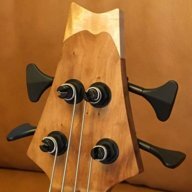
![clear[1].png](/data/attachments/5219/5219342-9eb57d1b0ef40a6439106bee512f25d2.jpg?hash=nrV9Gw70Cm)

