• TalkBass has been independent since 1998. Add your voice.
    Create a free account to reply to discussions, view embedded media, and browse with fewer display ads.
    Join freeLog in
    Want zero display ads or expanded classifieds tools? Compare plans.

You think the audience doesn't notice? Think again!

Status
Not open for further replies.
Old folks with hearing aids? Far from likely, and I currently wear a set of Rextons for business.

Younger employees that work there and have an interest in sound/tone? Absolutely. Which is good, because that typically means your band is doing a good job of managing the mix and volume.
Crowds at the Villages defy expectations. Yes, most are somewhere between 55 and death, but you would be surprised how many younger people show up. It's a pretty solid mix. And most of those older folks are very active and defy all stereotypes. Some can kick your ass, too. And they're women :D
 
Crowds at the Villages defy expectations. Yes, most are somewhere between 55 and death, but you would be surprised how many younger people show up. It's a pretty solid mix. And most of those older folks are very active and defy all stereotypes. Some can kick your ass, too. And they're women :D

Can't believe I'm quoting "Real House Wives of NYC" but hey, lie down with dogs, get up with fleas.
In any case, there was a amazing footage one season of Aviva Drescher's Dad - an octogenarian playboy living
in Florida -- as he characterized all the retirement communities and which are the best for meeting women.
Cant' remember his top pick -- but he said Boca is the worst.
 
  • Like
Reactions: JimmyM
Meh, his calling skeptics arrogant was just a "hot take" and not really a meaningful and sincerely felt diss, I think. Also, in proving that these people noticed at this time, he's proved that "people notice" bass tone. What the proportion is remains debatable[/B], but if some people notice, it's advisable to tend to this element of your presentation. You want to do it right every time, so that the one time you need for it to be done right when somebody is listening that matters, it's done right.

Every once in a while I have a fleeting urge to phone it in, or say "yeah, I messed that part up, but these people don't notice these things" but then I think about that bass player in the back who may be my equal or better, listening. Then I remember that you should always conduct yourself as if someone knowledgeable is listening, and listening closely, because more often than you think, they are, when you don't know it.
Proved is a strong word. What was demonstrated waa that in this situation with these people in this place with this and that and the other thing is that something was noticed. I have too much respect for what proof actually is to accept this anectodal story as anything but. All I'm proposing is the refusal to accept an assertion. You tell me this jar of gumballs has an even number of gumballs and I say I don't believe that doesn't mean I say there's an odd number.
 
If I had a sample size of one event and claimed that was proof of anything I'd probably avoid calling skeptics arrogant. Different strokes for different folks.

I can't just accept your probably avoiding calling skeptics arrogant. I need a scientific peer review with thousands of documented Gorns involved.
 
Meh, his calling skeptics arrogant was just a "hot take" and not really a meaningful and sincerely felt diss, I think. Also, in proving that these people noticed at this time, he's proved that "people notice" bass tone. What the proportion is remains debatable, but if some people notice, it's advisable to tend to this element of your presentation. You want to do it right every time, so that the one time you need for it to be done right when somebody is listening that matters, it's done right.

Every once in a while I have a fleeting urge to phone it in, or say "yeah, I messed that part up, but these people don't notice these things" but then I think about that bass player in the back who may be my equal or better, listening. Then I remember that you should always conduct yourself as if someone knowledgeable is listening, and listening closely, because more often than you think, they are, when you don't know it.

I get all of that. We should always strive for the best. But often when people are talking about great tone, or preferred tone, that is not to say that generally it is going to be perceived as better or worse to others. Someone may like the tone of an Ampeg or a Markbass or a Fender or a Rickenbacker, but is one really "better"? No, not better, just different. What does matter more than brand of gear or newness of strings is how the clarity and tone of just bass comes through the PA. This is why EQ matters MORE than any other variable or brand of gear. Another thing to factor in are the variables within variables. My band rotates through several clubs repeatedly, so we play the same clubs often 8-10 times a year. Every time the mix is different, even with all other variables being the same. Call it ghosts in the room or whatever, no two nights are ever exactly the same, though some variables are controlled, others are not. Still though, we shoot for the best in regards to gear, performance and the totality of what we put out there. I just find it funny how some put so much weight into brands of strings or types of pickup upgrades, etc. whereas the final product is really most likely not going to even be distinguishable at all. At least to ALMOST 100% of the crowd listening.

I think most of these differences that we focus on as players is really just stroking our own egos. We get a kick from it because it matters to us. But some guy playing a $100 bass out of a cheapo amp really has just about an equal chance of getting a great tone out of a final mix as the other guy who spent years honing his tone using $10,000 worth of gear. THAT is what I take away from this. Seeing live bands you see all kinds of brands and qualities of gear, but when listening to the band, it really doesn't seem to make much difference. Sometimes I hear "junk" sounding awesome and sometimes awesome gear sound like junk. These scenarios are really about even. I still like my particular basses and amps and strings though, but I'm not foolish enough to think it makes a difference to anyone else. More or less.
 
Last edited:
  • Like
Reactions: Admiral Akbar
Can't believe I'm quoting "Real House Wives of NYC" but hey, lie down with dogs, get up with fleas.
In any case, there was a amazing footage one season of Aviva Drescher's Dad - an octogenarian playboy living
in Florida -- as he characterized all the retirement communities and which are the best for meeting women.
Cant' remember his top pick -- but he said Boca is the worst.

I remember that guy! Very funny and he added to the show quite a bit. I like seeing these older guys with so much zest for life and desire for women. He could be disrespectful at times though which wasn't cool. As I remember one exchange he had with Ramona. Didn't care for Aviva at all.
 
  • Like
Reactions: Son of Wobble
I totally agree! We always hear compliments after our shows about the bass tone. Mostly from people that don’t even play!

Seems a lot of people expect to hear a softer scooped tone. Especially since we’re an electronic funk band. My tone is more mid range focused, paired with a B7k it sounds gnarly but does very well at cutting past competing synth backing tracks.
 
One little exercise many can do, it just go listen to any live video of a band on Youtube. Pick whatever genre you play, and just shoot for a halfway decently recorded live recording. Granted, video is different than live in person, but what you'll notice is bass is bass. Certainly a quiet setting


I get all of that. We should always strive for the best. But often when people are talking about great tone, or preferred tone, that is not to say that generally it is going to be perceived as better or worse to others. Someone may like the tone of an Ampeg or a Markbass or a Fender or a Rickenbacker, but is one really "better"? No, not better, just different. What does matter more than brand of gear or newness of strings is how the clarity and tone of just bass comes through the PA. This is why EQ matters MORE than any other variable or brand of gear. Another thing to factor in are the variables within variables. My band rotates through several clubs repeatedly, so we play the same clubs often 8-10 times a year. Every time the mix is different, even with all other variables being the same. Call it ghosts in the room or whatever, no two nights are ever exactly the same, though some variables are controlled, others are not. Still though, we shoot for the best in regards to gear, performance and the totality of what we put out there. I just find it funny how some put so much weight into brands of strings or types of pickup upgrades, etc. whereas the final product is really most likely not going to even be distinguishable at all. At least to ALMOST 100% of the crowd listening.

I think most of these differences that we focus on as players is really just stroking our own egos. We get a kick from it because it matters to us. But some guy playing a $100 bass out of a cheapo amp really has just about an equal chance of getting a great tone out of a final mix as the other guy who spent years honing his tone using $10,000 worth of gear. THAT is what I take away from this. Seeing live bands you see all kinds of brands and qualities of gear, but when listening to the band, it really doesn't seem to make much difference. Sometimes I hear "junk" sounding awesome and sometimes awesome gear sound like junk. These scenarios are really about even. I still like my particular basses and amps and strings though, but I'm not foolish enough to think it makes a difference to anyone else. More or less.

"But some guy playing a $100 bass out of a cheapo amp really has just about an equal chance of getting a great tone out of a final mix as the other guy who spent years honing his tone using $10,000 worth of gear"

I have to disagree there. Granted, a great player through a $100 bass and cheapo amp will sound better than a terrible player through $10k in gear, but there's a reason top pros do not generally use $100 bases and cheapo amps. I can certainly hear the difference between good tone and bad, but of course I am attuned to it. I have people that see me often than comment on tone/sound... maybe they like the tone of this bass versus that bass, etc., how it sounds one night vs another (even at the same venue), and describing various characteristics of the sound. Most are musicians but some are pretty casual musicians... SOMETIMES bass is bass, but there's still a palpable difference between passable and genuinely good.
 
  • Like
Reactions: JimmyM and smogg
EDIT: Sorry if posted in the wrong forum. Had no idea where to post it.

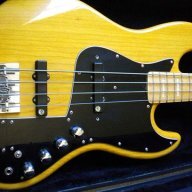
Did a gig last night at an outdoor venue at The Villages in Fla (a big giant retirement community) that I play once a month, and we get a lot of regulars. I've been using my Hammersmith with a very dead set of Dunlop Super Bright Nickels there pretty much exclusively most of the year. Tonight I got a wild hair and brought out my modded 76 Precision with a newish set of the same strings instead. Both these basses have Geezer PJ's, and to me they sound about the same when the strings have comparable wear. Everything else was the same as usual...REDDI into the PA, same pedals I've been using all year set the same way and used in the same songs, same sound tech we usually have there and the same PA, which is a decent but not particularly great PA (a souped-up and somewhat customized Bose PA...one of the bigwigs of the Bose family lives at the Villages and has the ear of the family who owns the Villages).

I probably had 20 people who are regulars at our gigs come up to me on break and ask me how come the Fender sounded so much edgier and aggressive than the Hammersmith. Only one of them plays an instrument, and while most were guys, plenty of women said the same thing.

So if I ever hear any of you jokers try to claim that the audience doesn't know or care about your sound again, I will tell you that you're a very arrogant person who has zero respect for your audiences. Of course, I have been saying that for years, but now I've got proof. A big outdoor venue with about 3000 people there in various states of inebriation, and several non-musicians noticed that the strings on the Fender made it sound edgier.

The lesson I learned is I need to change my strings more often :D The lesson YOU should learn is that if you think your audience is so stupid that they can't tell the difference in your sound no matter what you use, maybe they're not the stupid ones.

Happy holidays, everyone!

I've changed my strings literally before every gig for years, though my hands are more caustic to strings than most.

During a 10 hour recording session I may even go through multiple sets; they get cleaned and reused multiple times of course, as even with an endorsement deal using brand new sets every time gets cost prohibitive rather quickly ;)

I've also never paid too much attention to anyone who says "the audience can't tell the difference"...it can be well intentioned advice to stop people from buying gear they don't need, but it's just as easily a way to rationalize laziness and/or doing your job at a sub-optimal level.

It's never "fine" to give less than 100%: whether it's a crowd of 10 or 10,000, they deserve the same level of performance.
 
"But some guy playing a $100 bass out of a cheapo amp really has just about an equal chance of getting a great tone out of a final mix as the other guy who spent years honing his tone using $10,000 worth of gear"

I have to disagree there. Granted, a great player through a $100 bass and cheapo amp will sound better than a terrible player through $10k in gear, but there's a reason top pros do not generally use $100 bases and cheapo amps. I can certainly hear the difference between good tone and bad, but of course I am attuned to it. I have people that see me often than comment on tone/sound... maybe they like the tone of this bass versus that bass, etc., how it sounds one night vs another (even at the same venue), and describing various characteristics of the sound. Most are musicians but some are pretty casual musicians... SOMETIMES bass is bass, but there's still a palpable difference between passable and genuinely good.

Certainly most players are somewhere in the middle of $100 and $10,000. I consider myself a "top pro" (OK, maybe not "top" in recognition but certainly a very experienced pro with decades of experience) and I am not going to use some $100 bass, though I have used $300 Squiers with practice amps and I have played $3,000 basses with high end gear and my results are pretty much the same, IF you know how to maximize what you are using. I think reliability is often more important than brand to brand tone. What has held me back at times was not the brand of amp or bass, but rather the reliability of a head that cuts out if there is not sufficient power, or it overheats, or speaker cabinets that are not adequate or are blown easily, or an input jack on a bass or cords that are shorting out. In my younger days I dealt with these kinds of problems, which were a much larger issues than the type or brand of gear I was using. Granted the neck and playability of a subpar bass is going to distract, but if I'm playing a properly setup Squier with a 100-watt Acoustic or Behringer amp without issues, and perhaps a good pre-amp EQ pedal like a Tech 21 VT Bass, then I'm going to be able to compete with ANY high end gear, to the point probably no one in the audience will know the difference. And really, whatever we do or don't do on our end, the soundman can make or break the final result, and really then improve it or ruin it with EQ.
 
  • Like
Reactions: jnewmark
I agree with the theory that the audience will notice good and bad tones, but I think that the amount of instruments in a mix, as well as the volume compared to the other instruments can vary the outcome of this. I don't think that very subtle differences that people notice when practicing at home by themselves will be noticed if playing live in a band, but I do think a bad sounding instrument will show, and the audience will let you know about it.

When I play, I've never had a complaint about my bass sound, if anything just compliments, so my tone must sound good I guess. ;)
 
I've also never paid too much attention to anyone who says "the audience can't tell the difference"...it can be well intentioned advice to stop people from buying gear they don't need, but it's just as easily a way to rationalize laziness and/or doing your job at a sub-optimal level.

.

I never once took it that way when anyone said the audience can't tell the difference. People like me who often say something similar do not use this as an excuse to be lazy or not strive for the best, but rather are stating that even though we do, we ourselves are the ones who notice, not most others. I am a FIRM believer that most audience members don't care and can't tell, but in NO WAY am I still not using the best gear for me or am not still trying my best on every level. Personal satisfaction is a pretty big deal here. We want to feel good about what we are doing, in performance and song and groove, etc. But I am also a realist in knowing that most of our gear choices fall silent on deaf ears. Also realizing that improving my playing, or choosing better notes is going to magnify GREATLY any differences in the final result more so than any differences in gear that I am using. It is hard to quantify but roughly what comes out of the PA is going to be 75% hands and 25% gear.
 
  • Like
Reactions: danosix
If I had a sample size of one event and claimed that was proof of anything I'd probably avoid calling skeptics arrogant. Different strokes for different folks.
I going to support the OP's hypothesis, that the audience notices, and have some gnostic fun, (don't say I didn't warn you) In this case, there is 20 members of a sub-population of 3000, (the event), the population is likely highly bias.
The OP can make a statement that less than 1% of the audience will volunteer that they notices a difference in sound between dead strings and new strings. (One tail test).

A couple of reasons I think the population is bias, the information was volunteered and not randomly sampled.

Yes I believe JimmyM.
 
  • Like
Reactions: JimmyM
Status
Not open for further replies.