DI is great on certain applications. Like when I've done studio sessions for someone else's project. But when my originals band gigs my slightly dirty grindy tone is part of our sound. My guitarist scoops a bit and I bump my high mids. It works for us, now if a FOH guy re-EQs the way he thinks we should sound that may not come across. I usually talk to them beforehand and have had no trouble with someone micing up my cab.

Enjoy the benefits of a premium membership!
Upgrade Account
-
TalkBass has been independent since 1998. Add your voice.
Create a free account to reply to discussions, view embedded media, and browse with fewer display ads.
Join free Log in
Want zero display ads or expanded classifieds tools? Compare plans.
You are using an out of date browser. It may not display this or other websites correctly.
You should upgrade or use an alternative browser.
You should upgrade or use an alternative browser.
"your" tone vs PA
- Thread starter Randy440magnum
- Start date
More options
Who Replied?

I don't mind being handed a DI box but I usually say "hey, my amp's got a DI out right here"... and most of the time that's cool and FOH gets my amp's preamp tubes and pedals too.

No, but can you think of a better way? I get what I'd call a pretty 'sick' tone from my rig. On the infrequent occasions it gets mic'd, my tone is often described by others as being 'sick.' : DDefinitely a common question. Not much for me to say that hasn't been said before in other threads or here already.
I do find it interesting that there is an assumption that a mic will capture "your" sound. Each mic has a different profile, with various bumps and dips in EQ. Placement on the speaker (cap, crease, edge), has an effect on what the mic picks up. A mic isn't a sure-fire way to get the exact sound you hear standing next to your rig.
i respect any intended hyperbole, so take with a grain of salt.
i want to sound great to the audience. i also want to have a tone I can play confidently with on stage. if i sound empty, tinny, nasally with no rumble on the stage, I play with much less confidence, regardless of what the house sounds like. to me, my stage mix is hugely important. and i understand that will likely be eq'd completely different from the FOH.
This.
If the sound on stage is crap, it affects how I play. Monitor mixes are sometimes overlooked in small venues, hence reliance on the bass cabs as monitors. On stage volume and EQ (especially low mid) can be a nightmare with guitarists who crank their low mids AND want themselves loud in the monitor mix.
/rant

For me, taking the signal from a Boss 10B sounds better than out of the amp, but I don't know why. Amp tone really only matters if they are taking a DI AND miking the amp, which does happen at larger gigs. FWIW, our sound guy would prefer the amp tone brighter, as the 18's in the FOH cover the bottom, using amp tone as a sort of spice.
If you have a ''tone'' then you need to ask the sound guy to reproduce it in FOH. There is not other way to do it. It helps if you are famous so most of people know your tone, example Steve Harris and Geddy Lee or if you have some sort of recording the sound man can listen to.
Telling the sound guy that you want your tone to be ''Beefy grindy with a growly bite'' does not help neither.
Telling the sound guy that you want your tone to be ''Beefy grindy with a growly bite'' does not help neither.

No, but can you think of a better way?
There is no other way to capture the totality of the components in the signal chain (bass/pedals/amp/EQ/cab), aside from using a well placed and appropriate mic.
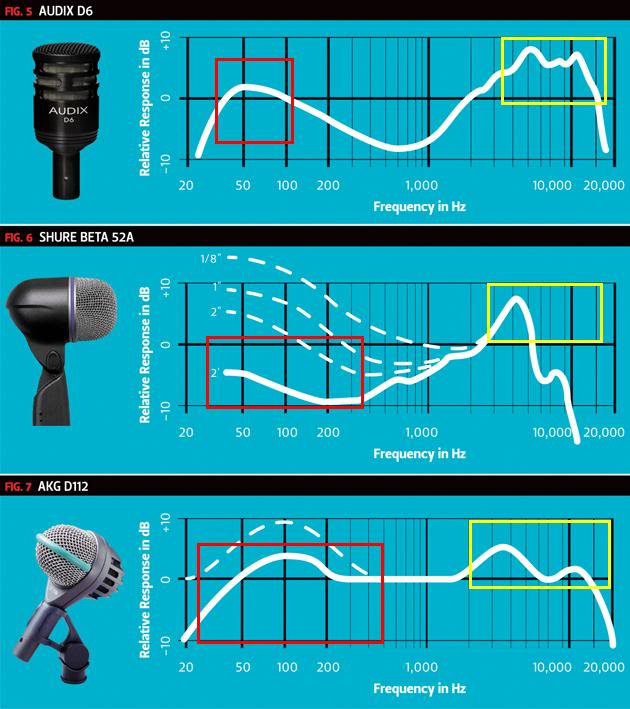
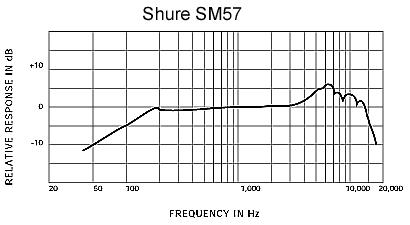
However, it needs to be the right mic and in the right location/orientation on the speaker. Admittedly, my experience is limited primarily to cab/mic sim in-the-box adjustments in a DAW model. I do think it is safe to assume the modeling is a reasonable representation of the real world. Based on my experience in this realm, the sound of mics can vary wildly (many companies publish eq charts and show their bumps and dips), and the orientation can have significant impact on the end sound. So, unless a bassist (and sound man/woman) understands what mic is being used and where the right placement spot is, the answer is not simply "mic it." It will be a bit involved, and depends on how fine a point you want to put on it.
Note the responses with these popular/common mics for bass application. Consider if you've got a cab with a tweeter or a 3-4k roll-off. Also consider the issue of mic placement on mid-driver cabs (like a 12/6):
For me, music is a collaborative thing. If nobody listens to it, it doesn't really exist. The soundperson, for better or worse, is part of that collaboration. I like to set my stage sound so that everyone can hear it comfortably and EQ it so that it doesn't put me off. It's the soundperson's job to make it sit in the FOH mix. I suppose it helps that I think of the bass as a funny shaped drum, so I'm not bothered by things that may concern a player with different interests.
There is no other way to capture the totality of the components in the signal chain (bass/pedals/amp/EQ/cab), aside from using a well placed and appropriate mic.
However, it needs to be the right mic and in the right location/orientation on the speaker. Admittedly, my experience is limited primarily to cab/mic sim in-the-box adjustments in a DAW model. I do think it is safe to assume the modeling is a reasonable representation of the real world. Based on my experience in this realm, the sound of mics can vary wildly (many companies publish eq charts and show their bumps and dips), and the orientation can have significant impact on the end sound. So, unless a bassist (and sound man/woman) understands what mic is being used and where the right placement spot is, the answer is not simply "mic it." It will be a bit involved, and depends on how fine a point you want to put on it.
Note the responses with these popular/common mics for bass application. Consider if you've got a cab with a tweeter or a 3-4k roll-off. Also consider the issue of mic placement on mid-driver cabs (like a 12/6):
Some musicians bring their own mics and set them up. This permits control of some of the potential variables you mentioned, such as position and mic.
Modelers are very consistent, but we can't assume everybody will be using them and they may not be able to represent that "tone" well.
Lastly, the D6, Beta 52A, and D112 are Bass Drum mics. Different application, but certainly rugged enough for bass cabs and stages. They are fairly uneven by design. For an onstage dynamic, I'd recommend the RE20 for bass cabs. A lot of venues will use 57s -- which is another good reason to bring a mic if you're picky about "tone".
Off the topic, but after forty years of playing live gigs, I'll have to say that's the best advice anyone can give.In any case, smile and look like you are having a great time. That's all most audience folks pick up on, other than vocals.
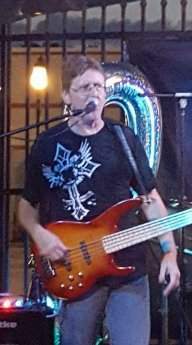
Just like bass players, sound guys are human....which means they are all different. (I happen to be both.)
Here's where the compromise needs to come in. The physics of your bedroom and your (relatively) small amp are completely different from the physics of a huge club and huge speakers. No, not even an 8-10 or a 4-12 is "huge" compared to really large 18" cabs tuned super low and huge mid driver cabs.
Here are some truths for both sides to keep in mind.
1) The short version is that bedroom tone...."your tone"......might sound like garbage in a live mix. It should be the goal of BOTH of you to make the BAND sound great....not just the bass player.
2) It is simply not true that a "pro" sound guy or a "good" sound guy should he able to make ANY bass tone fit in a mix. Physics is an evil mistress. She don't care if you're good or not. She gone do what she gone do.
3) Yes, sound guys SHOULD (If time and equipment allow) TRY to make an effort to use most or all of what the bassist sees as his/her tone. But....
4) The BEST way is for you to set your tone, and then ASK the sound guy "Is it too boomy? You need anything?" And then the sound guy needs to go out of his way to see to it that you make the LEAST amount of adjustment to your tone that he can work with.
Hope that helps.
Very well said.
I have my head and the Sansamp I use set with little tick marks so they get set the same way every time. That's my starting point. Usually the only thing that will change is the level knob on the Sansamp and maybe the bass knob too. I send a post EQ signal to the board from the head (I go from the bass into the SA, and then to the head) and then, as suggested in the quoted post, ask the sound dude if I need to turn up/down/less low end/whatever. Usually they are good with what I give them. I'm sure a few knobs are turned out front to satisfy what he wants too, but most of the time I sound like me.
Once, a guy wanted to only mic me, and I only wanted to go direct and it was kind of a tug of war. He ended up winning, only because there wasnt a DI around and I didnt have one. I understand now why he wanted what he wanted, because, really, you sound more like you if have the sound coming out of the cab being used, But now I would just say "If you have the channels available just do both and blend it".
BnB
Some musicians bring their own mics and set them up. This permits control of some of the potential variables you mentioned, such as position and mic.
Modelers are very consistent, but we can't assume everybody will be using them and they may not be able to represent that "tone" well.
Lastly, the D6, Beta 52A, and D112 are Bass Drum mics. Different application, but certainly rugged enough for bass cabs and stages. They are fairly uneven by design. For an onstage dynamic, I'd recommend the RE20 for bass cabs. A lot of venues will use 57s -- which is another good reason to bring a mic if you're picky about "tone".
Yeah. Owning a mic and treating it like part of the signal chain, and not an afterthought, is important. Work with it and get to know how it works.
I was only mentioning modeling as a reference to my experience, in terms of awareness to how mics respond to placement.
Some of the bass drum mics I posted are ones I've seen suggested for bass guitar application. Not their primary purpose, but they are options in my bass cab modeling software, and suggested in articles I've read regarding studio recording. Can't say how common they are on stages.

This is well said. I'm a pretty novice sound guy, but I am both as well, so I think we can hold a unifying perspective here. My best friend is our usual sound guy for worship, and for outside stuff. So much so that we try to take him with us wherever we play, and consider him a band member. Relationship between band and sound tech makes it easier for he/she to understand what the band wants to project, and for band to understand what he/she has the capability of doing to that vision. That said, not every venue or sound tech is going to be that way, and you sometimes have to be flexible with who you have. I like to introduce myself to the tech before the gig, and build a personal bridge, so that when crunch time comes, he/she wants to do whatever possible to give us the sound we want within reason.
This has helped me quite a bit in the past and I am sure it will in the future as well.
Yeah. Owning a mic and treating it like part of the signal chain, and not an afterthought, is important. Work with it and get to know how it works.
I was only mentioning modeling as a reference to my experience, in terms of awareness to how mics respond to placement.
Some of the bass drum mics I posted are ones I've seen suggested for bass guitar application. Not their primary purpose, but they are options in my bass cab modeling software, and suggested in articles I've read regarding studio recording. Can't say how common they are on stages.
Yup, or if DI is your thing, don't expect the soundman to always have enough on hand.
In that regard, some modelers are unusual. It seems like they blend two IRs (eg on- and off-axis) in order to approximate in-between positions. Straight IRs of cabs and/or mics work decently, although they are not Linear Time Invariant systems. IRs are the best common approach to this problem, but they are not perfect representations of cabs or mics. That's a complicated way of saying models can produce both good and unusual results of what they "model" regarding mics and cabs.
Yeah, the Beta 52 is not unusual in studios. Engineers have a love/hate relationship with D112s on bass cabs. A lot of engineers don't like the big mid scoops on the bass. Really, it depends on where you want it to sit. I think the RE20 and SM7B are the best 2 dynamics for bass cabs. Both, I believe, are much flatter than the kick drum mics you linked.
Sorry if that has been said , heaven't read all answers but a couple of points :
A PA will always be a close system wich is very different from any bass monitors.
It is absolutely impossible to reproduce exactly any instrument or any sources in a PA , whatever the source , whatever the PA.
Take a Piano for example , it is a radiant instrument , sound goes all around it , 360° , wherever you put the mikes , you will loose something and it is reproduce by a system of speakers wich will never be able to reproduce a piano EXACTLY as is. It is impossible. And I don't even talk about wich mike , wich console , which PA etc...
So miking a bass monitor will "capture" very approximately "Your sound" at that distance (right on the speaker), it will not be able to capture the other factors , a bass monitor is radiant too and it cannot be captured in it's totality like what you hear . It is gonna be captured by a mike that is not absolutely flat , will then be processed by stuff wich will color the sound again , then will get out of a series of speakers with are very different from your bass monitor , so obviously , will be very different from what's coming out of yours. Then , there is all the importance of the acoustics of the room etc....
Also bass monitors or bass amps are designed as "short throw" wich mean they will sound good right in front of it but not so good at 100' where the FOH is. It usually sounds like mud/garbage at that distance.
So what you hear right in front of you cannot and will never be reproduced in any PA in any circumstances , period , whatever the means and whatever the budget. It will always be an approximation.
The only thing I can see is if you use two bass monitors as the PA with the bass directly plugged in.
The bass will sound good right in front of it but the vocals and other instruments will not sound too good
A PA will always be a close system wich is very different from any bass monitors.
It is absolutely impossible to reproduce exactly any instrument or any sources in a PA , whatever the source , whatever the PA.
Take a Piano for example , it is a radiant instrument , sound goes all around it , 360° , wherever you put the mikes , you will loose something and it is reproduce by a system of speakers wich will never be able to reproduce a piano EXACTLY as is. It is impossible. And I don't even talk about wich mike , wich console , which PA etc...
So miking a bass monitor will "capture" very approximately "Your sound" at that distance (right on the speaker), it will not be able to capture the other factors , a bass monitor is radiant too and it cannot be captured in it's totality like what you hear . It is gonna be captured by a mike that is not absolutely flat , will then be processed by stuff wich will color the sound again , then will get out of a series of speakers with are very different from your bass monitor , so obviously , will be very different from what's coming out of yours. Then , there is all the importance of the acoustics of the room etc....
Also bass monitors or bass amps are designed as "short throw" wich mean they will sound good right in front of it but not so good at 100' where the FOH is. It usually sounds like mud/garbage at that distance.
So what you hear right in front of you cannot and will never be reproduced in any PA in any circumstances , period , whatever the means and whatever the budget. It will always be an approximation.
The only thing I can see is if you use two bass monitors as the PA with the bass directly plugged in.
The bass will sound good right in front of it but the vocals and other instruments will not sound too good
Last edited:

That is why I send the same thing to my amp as I do FOH. Sometimes they mic my cab and take a DI, but I like having some control on my end for tone (mostly flat anyway maybe boost mids a tad) since they get a feed from my SansAmp BDDI which also feeds my amp. Also, they generally realize the DI is better sounding than mic on the cab anyways and mute it.
Totally feeling you in theory here, but I don't think I've ever in my life seen an RE20 onstage. In my experience you'll either get an SM57 (or whatever more or less equivalent mic they have on hand) or very rarely one of the kick mics you mentioned. Probably the ~57, because any sound system will have tons of them around but may not have more than one kick mic and SADLY the drummer will probably bogart that.For an onstage dynamic, I'd recommend the RE20 for bass cabs. A lot of venues will use 57s -- which is another good reason to bring a mic if you're picky about "tone".
And a 57 will be fine onstage. Enough low end for the PA to work with, enough highs and mids that all your distortion and effects will come across.
Last edited:
Not very common, because kick mics are more expensive than basic SM57-type mics and way less versatile. It's probably for the best, because they don't usually sound great on bass unless there's something else to blend them with.Some of the bass drum mics I posted are ones I've seen suggested for bass guitar application. Not their primary purpose, but they are options in my bass cab modeling software, and suggested in articles I've read regarding studio recording. Can't say how common they are on stages.
I would think in most instances, "your tone" will mostly come across via DI. You'll get some higher frequency stuff that is attenuated through a speaker, but most sounds guys I've worked with are good about using cutting out that ultra high end that sounds so lovely through a tweeter.
IMO, the goal for "your tone" should be in the context of your band/group. Work on it with the group not solo.
IMO, the goal for "your tone" should be in the context of your band/group. Work on it with the group not solo.

Very well said.
I have my head and the Sansamp I use set with little tick marks so they get set the same way every time. That's my starting point. Usually the only thing that will change is the level knob on the Sansamp and maybe the bass knob too. I send a post EQ signal to the board from the head (I go from the bass into the SA, and then to the head) and then, as suggested in the quoted post, ask the sound dude if I need to turn up/down/less low end/whatever. Usually they are good with what I give them. I'm sure a few knobs are turned out front to satisfy what he wants too, but most of the time I sound like me.
Once, a guy wanted to only mic me, and I only wanted to go direct and it was kind of a tug of war. He ended up winning, only because there wasnt a DI around and I didnt have one. I understand now why he wanted what he wanted, because, really, you sound more like you if have the sound coming out of the cab being used, But now I would just say "If you have the channels available just do both and blend it".
BnB
Honestly, as a bass player and sound guy too, using two channels for bass is fun for me. I realize I have a unique perspective in that regard. I talked the guy at my church into trying it once. Now he won't get my signal any other way. So my tone knob dimed on the P bass going straight in for bright and edge, and a beefier signal out of the (usually) Mesa Walkabout or Ashdown LB30. He loves it. I love it. Sounds REEEEEEEEEALLY good out front.


