

Enjoy the benefits of a premium membership!
Upgrade Account
-
TalkBass has been independent since 1998. Add your voice.
Create a free account to reply to discussions, view embedded media, and browse with fewer display ads.
Join free Log in
Want zero display ads or expanded classifieds tools? Compare plans.
You are using an out of date browser. It may not display this or other websites correctly.
You should upgrade or use an alternative browser.
You should upgrade or use an alternative browser.
Your top setup tips
- Thread starter DubFiDub
- Start date
More options
Who Replied?
- Aug 25, 2007
- 835
- 6
- Disclosures
- I manufacture for several companies including but not limited to: Bridge City Sound, Catalinbread, more.
Remember, fretting pressure makes a difference in the way your intonation is set. If you play normally with a light touch, then dont gorilla grip the strings when you set intonation. Set it with the same pressure evenly.
Don't be afraid of ignoring Fenders (or anyone for that matter) setup specs. Often, instruments aren't perfectly crafted, resulting in less than optimal setups or setups that don't meet manufacturer specs. Just do it how you want to do it and damn the world!
Creating a good string break angle over the bridge is actually really important, especially for bass. I know someone already said it but SERIOUSLY LISTEN TO THAT GUY!
Get the proper tools for setting up your bass. There is nothing more frustrating than finding out you have to extract stripped screws or threaded hex screws or truss rods on a simple setup. Keep the stuff that comes with your instrument! If you cant find the stuff or purchased an instrument used, go find the right stuff. It will save your tech (or you) time .
Use measuring equipment. Its much easier to get your instrument to YOUR spec quickly and easily by using feeler gauges and a good solid rule with 32nd or 64th inch markings. Yeah, you can do it by feel. If you ever say "man I really liked the way I setup my guitar that one day but I cant seem to get it back to where it was", It will be a lot harder to duplicate if you don't take some simple measurements.
There is more but the list is so long that its almost worth making tons of mistakes to learn.......almost.
Don't be afraid of ignoring Fenders (or anyone for that matter) setup specs. Often, instruments aren't perfectly crafted, resulting in less than optimal setups or setups that don't meet manufacturer specs. Just do it how you want to do it and damn the world!
Creating a good string break angle over the bridge is actually really important, especially for bass. I know someone already said it but SERIOUSLY LISTEN TO THAT GUY!
Get the proper tools for setting up your bass. There is nothing more frustrating than finding out you have to extract stripped screws or threaded hex screws or truss rods on a simple setup. Keep the stuff that comes with your instrument! If you cant find the stuff or purchased an instrument used, go find the right stuff. It will save your tech (or you) time .
Use measuring equipment. Its much easier to get your instrument to YOUR spec quickly and easily by using feeler gauges and a good solid rule with 32nd or 64th inch markings. Yeah, you can do it by feel. If you ever say "man I really liked the way I setup my guitar that one day but I cant seem to get it back to where it was", It will be a lot harder to duplicate if you don't take some simple measurements.
There is more but the list is so long that its almost worth making tons of mistakes to learn.......almost.


Here is a string measuring technique I use that some may not know about. This only works with Fender style (inline) headstocks.
Stretch the string two tuner lengths past the one that you are stringing and then bend and cut. For example, when stringing the E, stretch the string to the D tuner post.
This results in about 2.5 winds for me. Actually depending on the gauge I may got 2.5 tuner lengths or less but it's a good place to start.
Stretch the string two tuner lengths past the one that you are stringing and then bend and cut. For example, when stringing the E, stretch the string to the D tuner post.
This results in about 2.5 winds for me. Actually depending on the gauge I may got 2.5 tuner lengths or less but it's a good place to start.

Here is a string measuring technique some may not know about: compare the new ones to your old ones.
BAM perfect every time.
BAM perfect every time.
One thing I frequently see is guys who complain that their bass buzz although they adjusted the bridge and trussrod several times and it will not go away 
 !
!
They have completely forgotten that the top priority aspect of setting up a bass guitar is to check that the frets are in level.
On a electric bass with a well made neck it is possible to have a action of less than 1 mm at the 12 fret without fret buzzing and lower still on a fretless!
!They have completely forgotten that the top priority aspect of setting up a bass guitar is to check that the frets are in level.
On a electric bass with a well made neck it is possible to have a action of less than 1 mm at the 12 fret without fret buzzing and lower still on a fretless!
My top tip: When setting intonation, don't become a slave to your tuner.
When you see that the intonation is very close, and you think it's about as good as you can get it, don't agonize over getting it perfect. If your ears tell you it's OK, then it is.
At that point, stop fussing with it and play it.
Why use a tuner i the first place when you have ears?

Buy the basic tools to do setups and make kits for each of your basses. This makes things much easier.
String action gauge is very useful for consistent setups
A complete set of hex wrenches
A set of those mini screwdrivers are also handy
Wire snips for string changes
Visit stewmac and peruse their guides and "how to's". There is a wealth of information.
If you are having problems with your bass, do some research before taking your stuff in to a tech. Also be very careful who you choose to do your work. I took one of my basses in to a very reputable local guy and learned first hand that even the best can't be trusted.
String action gauge is very useful for consistent setups
A complete set of hex wrenches
A set of those mini screwdrivers are also handy
Wire snips for string changes
Visit stewmac and peruse their guides and "how to's". There is a wealth of information.
If you are having problems with your bass, do some research before taking your stuff in to a tech. Also be very careful who you choose to do your work. I took one of my basses in to a very reputable local guy and learned first hand that even the best can't be trusted.
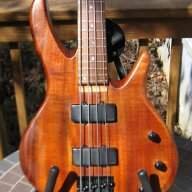
I always take the time to smooth and polish each fret on my basses. I also round the fret ends with a jewelers file if needed. this will make any bass play smoother and feel like a custom instrument.

not true at all, and a waste of time (except for tightening ric truss rods and any necks with problems.)When you adjust your truss rod always remove the string tension.
that works, but it's easier to just slap a capo on the first fret.If you have a bass that requires you to remove the neck in order to adjust the truss rod, tie off the strings at the headstock with something elastic. (I use my old hair ties)

I adjust the truss rods on my instruments with the strings tuned. But if I'm working on someone else's instrument especially an older one or one with a lot of relief, I detune completely, take all the tension out of the rod and let it sit for a while. This way the wood goes back to being straight all on it's own (wood has memory you know) and there is less risk of over tightening the rod.

not true at all, and a waste of time (except for tightening ric truss rods and any necks with problems.)
that works, but it's easier to just slap a capo on the first fret.
Yeah admittedly it probably doesn't hurt making minor adjustments with the string tension on.
It's just something I like to do because it's theoretically easier on the neck when the rod isn't having to fight string tension to get the neck where it needs to be.
I'll usually go a bit over my target point with the string tension off and then back it off a bit once it's in tune.
The reason I don't use a capo is probably pretty dumb but I don't like the idea of having the capo pushing the strings into the fingerboard as I'm always afraid it could dent the it.
The way I see it is, if you put a capo on with string tension and it's right behind the fret, its not applying nearly as much pressure (strings to board) as it would be if there where no tension there.
I wonder if any of you that have done this a lot could de-bunk this, because a capo would indeed be a easier alternative.
To each there own I guess.
I love seeing how we all do things a bit differently.


If the neck bears the weight of the bass, by resting the head on a bench or block, that will add relief that disappears when the bass is picked up. Wearing the bass is one way to avoid this.i have never heard this one. what would be the reasoning behind this?
I can't reliably distinguish 1/64" (0.015") by eye. I can see half that using a ruler & my feeler gauges can disclose .001". YRMV.why use a ruler when you have eyes?
like any other good measuring instrument, tuners and rulers are more accurate than our imperfect senses, and get the job done faster and more consistently.
Appled math; Circumference is Pi (3.14) times the diameter. If the tuning post is 3/8th inch diameter, each wrap is a little more than 1 inch long. I cut my strings 3.5 inches longer than the distance to the center of the post, to get 3 wraps & Yes, I use a ruler.Here is a string measuring technique I use that some may not know about. This only works with Fender style (inline) headstocks.
Stretch the string two tuner lengths past the one that you are stringing and then bend and cut. For example, when stringing the E, stretch the string to the D tuner post.
This results in about 2.5 winds for me. Actually depending on the gauge I may got 2.5 tuner lengths or less but it's a good place to start.


- Buy good tools.*
- Learn to use them properly.
- Take measurements.**
- Compile and record the data.
- Buy books.***
- Read the books. The entire book. All of them.
- Buy junk at a swap meet or flea market.****
- Practice on junk.
*Cheap tools are frustrating to use. Good tools make the work go smoother. Cheap tools end up getting replaced with good tools. That makes the price of the tool more expensive.
**Measuring trains the eye. The data gives a quick reference as to how to perform the repair. It makes adjustments repeatable. It is quicker than "eyeballing."
***The internet is great for research. However, reading a good repair manual (or ten) will get you thinking like a luthier/repairman. Dan Erlewine's Guitar Player Repair Guide is an easy read.
****Repeat the mantra: Practice on scrap.
no, that makes sense; tuned to pitch, a capo shouldn't cause the strings to touch the board at all, while loose, they will.The reason I don't use a capo is probably pretty dumb but I don't like the idea of having the capo pushing the strings into the fingerboard as I'm always afraid it could dent the it.
The way I see it is, if you put a capo on with string tension and it's right behind the fret, its not applying nearly as much pressure (strings to board) as it would be if there where no tension there.
I wonder if any of you that have done this a lot could de-bunk this, because a capo would indeed be a easier alternative.
i've used a capo forever for this, and never noticed a problem, even on glossy maple board instruments.
thing is, i use an older dunlop trigger capo that doesn't have so much clamping pressure. a keyser would be too much, i think.
anything besides a one-handed trigger-type and you might as well go back to the hair tie, or a strip of velcro, it would take just as long.
perfect would be the new planet waves NS adjustable, which is a trigger-type that can be relaxed or tightened via thumbscrew.
All been said, but not necessarily together... You should try to get three full wraps, and wrap from the top down/never overlapping. This will position the E and A low enough on most instruments not to be an issue at the nut. Once you are happy with the amount of wrap, cut new strings to the old ones, and you don't have any math to do. I also change mine one at a time, as opposed to ripping 'em all off. This maintains string tension and prevents bridge movement on some instruments. Got used to doing it on the Ric. Now I just always do it that way.


