• TalkBass has been independent since 1998. Add your voice.
    Create a free account to reply to discussions, view embedded media, and browse with fewer display ads.
    Join freeLog in
    Want zero display ads or expanded classifieds tools? Compare plans.

3-band onboard passive EQ idea

Dear all,

I've been toying with the idea in my head for a couple of days, and finally drew it on paper last night. Would there be any worth in creating a passive (therefore attenuating only) 3-band EQ to put in my Bass?

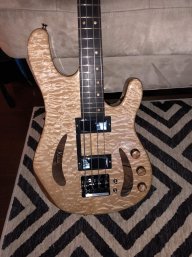
I'm making the Bass myself, so I was thinking of having a total of 5-6 knobs. Two for the gain of each of the pickups, and then 3 or 4 for the EQ.

If it does sound like a viable idea, then I have two choices to go with:

1. An EQ where all of the bands have fixed cutoff frequencies, and just have 3 pots to adjust the attenuation of each band

2. An EQ where the frequencies are fixed for the Low and high frequencies, but an extra pot is used to affect the centre frequency of the 'Mid' band.

It might be a little bit of overkill, but conversely thought it might be nice to have quick access to adjust the level of the Mid frequencies quickly on stage, without having to go to the amp.

Thanks for reading, and I apologise if I've missed a thread like this on here that has already covered this subject!

Dan

 
Interesting idea - although my mind is unable to process how you can boost a signal by passive means.

Continuously variable center frequencies aren't practically achievable with passive electronics (yes, you could use a variable capacitor, but these only provide very small capacitances which aren't particularly useful for audio)

Good point. I suppose in that case it would have to be just 3 attenuable circuits, with the Mid-range covering a frequency range of something like (at a guess) 300-600Hz, and then just have Low-Pass and High-Pass either side.

I wonder if there would be a way of using a variable capacitor, but multiplying its 'value' based on other components in the circuit. I suppose there's only so much you can do :)

I suppose the next step is to work out what values of resistor and capacitor I'll need for each circuit, based on the output of the pickups. Is that the ideally the best route, or can I use some 'generic' values to work from?
 
Interesting idea - although my mind is unable to process how you can boost a signal by passive means.

The only logical answer anyone has come up with (AFAIK) is that his circuit robs energy from one or more frequency ranges in order to add energy to the boosted frequency range. IOW there's no way it's a full-range boost.
 
So I guess the trade-off with using a transformer would be that you'd have to carry a DI box around all the time. Either that, or you'd end up with a lot of transformers in the Bass itself!

I may be flogging a dead Donkey here, but rather than using a variable capacitor, would it be possible to use a fixed capacitor and vary the resistor instead? That's obviously the most basic principle, given that a band-pass circuit has two elements.
 
L0calh0s5t has a cool signature.

You can't boost power without an active circuit. I wouldn't bother trying to go passive since it means capacitors and inductors in your bass taking up the room a battery could take, and without a huge component count the controls would be confusingly interactive.

More food for thought:
- Classic passive tone is cut-only and affects treble.
- One way to boost mids is to favour the bridge pickup
- so you get most of what you want with a simple volume-blend-tone stack

DanSwain - changing the resistor does change the circuit's 3dB point in a passive tone stack. Remember this is a first order (one of each component) low pass filter. Depending on the resistor, the circuit works by grounding (short circuiting) the treble, since capacitors pass treble.

A passive bass cut is more difficult and requires the presence of an inductor doing pretty much the same thing that the cap does in the treble cut.

Passive mid cut is a nightmarish resistor-inductor-capacitor thing that short circuits the mids. Trouble is, that's most of your volume gone now. Sure you can vary the tuning by switching extra caps and inductors in, but you're pretty much sending all your power to the short circuit and very little to the amp.

I'm confident that you'll get more joy either going passive v/b/t or going active.
 
L0calh0s5t has a cool signature.

You can't boost power without an active circuit. I wouldn't bother trying to go passive since it means capacitors and inductors in your bass taking up the room a battery could take, and without a huge component count the controls would be confusingly interactive.

More food for thought:
- Classic passive tone is cut-only and affects treble.
- One way to boost mids is to favour the bridge pickup
- so you get most of what you want with a simple volume-blend-tone stack

DanSwain - changing the resistor does change the circuit's 3dB point in a passive tone stack. Remember this is a first order (one of each component) low pass filter. Depending on the resistor, the circuit works by grounding (short circuiting) the treble, since capacitors pass treble.

A passive bass cut is more difficult and requires the presence of an inductor doing pretty much the same thing that the cap does in the treble cut.

Passive mid cut is a nightmarish resistor-inductor-capacitor thing that short circuits the mids. Trouble is, that's most of your volume gone now. Sure you can vary the tuning by switching extra caps and inductors in, but you're pretty much sending all your power to the short circuit and very little to the amp.

I'm confident that you'll get more joy either going passive v/b/t or going active.


Hey, active is great if you have the right set-up, but you're not 100% accurate here. There have been some innovations in passive circuits, and you need to check out Villex pickups. William Villex's systems are both cut AND boost, and they are entirely passive. The mid control is not cut only, and the sound is huge, like an active bass. That being said, you can also run them with a preamp. It's worth checking out if you want a passive circuit. If an active circuit you want, definitely check out East preamps.
 
and g&l basses use a simple capacitor on a pot to create a passive bass-cut.

the entire signal goes in one leg and comes out the other of a 1meg pot, which also has a small (.047uF, i think?) cap across those same two legs. when the pot is turned up, the two legs are shorted together for full signal. turning down the pot increases the resistance between the legs, attenuating what doesn't get through the cap, which would be the low end.
 
All the Villex does is run a small cap from signal to ground. This lowers the resonant frequency of the pickup, followed by a rather steep treble rolloff. Because there is more "energy" in mid and high mid frequencies, we perceive the lowered resonant peak to be louder.

That is one scheme. Passive treble rolloff is what is in all passive basses. A passive low filter can be used to reduce bass. G&L has this control in many basses. And a variable mid cut can be made, like a Gibson Varitone, which shunts mids to ground, at the expense of some high end.

Except for the lowering of the resonant peak of the pickup with it's perrceived mid boost, all other passive controls will remove signal, lowering output, and probably some high end and clarity. The original Ripper had a mid cut and a high cut. The mid was like a Varitone (cap and inductor) with only one cap. A Varitone uses 5 different caps, selected by the 6 position switch to select different caps, thus changing the frequency the mid cut takes place at.