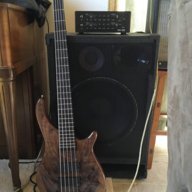
I am a confessed "CAPAHOLIC" - the bigger the better !!
In my long-term practical experience with a range of amps and models from different manufacturers I have discovered that over time as new models are released to the market they often include higher value capacitors in the power supply. These are basic full wave bridge (FWB) rectification systems with a single capacitor to each of the positive and negative rails.
In 1980 high powered PA amps featured large computer bus style capacitors, which cost the earth (and still do). But now domestic grade capacitors are finding their way into bass amps.
Over time capacitors have become progressively smaller and cheaper, allowing designers to use larger values - often in a smaller amp case. e.g in 1980 a computer bus cap of say 22,000 uF 63VDC would be 3 inches diameter x 6 inches high. Now a similar rated cap can be found with 1 3/8 inches diameter x 2 inches high - quite a difference. Not quite the same industrial quality but still does the job.
In larger amps multiple capacitors are now common because they are affordable and fit into the available space.
Advantages include:
- more energy storage for peak current draw
- reduced ripple current (hum)
- reduced power supply impedance for less voltage drop during peaks - i.e better power linearity
- better quality DC resulting in less (inaudible) ripple voltage modulation of the audio signal
- physically smaller and lighter weight power transformer for average current duty cycle
- better LF response when connected in series with the load - especially 2 Ohm loads
- better dynamic power response
However computer modeling shows that even with 100,000 uF the ripple voltage may still be higher with a large value single cap than with a simple PII filter - i.e smaller caps and a choke - as used in tube amps.
Ripple voltage is a natural product of rectification but can be eliminated by various design concepts requiring more complex circuitry - which increases cost. But it is cheaper as well as lighter weight when larger caps are used instead of a choke based filter or regulating circuitry, so that is what manufacturers choose for us
I disagree with some of BadCaps post above because filter caps are called filter caps because their primary function is to filter the rectified DC by smoothing the ripple voltage in a simple system. That concept goes back to at least the 1920's.
For the record, early tube amps used filter capacitors as low as 2 uF because that is all they had at the time. Consequently a filter choke was mandatory - otherwise the ripple hum was audibly unbearable. Tube rectifiers are also limited to filter cap size to prevent tube damage from inrush charging currents - so do not rush off and install huge caps in your tube rectified amp.
The beneficial byproduct of providing stored energy for peak currents is a bonus that came with the development of larger capacitors. An alternative is to use a higher current mains power transformer but that does not help when the peak audio signal coincides with zero or close to zero AC mains input voltage. A simple explanation is that the filter capacitors store energy for use between the AC mains input voltage cycles
Yes they act like batteries but also have a similar characteristic in that the internal resistance/impedance results in voltage loss. So again, the larger the caps the less likely voltage drop issues - i.e better power supply regulation.
In the case of the Sunn 1200S Bass Amplifier it is a Class H design, which means each leg of the output stage is connected in series such that the power supply capacitors are also in series. There are actually two sets of filter caps totalling 36,600 uF, but even though the nominal capacitance value is high the effective capacitance is reduced by subtraction - i.e 10,000 uF - 6800 uF in series. So what you get is the benefit of the high current storage but lose some of the benefits from the higher internal impedance
Nontheless the Sunn 1200 is a mighty top of the range bass amp designed to be 2 Ohms capable from its 16 power transistors. Designed by Fender it must be good.
As to "punch" that is a different issue. Punch is a function of dynamic power response. That requires instantaneous power from the power supply to all stages of the amplifier simultaneously - particularly the preamp.
It is common to see designers focus on the power stage and forget the preamp but the preamp also is dependent upon the main power supply. Even if the preamp power supply is separate it still usually derives its power from the same mains transformer as the power amp. So when a high current is drawn from the main power supply it causes the preamp supply voltage to drop also. A well designed amp will also feature adequately large capacitors in the driver and preamp stages so that each stage is relatively independent. The Sunn 1200S uses a regulated supply to the driver and preamp stages.
One important point overlooked is that at low frequencies the speaker impedance rises to maybe 8 to 10 times its nominal impedance. That has the effect of reducing real power output in that frequency range by a similar ratio.
So it becomes obvious why TBers are talking 1000 watts or more. To get 100 watts at 40 Hz the amp needs to be a 1000 watt capable amp so it will deliver 100 watts at 40 Hz into the speaker load of 64 to 80 Ohms. This is why 2 Ohm nominal loads are best for bass - but only if the amp will handle the low load value.
The Sunn and many of the Peavey amps will do this with ease.
WARNING: Extra capacitance results in a higher inrush/charging current at switch-on. This can blow the normal internal amp fuse and/or damage the rectifiers and/or power transformer. Proceed with care.
Comments are welcome.
Some good information, some incorrect information, filled with some horribly misleading conclusions.
1. The old can style caps were big because the technology was obsolete. both the design and materials technology.
2. Modern high quality caps are far superior in every aspect due to monumental improvements in design and materials. Specifically ESR, energy density, temperature limits, ripple current and lifespan.
3. Newer amps use larger filter caps generally because the amps have higher rated power.
4. Peak audio current doesn't matter if it occurs at zero crossing of the AC power waveform because the audio is asynchronous.
5. The Sunn 1200S does not have its high tier rail's power supply caps in series with the low tier, its a separate cap referenced to ground.
6. Punch has many different definitions, most of which relate to preamp response and tone choices.
7. Virtually all modern preamps use supplies regulated down from a higher voltage, therefore raw higher voltage supply voltage sag is of zero consequence.
8. Power amp driver stages on bipolar power amps track the output stage as a byproduct of the topology itself, so sag tracks exactly proportionally. On MOSFET power amps, driver stages usually use a boosted driver supply not for sag but due to the need to offset much higher Vgs voltage thresholds.
9. Rising impedance at resonance is also accompanied by rising sensitivity, otherwise there would be a huge dip at resonance (which there is not). There is need to generate that kind of additional voltage swing at resonance and to do so would not be helpful in any way in practice.
10. 2 ohms is not necessarily the best impedance to run a bass amp at, nor are there any benefits other than to be able to run more speakers in a practical way. The reason 2 ohms became popular and common is that back in the day, it was much easier to design such amps due the the difficulty (as in impossible) of sourcing high voltage power transistors. High current devices were MUCH more practical than high voltage devices or totem pole designs.
I urge you to be careful in drawing the conclusions you do in the face of multiple practical real world examples that contradict your conclusions.