• TalkBass has been independent since 1998. Add your voice.
    Create a free account to reply to discussions, view embedded media, and browse with fewer display ads.
    Join freeLog in
    Want zero display ads or expanded classifieds tools? Compare plans.

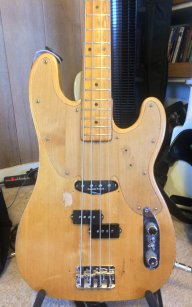
1958 Fender Precision

The thing is I really trust the guy that did the work on the bass. He is a master luthier and is a very well known name around town. I've been taking my stuff to him for years and he has always done an excellent job. I'm thinking that he wouldn't have done that unless it was absolutely necessary given his 25+ years of expertise and his credibility. My only concern is whether or not the "pillowed" neck plate will affect the value of the bass.

 
The shim wasn't necessary, nor was tightening the neck plate down that much. It won't affect the value, but a repair person should know better than to do that. There are less invasive ways to make the neck not move (like a piece of screen in the neck pocket) and they don't require over tightening the neck plate screws.
 
If you decide to flatten out the plate, use a vise with padded jaws.

I've done the neck-shift maneuver many times on old Fenders, never had a plate react like that, not even when the body wood had a pre-existing impression from the plate. Not liking what I'm seeing on yours.
 
I almost wonder if the previous owner had over tightened the plate at some point, damaged the wood underneath, and then straightened the plate prior to selling. If he retightened the neck bolts a little loose, it would most likely cause the neck to shift when the strings were retensioned. Then when your luthier checked the bass out and reassembled everything, the neck plate bent back the way it was. Does the nitro finish seem relatively undisturbed around the edge of the plate, or does there appear to be fresh damage? At the very least, I'd ask the luthier what happened.

FWIW, I don't think the value of the bass will be affected by that, but I'm not an appraiser. I would also be upset if it happened to one of my basses, but I could live with it.

Oh yeah, before I forget, beautiful bass, man!
 
  • Like
Reactions: DavidEdenAria
I almost wonder if the previous owner had over tightened the plate at some point, damaged the wood underneath, and then straightened the plate prior to selling. If he retightened the neck bolts a little loose, it would most likely cause the neck to shift when the strings were retensioned. Then when your luthier checked the bass out and reassembled everything, the neck plate bent back the way it was. Does the nitro finish seem relatively undisturbed around the edge of the plate, or does there appear to be fresh damage? At the very least, I'd ask the luthier what happened.

FWIW, I don't think the value of the bass will be affected by that, but I'm not an appraiser. I would also be upset if it happened to one of my basses, but I could live with it.

Oh yeah, before I forget, beautiful bass, man!

Thanks man! The finish around the neck plate appears to be undisturbed.
 
Thanks man! The finish around the neck plate appears to be undisturbed.
Since it's undisturbed, I bet it happened years ago, and the shop or previous owner attempeted to fix it prior to sale, and didn't realize that the neck would be looser as a result. It may have even been that way since new, and the paint cured around it. If your luthier/tech did that, he'd surely hear the paint and wood crushing/ cracking as he torqued the bolts down and would have stopped at the first one, I'd imagine. You also said he's trusted and has done prior work for you without incident.

Full disclosure, I'm not a tech, luthier, or vintage gear expert!
 
That's one of the downsides to having to remove/loosen the neck every time you need to make a truss rod adjustment. After repeated loosening and tightening the wood compresses. The "pillowing" neck plate is unavoidable and is normal for most basses with this type of truss rod adjustment. That's why on later models they notched the body to allow access to the adjustment.
 
That's one of the downsides to having to remove/loosen the neck every time you need to make a truss rod adjustment. After repeated loosening and tightening the wood compresses. The "pillowing" neck plate is unavoidable and is normal for most basses with this type of truss rod adjustment. That's why on later models they notched the body to allow access to the adjustment.

It's neither normal nor common.

It might happen once in a while but that's it.
 
I almost wonder if the previous owner had over tightened the plate at some point, damaged the wood underneath, and then straightened the plate prior to selling. If he retightened the neck bolts a little loose, it would most likely cause the neck to shift when the strings were retensioned. Then when your luthier checked the bass out and reassembled everything, the neck plate bent back the way it was. Does the nitro finish seem relatively undisturbed around the edge of the plate, or does there appear to be fresh damage? At the very least, I'd ask the luthier what happened.

FWIW, I don't think the value of the bass will be affected by that, but I'm not an appraiser. I would also be upset if it happened to one of my basses, but I could live with it.

Oh yeah, before I forget, beautiful bass, man!
This.......I mean cmon, its a factory built bass and the truth is there was a tiny bit of slack in the neck pocket or a shim wouldn't fit in the first place.

I am guessing the neck had been tightened down many years ago and caused the neck plate to pillow....these are not FLAWLESS instruments and there is always a slight bit of variance.

The most important part is how flush the body and neck actually seat when the neck is screwed down

I wouldn't worry about it for 5 seconds and play the bass as is.....bottom line is how it plays and sounds!