• TalkBass has been independent since 1998. Add your voice.
    Create a free account to reply to discussions, view embedded media, and browse with fewer display ads.
    Join freeLog in
    Want zero display ads or expanded classifieds tools? Compare plans.

1969 SVT restoration project

Now all you gotta do, is find a way to leave that Markbass amp at home, and fly with that SVT head-perhaps you can get it it's own seat? The seat belt should be able to hold it in :D

Just kidding of course!! Glad you're finally getting your amp back.

I bought an SVT head in Lima Peru, right before they hired the gestapo to check your bags and lowered the amount of weight you could put on an airplane. I flew home with that head and two B-15T cabs. All I did was put thick cardboard around the whole thing so it was about 1" thick and wrote fragile all over it.
 
Too bad Bowser can't hook you up with a private jet for you, and that SVT-oh, but then he'd actually have to HEAR the bass!! :eek:

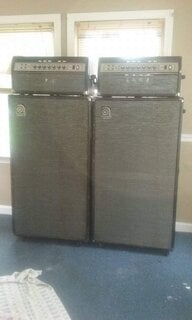
Hey, when you finally get it home, post a pic if you can, ok?
You know, the $1425.00 is a big outlay, but think of it this way;the new SVT-VR reissue is a lot more money, and the guys who know how an SVT is supposed to sound-like Psycho Bass Guy-will tell you that it's not even close to an authentic model, like you have. Now that it's like new, it should last decades longer!

Take care with that bad boy Jimmy :hyper:

I'm not Psycho but I can tell you that half the tubes in a VR are not the same as SVT's have in them. I've never heard one so can't comment on that but have owned 4 SVT's over the past 33 years and I can't believe all the problems people are having with the VR's. You'd have to be nuts to spend 2 grand for one when you can get a real SVT for half to three quarters what VR's cost and remember VR stands for Vintage Reissue. The last SVT was made in 1984 in Japan, all since them have been SVT-XX bla, bla, bla. I have two SVT heads currently, both over 30 years old and while both have been recapped and retubed everything else is original except for a resistor or three and they work no matter how low the line voltage falls :rollno: SVT's have been the most reliable amps I've ever owned and I abused the hell out of them when I was a kid.
 
I guess you missed the part where I said "those who know what an SVT is supposed to sound like" I don't own an SVT, never said that I did, and if you are unhappy about that, show me where I said different. I said PSYCHO BASS GUY-he owns authentic SVT's, and has test driven the SVT-VR.

I'm outta here-jeez, the stupidest s*** gets people's panties in a bunch around here-especially those who don't read the posts carefully. Sorry if I insulted one of your obviously favorire amps. Personally, I play a Fender-if you think that sucks, who gives a rats ass? I enjoy my amp-enjoy yours. Aren't there more important things in the world to worry about??

i did read your post (and everyone else's) very carefully and basically, all you did was perpetuate a rumor without having any experience to back up your statement. all i'm saying is, why make a statement like that if you haven't owned or made the actual comparison yourself? it just contributes to more web misinformation.

PS. i couldn't care less what type of amp that you play thru.
 
I played an outdoor party Sat with my 73 SVT and the 8x10 in like 98 degree heat with humidity that was almost suffocating. Shirt removal was mandatory :eek: because your shirt was soaking wet after about 2 minutes. My new CS Jazz got a little wet and my SVT ran at half throttle (12 oclock) the ENTIRE night (5+ hrs) and didnt even whimper! I reached in and felt the front transformer after about an hour and my skin almost melted! I found a fan and stuck it behind it after that (I also removed the front grill panel) just because I didnt want to test it any more. These heads are so dependable! I've had mine a year and it always fires right up and finishes strong. Best amp ever.

I did blow a speaker(s) in my 8x10 though first thing :(. All original cones in it. Very sad. Maybe my SVT is running a little over 300 watts? Had to go home and get the fliptops 4x10. It did great! I really am liking that cab more and more -which is good I guess since it is my only working cab now!
 
I guess you missed the part where I said "those who know what an SVT is supposed to sound like" I don't own an SVT, never said that I did, and if you are unhappy about that, show me where I said different. I said PSYCHO BASS GUY-he owns authentic SVT's, and has test driven the SVT-VR.

I'm outta here-jeez, the stupidest s*** gets people's panties in a bunch around here-especially those who don't read the posts carefully. Sorry if I insulted one of your obviously favorire amps. Personally, I play a Fender-if you think that sucks, who gives a rats ass? I enjoy my amp-enjoy yours. Aren't there more important things in the world to worry about??

A little harsh, no? The guy owns both and you dont own either. I have heard the VR is real close to the original by several people. The same? Not many have said that, but its supposedly a lot closer than a CL. I only have the real deal so I wont comment on the VR, but if someone has both I definitely respect their opinion. Having both eliminates any bias towards one or the other IMO.
 
Beef and JohnK, thank you guys for trying to stir a little controversy up in my thread. It's always appreciated. I like watching other people argue for a change ;)

John, didn't you say that you replaced a few tubes in the VR before you said you thought it was as good as the old ones? I've played a VR before and thought it was terrific, but never was able to do a direct comparison.
 
Beef and JohnK, thank you guys for trying to stir a little controversy up in my thread. It's always appreciated. I like watching other people argue for a change ;)

John, didn't you say that you replaced a few tubes in the VR before you said you thought it was as good as the old ones? I've played a VR before and thought it was terrific, but never was able to do a direct comparison.


hey Jimmy, not trying to stir up anything. Some guy who owns a SVT-VR thinks I disrespected him somehow.

Anyway, enjoy your amp my brother :hyper:
 
A little harsh, no? The guy owns both and you dont own either. I have heard the VR is real close to the original by several people. The same? Not many have said that, but its supposedly a lot closer than a CL. I only have the real deal so I wont comment on the VR, but if someone has both I definitely respect their opinion. Having both eliminates any bias towards one or the other IMO.

Psycho has played both, that was my point-a guy like him who has played both knows how one compares to the other.
Does his opinion matter then? Just because he's not from a vintage guitar company, does his opinion matter any less?

Hey man, whatever-play what you like and enjoy it :hyper:
 
Beef and JohnK, thank you guys for trying to stir a little controversy up in my thread. It's always appreciated. I like watching other people argue for a change ;)

John, didn't you say that you replaced a few tubes in the VR before you said you thought it was as good as the old ones? I've played a VR before and thought it was terrific, but never was able to do a direct comparison.

Hi Jimmy,
yes, i replaced the three 12AX7A's and two of the 12AU7's in the VR's preamp with NOS tubes and it made it alot smoother, but it was pretty good with the stock (crappy and noisier) tubes. After owning nine original SVT's since 1972, i must say that all of them were a little different from one to the next, but all of them had the unmistakable "SVT" sound and were very powerful. I was actually very surprised (and pleased) when i first played thru my VR to hear that it sounded like what i've come to expect an SVT to sound like. i now use it at gigs rather than taking the old one since its a replaceable amp and it hasn't let me down, both tone-wise, and in reliability, yet.

in no way was i trying to start a flame war in your post, just trying keep this thread free of "hearsay", based on my actual tests. BTW, i bought my VR for $1500 even brand new in the box, so to me, it wasn't all that expensive for an all tube 300 watt bass head.

if i were to recommend an amp to someone that wanted an SVT, i would recommend a vintage original (mostly for the sake of investment) since they actually appreciate in value, but i am not sorry in the least that i own both.
 
This is kinda long, but it's an article I found about the differences between the 6146/6146A/6146B tubes. I thought I would share this for those who are interested to be aware that there are differences; also for those who are bored and need to kill some time at work. :hiding:


The 6146 Family of Tubes


by


Glen E. Zook, K9STH


Probably the most used tube of all times in the final amplifier of "boat anchor" transmitters is the 6146. From the early 1950s until at least the 1980s, the 6146 found its way into virtually every manufacturer's line of transmitters. In fact, during the early 1960s RCA had a series of advertisements on the back cover of QST that listed a different manufacturer's equipment that used the 6146 each month. A copy of the January 1960 QST advertisement featuring the Hallicrafters HT-37 is included with this article.

There are actually three distinctive variants of the basic 6146: The 6146, 6146A, and 6146B. It is unfortunate that the 6146B was called the 6146B for it is really a different tube from the first two. Primarily the difference between the "plain" 6146 and the 6146A is the makeup of the heater ("filament"). The 6146A has what RCA calls the "dark heater". This "dark heater" is supposed to be more resilient to vibration, work well at a larger "range" of voltage, etc. Otherwise, the 6146 and the 6146A are the same tube.

In mid-1964 RCA introduced the 6146B with the "claim" of 33.33 percent higher power input than the 6146 / 6146A. Also, it was "claimed" that the 6146B could be directly substituted for the earlier tubes. The 6146 / 6146A had a maximum rated power input of 90 watts for CW and SSB operation and the 6146B had a rating of 120 watts for the same emissions. You can see this in the attached copy of their ad from the September 1964 issue of QST.

Many amateurs are aware that the military "ruggedized" version was designated the 6146W (I will get to these tubes a bit later). However, RCA also introduced in the early 1960s the 8298 tube for use in commercial mobile equipment. The 8298 is just a "heftier" 6146A. Motorola, General Electric, and quite a number of other commercial FM equipment manufacturers used these tubes in all sorts of FM communications equipment for both low band (30-50 MHz) and high band (150.8 - 172 MHz). When the 6146B was introduced, RCA "announced" the 8298A commercial equivalent of the 6146B. In fact, most of the RCA 6146B tubes were "cross branded" with the 8298A number in addition to the 6146B.

Those companies who were manufacturing 6146 series tubes for the military changed from the "plain" 6146 to the 6146A to the 6146B as the military decreed. However, all of the tubes manufactured under military contracts were known as 6146W and, to my knowledge, nothing was done towards marking the tubes as being equivalents of the 6146, 6146A, or 6146B. The only way of telling is from the "date code" which is printed on each tube. Different manufacturers changed tube types at different times. Also, I know of no "master list" telling on what date a particular manufacturer changed from the 6146 to the 6146A to the 6146B. The only "sure" way to know if a particular 6146W is of either the 6146 or 6146A type is to look for a "code date" of before 1964 since RCA introduced the 6146B in the middle of that year. However, some manufacturers did not start manufacturing 6146B equivalent 6146W tubes for at least a year after RCA introduced the 6146B.

RCA "claimed" that the 6146B was directly interchangeable with the earlier members of the 6146 family. Unfortunately, this did not hold true in most cases. Collins, Heath, and probably other companies, at first issued various documents saying that the use of the 6146B in their equipment was "fine". But, this soon proved otherwise!

For example, when the 6146B was used in the Collins 32S-1, 32S-2, 32S-3, 32S-3A, KWM-2, and KWM-2A it was discovered that the components in the neutralization circuitry "burned up" in a very short amount of time. Thus, Collins had to retract the statement that it was "OK" to use the 6146B. Then, due to the fact that the United States military establishment wanted to "standardize" on the 6146W equivalent of the 6146B, the neutralization components had to be redesigned to allow the 6146B to be used. Fortunately, these changes did not affect the use of the earlier 6146 and 6146A in those transmitters manufactured to use the 6146B. All three types of tubes may be used without any problem in these transmitters.

Replacing the 6146 / 6146A tubes with 6146B types often results in spurious emissions, parasitic oscillations, etc. This is due to the fact that there are different bias requirements, different inter-electrode capacitances, etc. of the 6146B versus the other two. It is often difficult to neutralize 6146B tubes when used in place of the 6146 / 6146A. If neutralization can be achieved, often it lasts for just a few minutes before the tube(s) goes into oscillation.

If one insists on trying the 6146B tubes in place of the 6146 / 6146A types, the very first thing to do is to neutralize the final amplifier. If it will not neutralize, then the 6146B tubes should immediately be replaced with the older type tubes. If it does neutralize, then the neutralization should be "watched" for several hours (even days) of operation. If the neutralization changes, then the 6146B tubes again should be replaced with the 6146 / 6146A series. If the neutralization remains constant after several days, then use of the 6146B is fine in that particular transmitter.

I have, in my shack, a number of transmitters that use the 6146 / 6146A type of tubes. These include Collins 32S-1, 32S-3 (earlier model before the neutralization was changed); Heath Apache, DX-100, DX-35, SB-401, SB-110, Seneca; Johnson Pacemaker; and other transmitters as well. Every one of these is much "happier" with the 6146 / 6146A family of tubes. In addition, I have owned transmitters like the Knight T-150 and T-150A that use the 6146 tubes. Frankly, these transmitters were much happier with the 6146 / 6146A tubes.

There is another 6146 family tube that is "superior" for operation at least through 10 meters. That is the 6293. This tube was designed for "pulse" service and is rated at 1-Kilowatt pulse power input. The primary difference between these and the "normal" 6146 is that the plate is much "heavier" in its construction. Back in the late 1950s and early 1960s we would almost "kill" to get our hands on a pair of these for our DX-100s, etc. The 6293 outlasts the 6146 in "normal" service by at least 5 times and often more than 10 times the life of the tube. These tubes "show up" at hamfests, swap meets, etc., from time-to-time. If you see some of these, definitely "glomp" onto them!

The 12-volt equivalent of the 6146 is the 6883, the equivalent of the 6146A is the 6883A, and the 6146B is the 6883B. Now, there are the tubes that were manufactured for FM commercial service. These series go as follows: 6883, 6883A / 8032, 6883B / 8032A / 8552. Again most of these are "cross branded" with all of the tube numbers that are equivalent.

From 1970 until late 1979 when Motorola went out of the reconditioned equipment business, I owned the Motorola reconditioned equipment center for the south-central United States. We reconditioned Motorola FM equipment for 14 states, everything that Motorola sold reconditioned that was exported, and everything that was sold to the United States Government (this was the height of Viet Nam and the Government did buy reconditioned equipment!).

At that time, the Motrac series of mobile equipment was very popular. Depending on the model, these normally used one, or two, of the 6883A / 8032 tubes. It was only in the very "latest" models (HHT "E" series, LHT series, and MHT series) that Motorola had redesigned the equipment to use the 6883B / 8032A / 8552 tubes. Around late 1976 or early 1977, Motorola decided to eliminate some of the tube types that they were "stocking" at the Schamburg, Illinois, parts depot. Thus, they started shipping 8552 tubes in boxes that were marked as 8032. The Motrac is unique in the fact that you cannot see the tubes when they are in operation (they are enclosed in a metal "heat sink"). In fact, it is difficult to even "tune" a Motrac when the heat sink is not in place.

We went through from 50 to over 100 of the 8032 type tubes per week and within days were "down" to using the 8552 tubes in the 8032 boxes. Within a very few days of starting to use the 8552 tubes we started receiving complaints that virtually every Motrac unit that was received by customers arrived with one, or both, tubes broken. Prior to this we had never had a single complaint. Upon investigation we found that the 8552 tubes had so many parasitic oscillations that they were getting so hot that the glass envelope was being annealed! This was happening within a minute, or two, of tune-up and final quality control. When the radio was subjected to normal vibrations of shipping, the glass envelope of the tubes was being shattered.

This was reported to Motorola. At first they refused to believe us saying that we must have gotten a "bad" shipment of tubes. But, within a couple of weeks they received over 1000 complaints from their service stations about exactly the same problem. It cost Motorola one "heck of a lot" of money to pay the warranty claims because they had tried to "cut costs" by eliminating the earlier type of tube. They had to re-box all of the 8552 tubes that had been put into 8032 boxes and get in a "rush" shipment of 8032 tubes.

The whole problem stemmed from the fact that the "B" series of tubes is not the same as the "plain" and "A" series. The parasitic oscillations were caused by the different bias requirements and by the "fixed" neutralization of the driver and/or amplifier tube in the Motrac. There was no practical way to change the circuitry to handle the "B" series tubes. Also, making such a change would void the "type acceptance" of the units.

In a "practical" sense, it is "OK" to mix 6146 and 6146A tubes since the primary difference is in the design of the heaters. But, NEVER mix 6146 / 6146A tubes with a 6146B! This is really "asking for trouble".

Also, in a number of transmitters and transceivers (especially the Heath SB-Line) the heaters ("filaments") of the pair of 6146 tubes are in series. In these units it is very easy to change the heaters from series to parallel and substitute the 6883 / 6883A / 8032 tubes. The 12-volt equivalent tubes are often available for "pennies" because of the vast number that were used in the commercial FM market. I have done this with my Heath SB-110A and it works "like a champ". If you every want to change back, it is a very simple operation to do so.

I know that there are amateurs who say that they have used the 6146B tubes in place of the 6146 / 6146A without any problems. I can definitely believe that. But, I have seen way too many examples of the 6146B causing problems in relation to the cases in which the substitution has no effect. As I said before, neutralize and keep checking the neutralization for several days if you do replace your 6146 / 6146A tubes with 6146B types. Otherwise, you can find yourself with TVI, "burned out tubes", and other damage to your transmitter.

You must be VERY careful when dealing with the various tubes of the 6146 family, otherwise you just might be in for some very interesting problems.
 
all you did was perpetuate a rumor without having any experience to back up your statement.

I take exception to my observation being called a rumor. The VR I played neither sounded nor physically felt like any of my SVT's, so much so, that I suspect it to be different from other VR's. AFAIK, it's still at GC Nashville, where it has been for over a year, so if anyone wants to double-check my observations there, please do.
 
lneal, thank you for posting that article. My tube guy actually recommended I get the 6146W's, but since I was so keen on putting my amp like it was in the day, and since 6146W's didn't exist in 69, I got 6146B's. But when I pulled the tubes out of my amp, I had a couple 6146's mixed in with the B's. I don't think it came from the factory like that, but according to this article, it might have contributed to its eventual downfall.
 
Yea Jimmy, that article was about RF applications, so some of those interelectrode capacitance issues that are a major problem at RF frequencies probably wouldn't be a problem in audio apps. The differences that affect us audio guys would be more in the biasing, considering that, according to the RCA transmitting tube manual the average plate resistance (at 600 volts) of the 6146/6146A in class AB2 (push-pull) is ~7500 ohms where the 6146B is ~ 5000ohms. They also suggest an idle plate current of 31mA for the 6146/6146A and 50mA for the 6146B in class AB2. That's a significant difference. In the same mode (also @ 600V), the max plate dissipation is 130 watts per pair of 6146Bs where the 6146/6146A is rated at only 90 watts. (As an aside, the 6550 is rated @ 100 watts per pair under the same conditions, which could explain some of the higher power measurements for the 6146B over the 6550).

I pointed all this out to show it is very likely that your SVT or anything else for that matter would have been impossible to get biased properly with a mixture of the different 6146 types in there and maybe would have eventually eaten itself. I have my own sick, twisted reasons for knowing all this about those tubes, haha (a future DIY project??).:hyper:
 
I take exception to my observation being called a rumor. The VR I played neither sounded nor physically felt like any of my SVT's, so much so, that I suspect it to be different from other VR's. AFAIK, it's still at GC Nashville, where it has been for over a year, so if anyone wants to double-check my observations there, please do.

Psycho, thank you so much for watching my back brother!!

You know, if that guy came off a little nicer, rather than starting with "this kind of remark really gets to me" none of this would have happened. He could have just stated his observations-like you did when you compared them.

I'am also sorry if I dragged you into anything-it wasn't my intention. Since you have played, and repaired SVT's for longer than a lot of us have been alive, when you do a comparison, I trust it. I've never played thru a vintage SVT-especially one in good working order, so I'm the LEAST qualified to say how they sound, and I know it.

Again my brother, thanks for looking out for me :bassist:
 
I'm not Psycho but I can tell you that half the tubes in a VR are not the same as SVT's have in them. I've never heard one so can't comment on that but have owned 4 SVT's over the past 33 years and I can't believe all the problems people are having with the VR's. You'd have to be nuts to spend 2 grand for one when you can get a real SVT for half to three quarters what VR's cost and remember VR stands for Vintage Reissue. The last SVT was made in 1984 in Japan, all since them have been SVT-XX bla, bla, bla. I have two SVT heads currently, both over 30 years old and while both have been recapped and retubed everything else is original except for a resistor or three and they work no matter how low the line voltage falls :rollno: SVT's have been the most reliable amps I've ever owned and I abused the hell out of them when I was a kid.
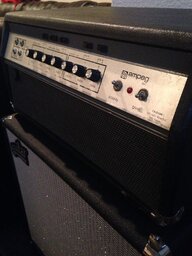
Well, there is definitely a reason so many older ones are still around. Whats cool is, Jimmy has a first year SVT!

If I had the need, and the money for an amp like that, it would be a vintage SVT, like Jimmy got, or like you have(had)For no other reason, than like you said-they take a licking, and keep on ticking, and from what the owners say, just sound so good!! :hyper:
 
I take exception to my observation being called a rumor. The VR I played neither sounded nor physically felt like any of my SVT's, so much so, that I suspect it to be different from other VR's. AFAIK, it's still at GC Nashville, where it has been for over a year, so if anyone wants to double-check my observations there, please do.

PBG,
my intention was not to offend you, and i'm not saying that your opinion isn't valid. as a matter of fact, i value it, however IIRC you also previously stated that that particular VR weighed less too (?), which is not the case with my VR. It weighs, within a pound or two, the same as my 1969 SVT (approx 90 lbs). it makes me wonder if it possibly could be that the one the you tried at GC wasn't running properly (in need of service) or it was just a bad one? and not being there and playing thru it, i can't possibly make that determination. if it was as bad as you said it was (and i believe you), i wouldn't have purchased one, thinking that all of them were that way.

i have stated many times that i was surprised to hear that my new VR sounded like all of the previous SVT's that i've owned over the years and i wish that you lived closer so you could play thru both of my SVT's to hear them side by side. they are so similar sounding, i think that you would be surprised as well.

i don't think that my VR is necessarily an exceptional one as a friend of mine also has one, and it too sounds like mine.

IMO the SVT-CL doesn't sound or feel like an original SVT. not to say that they aren't a good amp, they just don't capture the SVT sound that i've grown so accustomed to.
 
Wow, look at everyone getting along now! That's cool...I like all involved very much, so even though I like to see people throw out a few tweaks here and there, I see no need to take it seriously.

Anyway, here's the report after getting it back...

I wish there was a "poop your pants" icon. Yeah, that's the sound! Holy cow, that's the sound! Never have I heard an SVT that sounds so good! That 6550 in there was killing it tonally. It sounds amazing! Birddog replaced all the caps, replaced all the plate wires for the 6146B's, installed a modern AC cord with receptacle, and fixed a grounding problem, and now it works as good as new. Almost...I think I may need to replace the 12AX7 in channel 2's preamp, which is a pain. But it's got crackling that's either a dirty pot or a bad 12AX7. Sounds great when it's not crackling. Not a big deal, but I'm surprised he didn't catch it.

Now for the "bad news"...he didn't use the tube relay. His explanation made sense...they're prone to going bad, and when they go bad, they lock up the whole amp. It's not a big deal, I guess, but I did pay $22 for it and I thought it was one of the cooler things about it. I also was a bit bummed that he didn't replace any pots that were non-standard. I thought I had asked him about that, but maybe I didn't.

Anyway, it still looks like crap cosmetically, but boy does it sound good! I'll post pics when I can but this is a bad 2-week stretch for me. It really doesn't look any different ;)