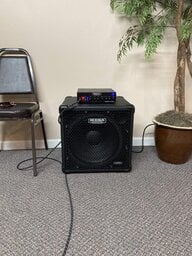
When I asked whether to use the 2ohm or 4ohm input in this or another thread with my 112AV/212AV cabs, IIRC, jimmyM said use 2ohm as did a couple others. But CL400PV said use the 4ohm input. I'm guessing this is because the 8ohm/4ohm cabs is about 2.67 ohms and that's still above 2ohms, so the 4 ohm input was suggested. I think a couple here have said either is fine. But be nice to know exactly which is best to use for long term.
The short answer is use the correct impedance. With a mismatch, it could be done either way in this case but there are tradeoffs.
Here's a longer confusing answer. It's more complicated than what I'm outlining here. The designers concluded that at the plate and screen voltages of the amp, the 6L6GC tubes are matched to the output transformer when they see an impedance of around 2200. Matched means that the power transferred from the tubes to the speakers is optimized over the frequency range that the transformer was designed for. The output transformer primary in the V4B is 2200, the secondary is 2, 4, and 8. This means that if you connect a speaker cabinet rated at 2 ohms to the 2 ohm tap, the tubes will see an impedance of 2200 ohms. Likewise, if you connect a 4 ohm cabinet to the 4 ohm tap, the tubes will see an impedance of 2200 ohms. The impedances are matched.
2200:2 has a winding ratio or 1100:1; 2200:4 has a ratio of 550:1; 2200:8 has a ratio of 275:1
The tubes see what is called a reflected impedance. That is, the transformer serves to reflect what is connected to it from the speakers to the tubes.
If you connect a 2.67 ohm cab to the 2 ohm tap, the tubes will see an impedance of 2.67 X 1100 = 2937 ohms. This is 33.5% higher (2937/2200=1.335%) than the designers optimal choice of 2200 ohms.
If you connect a 2.67 ohm cab to the 4 ohm tap, the tubes will see an impedance of 2.67 X 550 = 1468.5 ohms. This is 33.25% lower (1468.5/2200= 0.6675% or 1-0.6675=33.25%) than the optimal 2200 ohms.
Depending on how you connect the cabinets, you are right in the middle, about 33% higher or lower than the optimal impedance match.
What happens when the impedance is not matched? The operating point of the tubes shift, current flow is affected, and the amp will perform and sound a little differently. There are tradeoffs with tube life and transformer current. There will be a bit less power with a 2.67 ohm cab connected to the 2 ohm tap, a bit more power with the cab connected to the 4 ohm tap. You won't hear the difference in power. Headroom, compression, and onset of distortion will be a bit different. How much so depends on the amp's design. Some amps can better cope with an impedance mismatch than others. In this case, I don't believe that it will harm the amp running a 2.67 cabinet connected to either the 2 or 4 ohm tap.
The general rule of thumb with a tube amp is that it is safer to present a lower impedance to the tubes than it is to present a higher one. The reasons are complicated. Adopting this rule, connect the 2.67 ohm cabinets to the 4 ohm tap. You can't just look at numbers though, listen and use whichever connection you think sounds the best.
One thing that wasn't touched on. Are the same speakers found in the 212AV and 112AV? When you connect 4 and 8 ohms cabs in parallel, they will not perform equally. This is another can of worms.





 Peace y'all, ernie
 I will try to apply that wisely and yeah...I do plan to enjoy this; my heaviest rig in years. When I do get lazy, I have the other 5-lb amps/45-lb 212 cabs, that I will still use as well.