Well if there's one lesson we should learn from the SVT, it's that tubes themselves aren't nearly as important as the overall design.
Actually, I think you've got it backwards. The tubes are what matters. The design of the amp has to respect the operating limits of the tubes, or the amp is going to fail. Period.
The reason that the SVT works as well as it does, even at those high voltages, is because it's designed to run on 6550. 6550 are robust tubes that were designed to run at extremely high voltages. They will laugh at the kind of voltages that will kill many a good 6L6.
The SVT is a great amp because it combines a robust tube that's designed to operate under extreme conditions, with a circuit that is designed to get the most out of those tubes under those conditions. Everything in the original SVT is designed to work well within the operating limits of the tubes, and the result is a monster of an amp.
So I'm scratching my head about this V4-B reissue. If you want an amp that's going to have all of the balls of the original, then it's going to have to run at really high plate voltages. There aren't any real 7027 in production today, all that we really have are 6L6 that aren't the equivalent of the 6L6 of yesteryear. And of course, that means they're not anywhere close to being a real 7027.
There haven't been any disclosures to indicate whether LOUD is being true to the original design with high plate voltages, or if they're taming the voltages down a bit in order to be easy on their choice of a less robust tube. The problem is that we might be looking at a lose-lose situation from an engineering standpoint.
If they're being true to the original design, with it's high B+ voltages, then their choice of 6L6 was just stupid, as the current production 6L6 aren't likely to last very long under those operating parameters. OTOH if they've chosen to lower the plate voltages to run the tubes under less strenuous operating conditions, then the result is going to be a less ballsy amp.
It's evident that they've given up on using real 7027, so they chose to change the tube specification. But what amazes me is that when they changed the tube specification, they decided to move DOWN a tube grade to a 6L6. What they should have done would have been to move UP a tube grade to a 6550. But doing that would require a circuit redesign, and the result would be a new amp rather than a reissue. Maybe the people who own the Ampeg name today aren't up to the challenge of engineering a new amp of this caliber from scratch. After all, the Ampeg name is now owned by Loud Technologies, which is colloquially known as the House of Crate.
If Ampeg were smart they would have chosen a tube that could easily handle the required operating parameters, like the 6550.
If they're taming the voltages to be easier on modern day 6L6, then IMO the amp isn't going to be much of a V4-B reissue, as the high voltages are what it takes to get the tone and power that earned the V4-B it's reputation.
I realize that I'm going to have to duck for cover as I say this, but I'm not at all excited about Loud Technologies bringing out a V4-B reissue that uses 6L6. I think it's going to be a disappointment. Depending on the voltages they used, it's going to be either a tube eater that will chew up and spit out 6L6, or it's going to be an emasculated poser that's designed to run on lesser tubes and will never reach the performance level of the original V4-B.
What they really should have done -- what I would have done if they hired me to engineer their new reissue -- would have been to design the V4-B to run on a pair of 6550 under operating conditions that are similar to having 1/3 of an SVT. Instead of doing that, the House of Crate just did a no-brains reissue of a circuit for which the required tubes aren't even available. In doing this, they chose to down-spec the output tubes to something that's not as good as what the original used.
This kind of thing happens when the company that designed the amp goes out of business, and their assets are bought by a company that markets a portfolio of products under different brand names that they've acquired. I'd really like to know if there's anyone at home at the House of Crate that really understands tube engineering. I'm beginning to really wonder. :/
Edit: I'm not an Ampeg-basher. I have a pair of SVT-2 Pro that I think are the bees knees, one being a USA/SLM model and the other being a Korean/Loud model.



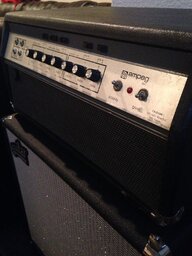







 . The cab could be recovered, and the grill cloth, slip cover and speaker basket replaced.


