• TalkBass has been independent since 1998. Add your voice.
    Create a free account to reply to discussions, view embedded media, and browse with fewer display ads.
    Join freeLog in
    Want zero display ads or expanded classifieds tools? Compare plans.

Double Bass 3/4 bass for 5th grade orchestra?

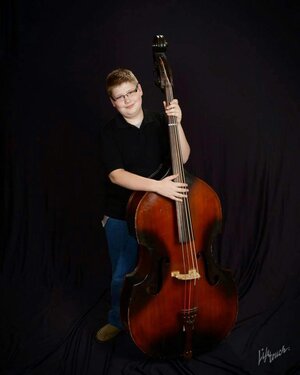
Son #2 tells us tonight he wanted to play bass in 5th grade orchestra. I'm going to talk to the teacher tomorrow but i wanted to get some opinions here. Our soon its a brilliant student in general and he's also 5'6'' at 10 years old - just a big kid. My question is; can he play my 3/4 bass?
 
I'm pretty sure you're okay to post a thread here. It reads, "Topics may be created by the resident teachers, or requested by others." "Others" would include you, and other non-teachers have posted threads here.

As far as your question, I'll be interested to hear what others have to say, but I think your son is probably big enough for a 3/4 bass. I've known adults not much, if any, taller than that to play a 3/4. Especially considering he could be another 2-3 inches taller by the end of the year, I wouldn't think it would be out of the question.
 
  • Like
Reactions: praisebass
Good idea - I've got a friend with a music ed degree who is a bass player. I'll ask him. I have a niece who started bass a couple years back on a school's 1/4 size bass and I thought she could use a larger instrument.

As a follow up question, aiming we all determine a 3/4 is the right size and if the school has an instrument to use, what are your thoughts on keeping the school bass at school and using my bass at home for practice/lessons? How much would it goof up a young player top learn on two separate instruments? It would certainly make the logistics easier.
 
I wrote a piece on this very subject which you can find on the Gollihur web site. (If someone wants to priced a link, that would be great.)

Bottom line: a 1/4 size bass has been the right size for every fifth grader I've ever taught. A 3/4 size is the standard size for an adult. (The bass is the only instrument in which the standard adult size is not full size.)

-Sa
 
To your question about learning on two instruments, one at home and one at school, yes, it's fine provided they're similar in size. Playing a 1/4 one place and a 3/4 in the other isn't something I'd recommend for a beginner. I keep a 1/4 size bass at home just so that my students can take their lessons even when they can't bring their own bass.

-S-
 
BTW, I've been considering a 1/4 size Englehardt but I'm afraid I'd end up playing it more than my soon and the wife would accuse me of buying another toy for myself. If the orchestra teacher says he needs a 1/4, I've got an out!

Do most beginning bass students play a 1/4 until they move to a 3/4 our do they typically play through a 1/2 size? The way my kids grow, they would be out of a jr. size instrument pretty quickly.
 
The middle school I work with has a few 3/4 basses and I feel they are too large for any of the students. Ideally, I'd start them on 1/4 or 1/2 depending on their size. I've seen very few students who need or are capable of playing a 3/4 bass until they get to high school.
 
The bass guy at one of the music store in town shared that he has the same experience as a fifth grader. I thought that was a good thing to share given he has a personal interest in settling basses. (You don't happen to work at Hover music do you?) Anyway, his orchestra teacher said she would evaluate him and we'll go from there.
 
I started at that age on a 3/4, though I might have been closer to 5'10" by then. At that height, it really wasn't a problem to start with an adult-sized instrument. I was already adult-sized, myself.
I've never been close to 5' 10". Just under 5' 8" is the closest I've gotten, and I'm now old enough that I'm a little shorter than I used to be.
 
Thanks all. Dave really wants to play my bass and honestly I can't really afford to rent our buy a bass if I don't have to. I'm going to let him play mine a few more weeks and see how it goes. Although I may but him a Glssser French bow instead of my German style bow
 
Have a look here, Thomas Martin was one of the top soloists and former principal of the London Symphony Orchestra he is 5'5.
This video shows him playing a 4/4 sized bass


A 3/4 sized bass without big shoulders should be fine. More important might be to set it up with a light setup, low and light strings. If they have a good 1/2 bass then go for it - if they don't have one then don't fret (no pun intended)
 
Last edited:
I would say that Thomas Martin is the exception that proves the rule. There are two points to be made here:

First and foremost, when an instrument is difficult to play for a beginner, it can cause them to be frustrated and ultimately to practice less or to stop playing entirely. Too small is better than too big when it comes to beginners, especially on the double bass, IMHO.

Second, when you are an experienced player, you can and should play whatever you like. I'm a relatively normal sized adult and I have no problem on my main instrument, which is the guitar, playing a wide variety of sizes. I own dreadnaughts, which are rather a "plus" size, standard full-sized instruments, and "parlor" instruments that are noticeable smaller in all regards. I love playing them all and they're all fine for me - but I am not a beginner.

In the video you show, the player cannot place the bow midway between the end of the fingerboard and the bridge when playing near the nut because the instrument is too big. This isn't a show-stopper for him, but it is definitely not what I would want for a new student.

I see this a lot in many areas of physical endeavor, e.g., athletics. People think that a program that works for a professional, full-time, very gifted athlete is how they should train themselves. This isn't to say, of course, that we shouldn't all learn from the best at what we do, but there is a big difference between "learn from" and "copy." One should not copy Thomas Martin's example when it comes to sizing a young person's first upright bass, or an adult's for that matter, either.

-S-
 
I would say that Thomas Martin is the exception that proves the rule. There are two points to be made here:

First and foremost, when an instrument is difficult to play for a beginner, it can cause them to be frustrated and ultimately to practice less or to stop playing entirely. Too small is better than too big when it comes to beginners, especially on the double bass, IMHO.

Second, when you are an experienced player, you can and should play whatever you like. I'm a relatively normal sized adult and I have no problem on my main instrument, which is the guitar, playing a wide variety of sizes. I own dreadnaughts, which are rather a "plus" size, standard full-sized instruments, and "parlor" instruments that are noticeable smaller in all regards. I love playing them all and they're all fine for me - but I am not a beginner.

In the video you show, the player cannot place the bow midway between the end of the fingerboard and the bridge when playing near the nut because the instrument is too big. This isn't a show-stopper for him, but it is definitely not what I would want for a new student.

I see this a lot in many areas of physical endeavor, e.g., athletics. People think that a program that works for a professional, full-time, very gifted athlete is how they should train themselves. This isn't to say, of course, that we shouldn't all learn from the best at what we do, but there is a big difference between "learn from" and "copy." One should not copy Thomas Martin's example when it comes to sizing a young person's first upright bass, or an adult's for that matter, either.

-S-

Playablility is in my opinion more important. Keep in mind that that is a 4/4 and the discussion is 1/2 or 3/4.
It is also a lot less cut and dry. It is more important to judge each instrument and its individual playability.
 
Thanks all for the input. So far, it seems to be working out ok. He really enjoys playing Dad's bass.
 

Attachments

  • 1415103806574.jpg
    1415103806574.jpg
    29.6 KB · Views: 170