
Enjoy the benefits of a premium membership!
Upgrade Account
-
TalkBass has been independent since 1998. Add your voice.
Create a free account to reply to discussions, view embedded media, and browse with fewer display ads.
Join free Log in
Want zero display ads or expanded classifieds tools? Compare plans.
You are using an out of date browser. It may not display this or other websites correctly.
You should upgrade or use an alternative browser.
You should upgrade or use an alternative browser.
3 Pickup Bass owner....how did you configure your knobs and electronics?
- Thread starter KayXero
- Start date
-
- Tags
- electronics knobs pickups
More options
Who Replied?
That said, Ive never heard someone not use a tone.
Really? My basses only have volume pots.

Last edited:

Sweet looking bass! I've thought about a similar design to this myself: how does the neck PU sound? Is it use able on its own for that 60s or Rick neck PU tone?

You are about to get lost in nuances that will never matter to your live or recorded performance. If it were me, I would do an on/off switch for each pickup and a master volume and tone.
When I designed a bass recently with Hammersmith, I went with a 3-way neck/both/bridge selector, a single/series/parallel for the bridge and a master volume and tone. Plenty of tones to get after using those controls. You'll get lost in tone and volume controls for each individual pickup. You'll be tweeking knobs and throwing switches all night.
I know you guys don't care about this kind of thing, but you'll also be driving the sound guy crazy.
When I designed a bass recently with Hammersmith, I went with a 3-way neck/both/bridge selector, a single/series/parallel for the bridge and a master volume and tone. Plenty of tones to get after using those controls. You'll get lost in tone and volume controls for each individual pickup. You'll be tweeking knobs and throwing switches all night.
I know you guys don't care about this kind of thing, but you'll also be driving the sound guy crazy.

This is King Billy. I went with EMG j-p-j pickups and a BTS EQ, a basic vol-blend-bass-treble setup. I have the bridge J wired to one side of the blend pot and I run the P and neck J into a 3-way mini-switch. The output of the mini-switch is wired to the other side of the blend. This way I can have all three pickups together, on their own, in any pairing, but with the ability to dial in as much or as little growl from the bridge J as is required and it’s very intuitive to use.
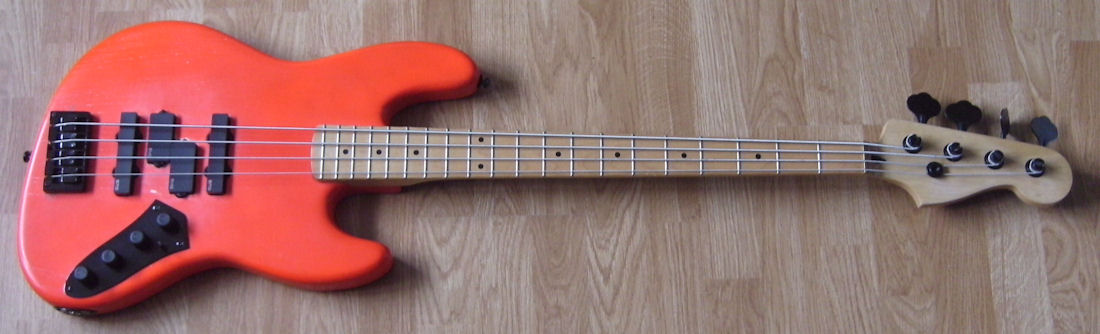
More here King Billy
More here King Billy

You might want to browse this thread:
Show us your 3 pickup basses!
I have done a lot of triples. People like different things, but I prefer to have one set of master controls with an on/off toggle switch for each of the pickups. I would also suggest using inline split coil pickups for the J's so that you can operate without noise in any configuration.
Note that with passive controls you can't get complete isolation on the tone controls, so dialing back one tone control will have an impact on the tone of the other pickups. If it is possible it would be news to me.
It is possible to isolate the tone controls by using a J-style wiring for vols in parallel and placing the tone circuit tap on the respective volume wiper. Winding the volumes back isolates the tone controls.
@KayXero
As an aside, in a three-way VVV setup I would avoid 250k volume pots as the combined loading of 75k will be a real tone suckers. I think 3x500k would be OK but I would be tempted by 1M pots, especially as these would also benefit tone control isolation in a VTVTVT setup.
YMMV.
Edit: I only meant 1Meg for the volumes. Stick with 250k for the tones else they end up being little more than on-off switches.
Last edited:
Sweet looking bass! I've thought about a similar design to this myself: how does the neck PU sound? Is it use able on its own for that 60s or Rick neck PU tone?
The P pickup is very usable by its self. It growls a bit more if you dig in because they are Quart Pounders. But you play it light or Normal you get a very deep bass tone. If you play with both the neck and P-pickup together it gets even deeper.
Sweet looking bass! I've thought about a similar design to this myself: how does the neck PU sound? Is it use able on its own for that 60s or Rick neck PU tone?
You know what I just re-read your question...and yes the Neck pickup is good to run solo. Nice boomie tone to it on its own. That's why I wanted it since I pluck on the actual fret board normally when i play her. Now I play a lot of Blues, Jazz, Rock and Reggae so I really get my moneys worth out of it.



Fender Tele bass body with tele, p, and jazz bass pick-ups and a 32 position switching system.
I finally ran across this so I thought I'd post it.
Dan Armstrong's article from Guitar Player Magazine:
You can wrest six wiring combinations from a pair of pickups. Three pickups, however, allow for a whopping 35 combinations. As alluring as this sounds to Strat players, it's a problem to access so many colors in a practical way. For over 20 years, I've applied my twisted mind to the question of how to switch three pickups. I experienced many an "aha!" during this time, including a "secret switch" for Jimi Hendrix, the 9-way switching for Fender's The Strat, and the "stock parts only" project for Guitar Player in Feb.'87. Those schemes have all been somewhat compromised by a perceived need to use the traditional Strat lever switch. By breaking free of this limitation, I was able to rethink this entire matter and arrive at a rational switching system that provides all of the very best combinations and still makes mechanical sense.
This modification yields 12 settings. It requires three mini-toggle switches (one is a 3-way), each relating to its own pickup. Here's what you get:
* each pickup alone (three settings)
* three parallel pairs
* three series pairs
* three pickups in parallel
* three pickups in series
* three pickups in series/parallel
All combinations are in phase. Tone controls follow the standard Strat convention, i.e., no tone control for the bridge position. The tone controls operate on the neck and middle pickups: they provide particularly interesting sounds in the series settings.
I've been using this system for years (with some variations, such as coil-splitting), and have duplicated it for many guitarists. Although it's more complicated than a 5-way switch, no one seems to have problems learning how to operate it efficiently. This is the most comprehensive and satisfying control system I've ever used-I'm completely spoiled by it.
This wiring is rather complicated. If you're a beginner at this sort of thing and not proficient at soldering and reading circuits, turn the job over to someone with more confidence and experience. If you wish to wire up this system yourself, here are a few pointers:
*Use only high-quality switches. Cheap ones can be susceptible to noise and premature breakdown.
*Use a good electronics-grade rosin core solder. (Never use acid-core solder. It corrodes metal parts, including switches pots jacks and wires.)
You'll need two DPDT on/on 2 position switches, and one DP3T on/on/on 3 position type. (Note: Make sure you get an on/on/on. This hard-to-locate switch is available from such specialty parts suppliers as Spitzer's Music, Chandler, and Warmoth). Replace the lever switch with three mini-toggles. Drill three little holes in the pickguard so you can mount the switches side-by-side with their levers about 1/2" apart. The entire triple switch array fits into the slot where the stock switch used to be.
Be sure to ground the switch bodies (some have a solder tab, others require wrapping a wire around each switch's threaded "neck" and wiring that to a ground point). If your bridge pickup is a humbucker (with or without a coil splitter), the circuit needs no modification. For guitars with only one tone control, use the optional master tone shown in the diagram. The .05uF capacitor in the string-to-ground line is for shock proofing; it greatly reduces the likelihood of shock if you touch both your strings and other electrical gear.


On/off and phase switch for each pickup, master volume and tone. When I run it wide open, all pickups on, it is the loudest/highest output bass I've ever played. Throwing any of the pickups out of phase knocks the volume way down, but does create some interesting sounds.
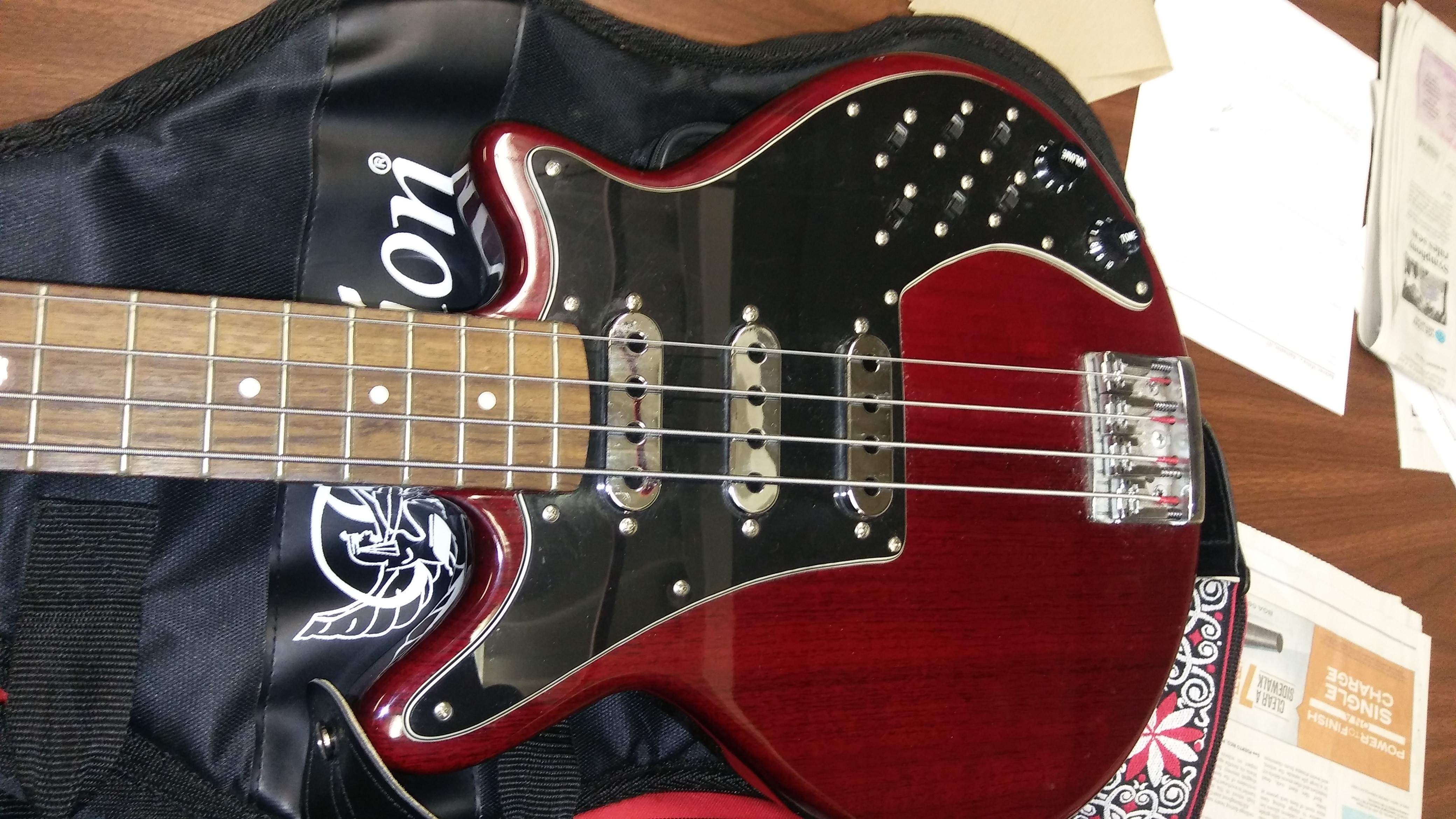
My 3 pickup monster has a master volume, pan pot for the J pickups and a switch for the P pickup
4 way switches:
1. P only
2. P with J (from the bridge/neck pan)
3. J only (from the bridge/neck pan)
4. Standby
View attachment 3034919
View attachment 3034920
Possibly one of the most logical and useable schemes I've seen...
Doner Designs
Steve Doner
- Jun 2, 2012
- 5,784
- 6,819
- Disclosures
- Doner Designs is an alias for Steve Doner
Almost always the same. Standard two pickup wiring with a blender. The middle and neck both go on the neck side of the blender. Also an on/off mini toggle for each pickup.

I've thought it would be cool to have Fender way back in the day do a custom Jazz bass with 2 very closely spaced bridge pickups wired in series & then a P pickup in the standard spot wired in parallel with the bridge pups - 1 volume control for the P pup & 1 volume control for the 2 J pups along with a global tone control.
I finally ran across this so I thought I'd post it.
Dan Armstrong's article from Guitar Player Magazine:
You can wrest six wiring combinations from a pair of pickups. Three pickups, however, allow for a whopping 35 combinations. As alluring as this sounds to Strat players, it's a problem to access so many colors in a practical way. For over 20 years, I've applied my twisted mind to the question of how to switch three pickups. I experienced many an "aha!" during this time, including a "secret switch" for Jimi Hendrix, the 9-way switching for Fender's The Strat, and the "stock parts only" project for Guitar Player in Feb.'87. Those schemes have all been somewhat compromised by a perceived need to use the traditional Strat lever switch. By breaking free of this limitation, I was able to rethink this entire matter and arrive at a rational switching system that provides all of the very best combinations and still makes mechanical sense.
Yes! Love this system. Depending on your pickups, you might find some very useful combinations that you otherwise wouldn't discover.

Interesting arrangement I no longer have a 3 p.u bass it was a fujigen j bass with fender neck I still have it but I returned back to 2 p.u configuration but it had 3 dimarzio j model split coils with 3 volume controls and a master tone input jack moved to the bottom side, just did not care for that gibson like sound that was produced by the neck p.u it looked cool but naaaaa.


