
Enjoy the benefits of a premium membership!
Upgrade Account
-
TalkBass has been independent since 1998. Add your voice.
Create a free account to reply to discussions, view embedded media, and browse with fewer display ads.
Join free Log in
Want zero display ads or expanded classifieds tools? Compare plans.
You are using an out of date browser. It may not display this or other websites correctly.
You should upgrade or use an alternative browser.
You should upgrade or use an alternative browser.
More options
Who Replied?
What 4 string basses come tuned BEAD?
What 4 string basses are good for converting to BEAD?
What is your opinion on 35" scale being necessary for a good B string?
Are there any other factors to consider?
Are you currently wearing socks?
Thanks in advance.
First, no - 35" is not necessary. A good old P, J, Stingray, G&L L2k, etc will sound fantastic tuned B-D. As will just about any other 4-string bass.
The only potential factor to consider is that you'll need a new nut. Well, you'll need to modify the nut on the instrument and cut a new nut if you ever go back to EDAG.
Case in point: Will Lee is played a BEAD tuned Sadowsky on this cut from nearly 20 years ago.
I have my Ibanez GSR200 tuned BEAD. Since I am using a lighter than stock string gauge I have not bothered to file the nut out. It is working so far.



- Feb 3, 2005
- 7,331
- 10,198
- Disclosures
- Endorsing artist: Bergantino Audio Systems and GHS Strings
My band tunes CFBbEb and I use 2 Spectors currently. One is the Euro 435lx, which is a 35" scale 4 string. The other is an NS4, a 34" scale 4 string. I do feel the 35" scale helps with the tone and tension I prefer, although this is definitely preference over absolute need. I also like to use a bit lighter string (.111 set), so it helps there as well. Once again, I think it matters for tone and string choice more than you have to have a 34 or 35. After all, some five string players prefer one over the other, so no different for a BEAD tuned 4 string really. I would say to pay close attention to strings. I'm using La Bella's special set designed for down tuning a 4 (it starts with a .111). However, you may find a big difference between 2 brands of the same gauge. I have used .115 sets of Dean Markley and D'Addario fine, but found the Dunlop's looser tension did not work for me (granted I do not have a soft touch technique wise either).


Just tune your 4 string down 3 steps. The low string tension sounds great and makes your bass play effortlessly!
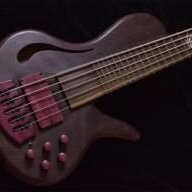
I would disagree with anyone saying 35 is no different than 34.....
Your D and G strings sound Alot thinner, B E and A strings have much more presence. Comparing 35 to 34 I mean.
I play in drop A on a 35' five string. Use anything from .145 to .166 for the low A string.
Sounds much better on 35' to me.
The Warwick rockbass darklord is probaly the cheapest 35', 4 string out there.
Your D and G strings sound Alot thinner, B E and A strings have much more presence. Comparing 35 to 34 I mean.
I play in drop A on a 35' five string. Use anything from .145 to .166 for the low A string.
Sounds much better on 35' to me.
The Warwick rockbass darklord is probaly the cheapest 35', 4 string out there.
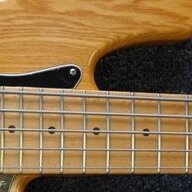

When I was a young lad, before I got my first 5-string, I did a BEAD setup on my Squier Affinity P-Bass, which worked fine, but the hole for the B string had to be drilled out to allow the B to fit. That's all I'd really worry about. Oh, and you will almost certainly ruin your nut, depending on what it's made of, so if you ever decide to go back to standard strings and tunings, it may need replaced.
I would disagree with anyone saying 35 is no different than 34.....
Your D and G strings sound Alot thinner, B E and A strings have much more presence. Comparing 35 to 34 I mean.
I play in drop A on a 35' five string. Use anything from .145 to .166 for the low A string.
Sounds much better on 35' to me.
The Warwick rockbass darklord is probaly the cheapest 35', 4 string out there.
A 35 foot bass sounds excessive.


No longer scale isn't necessary for bead just get a decent 5 string set of string and don't use the g string, you'll probably have to have the nut filed open a little so the strings sit properly in the nut, some basses the bridge might need altering but no scale isn't a big deal, the neck construction and the electronics and overall quality of the instrument are more important. Longer scales are really only useful IMO if you plan on using super low tunings and being primarily a 5 string player b is pretty normal.I want a bass tuned BEAD and am wondering if you guys and gals think 35" scale is necessary? Anything else to consider?

Jaco didn't play a BEAD bass....
I must wear socks.....not a pretty sight......
Not sure about Jaco's socks.
I must wear socks.....not a pretty sight......
Not sure about Jaco's socks.

I'll have to put on socks this week for Thanksgiving & probably again for xMas. It's either that or keep my shoes on at my Aunt's place. I don't wear shoes in my own home, so I would definitely not wear them in someone else's home.

I bought a 5 string bass this year; ended up with a Fender Jazz Deluxe in all black. I'm not disappointed in the sound one bit. It's a 34" scale and I tune drop A.
I bought a 5 string bass this year; ended up with a Fender Jazz Deluxe in all black. I'm not disappointed in the sound one bit. It's a 34" scale and I tune drop A.
What gauge do you use for the low A string?

A B string on a 30" scale at 44 in./lbs. of tension, would need to be .160".
i've wondered about this. it seems to me that it would be the core of a bass string which would determine its tension much much moreso than the wrap layers. i wish manufacturers would label strings with their tensions at concert pitch. among other things, this would make it easier to balance custom sets assembled from singles.
I find bass string sets horribly unbalanced, with the E on a 4 string being too slim for Drop D.

My main bass is a Warmoth Jazz with quarter pounder pickups. I currently have it strung BEAD. Had to file the nut out a bit...no problem with the 34" scale.


