• TalkBass has been independent since 1998. Add your voice.
    Create a free account to reply to discussions, view embedded media, and browse with fewer display ads.
    Join freeLog in
    Want zero display ads or expanded classifieds tools? Compare plans.

4x10 vs. 1x15 Cabs

Status
Not open for further replies.
Enlightening.............

You are now officially smarter then the people that actually design and build cabs for a living.

most likely not, however I am intelligent enough to read.

Simple matter of weight ratio...A five ounce bird cant carry a one pound coconut...

Measured Data for a Real Loudspeaker
realspeaker.gif
The animation at right shows actual directivity data measured for a 4-inch boxed loudspeaker.[1] At low frequencies (250 Hz) the speaker radiates sound equally well in all directions. At higher frequencies (10 kHz) the speaker radiates all of its sound in front - the sound level behind the speaker is almost 25 dB lower than the level in front, indicating that much more sound energy is being radiated directly in front and very little behind.
This tendency for a loudspeaker to become directional at higher frequencies is one of the main reasons for using a cross-over network when designing a multi-speaker system. The goal is to have each speaker in the system radiate sound with approximately the same spatial distribution over its own frequency range, so that the entire frequency output of the speaker (20-20,000 Hz) is radiated evenly into the listening space. The cross-over filter sends low frequencies (really small k) to the larger speaker (medium sized a) so that it is fairly omnidirectional (ka<5 is a typical upper limit). Likewise, mid-range frequencies (largerk) are sent to the mid-size speaker (smaller a) so that it has the same upper limit of directivity (ka<5). Finally, the highest frequencies (large k) are sent to the smallest speaker (really small a) so that it also has approximately the same spatial directivity (tiny speaker size ensures that ka is still < 5). The more omni-directional you want each speaker to be, the more different sized speakers you will need in order to cover the entire frequency range.[2] As an example, I have a set of Kenwood JL-840W 4-way speakers at home. The table below compares the speaker sizes and frequency ranges.

Speakerdiameter (cm)Frequencies (Hz)cutoff ka
woofer3020-2,0005.5
mid-range122,000-5,0005.5
tweeter65,000-10,0005.5
super-tweeter310,000-20,0005.5
[1] D.A. Russell, J.P. Titlow, Y.J Bemmen., "Acoustic monopoles, dipoles, and quadrupoles: An experiment revisited," Am. J. Phys.,. 67(8), 660-664 (1999)
[2]There are lots of other arrangements of speakers which can produce nearly omni-directional sound over the entire frequency range. I'm using the example of a speaker system with several different sized speakers, each with its own crossover network, in order to demonstrate the effect of directivity on loudspeaker performance.
 
  • Like
Reactions: StringCanvas
lol, it says in no uncertain terms there that the larger the driver diameter the lower the frequency range. Technically speaking, any size driver can reproduce frequencies at any rate, but the frequencies dont get produced in useable volume outside their range. Im not making a case for either size or style of cab. Just saying that from a logical standpoint certain types of enclosures and size drivers are better suited to certain frequencies and volumes. Ive used 15 and 18's as well as multiple 10" cab systems. each shines in thier own intended purpose and design. Its pretty clear that in the two manufactures specs that they intended certain frequency areas in their 15" drivers and their 4x10" drivers. The 4x10 extends to the higher range 15k to 18khz. that is primarily due to diameter of the driver. simple.
 
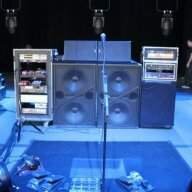
I think you guys are missing a key aspect of speaker size which is.. physics There is a reason that some professional players use 2x18 cabs like showed in my picture.. lol that rig is 4x18s 2x12s and a swr 410 Goliath that is not even in the pic. bigger speakers move more air which is why pa speakers are bigger.......
 
  • Like
Reactions: Philonius
Status
Not open for further replies.