• TalkBass has been independent since 1998. Add your voice.
    Create a free account to reply to discussions, view embedded media, and browse with fewer display ads.
    Join freeLog in
    Want zero display ads or expanded classifieds tools? Compare plans.

4x10 vs. 1x15 Cabs

Status
Not open for further replies.
I've never seen a data plot that took thousands of speaker frequency responses and mapped their distribution based on size.

I have seen anecdotes that drivers of any size can relate to drivers of any other size with expected or unexpected results.

I strongly suspect a data plot across the history of bass speakers would loosely support a generality. However, because a generality can be proven to be inapplicable in a number of circumstances it generally won't be accepted here.

But please note that utter randomness hadn't been proven either.

Anecdotally every time I listen to cabs of different cone sizes by the same manufacturer side by side my ears agree with the unacceptable generality. Careful if you want to make that point. You'll be accused of listening with your eyes or confirmation bias.

Bottom line. Some people like 15's and others like 10's. I like chicken in mushroom sauce.
 
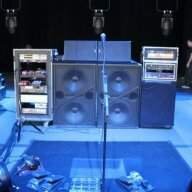
...There is a reason that some professional players use 2x18 cabs like showed in my picture.. lol...

Yes, it's called marketing or listening with your eyes. Not all (I'd venture to say most) professional musicians are sound engineers or command a degree in audio physics. A band that can afford gear like that AND have roadies to carry it is going to do DI or mic some cabs because they'll need PA support for large stages that can support a rig like that....so what "big musician A" uses is a moot point, they aren't going for efficiency on a stage. This topic is covered ALL THE TIME on here, do a thread search or read the FAQ.
 
Bass-Rig-Macro-660x440.jpg

Gee I found a big version of that picture and I still can't see the mics on those oh so important speakers! Just a bunch of pointless DI stuff!
 
Yes, it's called marketing or listening with your eyes. Not all (I'd venture to say most) professional musicians are sound engineers or command a degree in audio physics.

And in four minutes, no less.

Please, please, please drop this from the repertoire. There's nothing more trollish than basically saying "I'm smarter than you and more objective than you."
 
Because most 4X10's go louder, and lower then a 1X15.

Speaker size tells you nothing except how big the speaker is.
Lower? Maybe. Perhaps probably. All depends on the driver's frequency response.

Louder. Well...yeah. Provided that the Xmaxs are similar, a 410 is roughly the equivalent of a 215. If the sensitivities are similar and Xmaxes are similar, the 410 will be very noticeable louder than the 215.
 
Last edited:
  • Like
Reactions: Sartori
All the way across the range of cabinets, the 15" enclosures between those two manufactures top out at 5khz. The multiple 10" drivers top out at 15khz to 18khz....size dose matter lol
Boy oh boy :eek: . Multiple drivers of any size do not increase the frequency range. The freq range for a driver is what it is. Period. One, two, or 100 will not change that. Cab sensitivity yes, frequency response, no.
 
Last edited:
  • Like
Reactions: Sartori
lol, it says in no uncertain terms there that the larger the driver diameter the lower the frequency range. Technically speaking, any size driver can reproduce frequencies at any rate, but the frequencies dont get produced in useable volume outside their range. Im not making a case for either size or style of cab. Just saying that from a logical standpoint certain types of enclosures and size drivers are better suited to certain frequencies and volumes. Ive used 15 and 18's as well as multiple 10" cab systems. each shines in thier own intended purpose and design. Its pretty clear that in the two manufactures specs that they intended certain frequency areas in their 15" drivers and their 4x10" drivers. The 4x10 extends to the higher range 15k to 18khz. that is primarily due to diameter of the driver. simple.
There are no 10" drivers whose frequency response goes to that level. 5kHz is about it for any 10". Now coaxials are a different beast entirely.
 
  • Like
Reactions: Sartori
I think you guys are missing a key aspect of speaker size which is.. physics There is a reason that some professional players use 2x18 cabs like showed in my picture.. lol that rig is 4x18s 2x12s and a swr 410 Goliath that is not even in the pic. bigger speakers move more air which is why pa speakers are bigger.......
Except for 8", 10", & 12" P.A. speakers, lol :woot: . 15s & 18" are used for subs to a great extent, yes.

 
  • Like
Reactions: Sartori
IME there are tons of different factors that make a cab sound the way it does. I've heard 410s go deeper and have more balls than some 2x15s, and I've heard 5" drivers seemingly push more air than an 8x10. The design of the box, crossover, and speaker specs (RMS rating, ohms, etc.) are all just as important as the size of the driver. On paper, any 15" will get you lower frequencies than a 10". But then all those other factors come into play and can sound different than one would expect. Find what works for your sound and rock it.
 
check the link itself. the direction the waves travel gets shorter and more focused (less aduible) the higher the frequency on the larger diameter speaker.

google how speakers work.

I am not asking "how speakers work." YOU posted an article. YOU claimed that article clearly states that "that the larger the driver diameter the lower the frequency range." I am asking YOU, not Google, where in the article it says that.
 
Status
Not open for further replies.

Latest posts