• TalkBass has been independent since 1998. Add your voice.
    Create a free account to reply to discussions, view embedded media, and browse with fewer display ads.
    Join freeLog in
    Want zero display ads or expanded classifieds tools? Compare plans.

5 string Fretless 36" scale Padouk-Pau Ferro-Ebony-Silver Oak CT inspired

After been inspired by you all in this poll i will show you the building of a new bass.

Spec:

5 strings
36” scale
Fretless lined
Set-neck construction
Width at nut 47mm (1.85”)
Thickness at nut 21mm (0.83”)
Width at 12° fret 62mm (2.45”)
Thickness at 12° fret 24.8mm (0.98”)
Body thickness 28mm (1.10") or more if i decided to make it chambered. What do you think about?

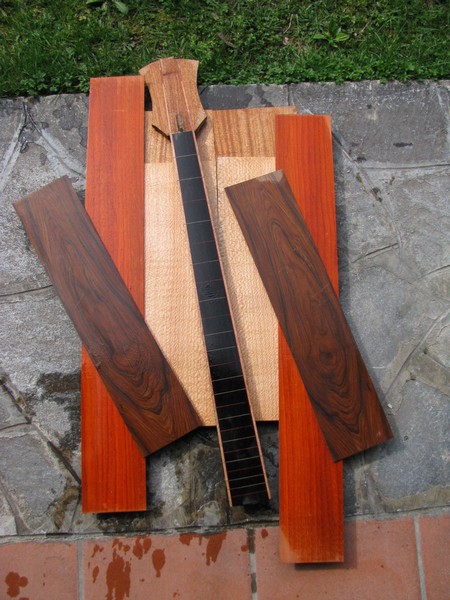
Neck one piece of Quatersaw African Mahogany with Silver Oak binding and Red veneer
"B" grade Ebony fretboard, 16” radius, lined with red and light brown veneers.
Two pieces African Mahogany body
Padouk/Pau Ferro top and back with Silver Oak stripes, and some accents of Bocote and Walnut around***
Padouk heel block
Pau Ferro headstock front and back
Finish with Danish oil

Passive electronics:
1 Bartolini humbucker W4BCB with Pau Ferro/Silver Oak cover, propably in P position. Suggestion?
Switch DPDT for serie/parallel/single wiring
Volume pot 250Kohm
Tone pot 250Kohm with Mallory cap 0.033uf
Bass defeat pot (like G&L) 500Kohm with a 0.0022uf cap
Switch DPDT for tone-bypass/tone pot/tone pot+treble defeat with an extra Mallory cap 0.033uf

Black Hipshot B style bridge 17mm spacing
Black Hipshot Ultralite Licensed Y tuners

Render, thanks to MrArose13:
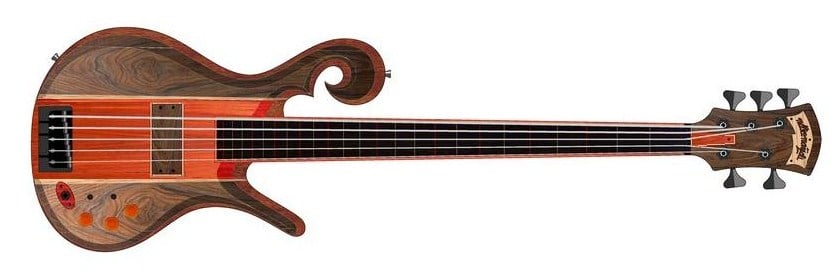
Renderfront_zps60f78212.jpg


The woods:
Fretlesswood_zps18eafcc5.jpg


***
[....]I just thought that, since you like Mr. C T's work, that could be a direction. The man can put together a dozen different and (more to the point) not so different woods and make them look as if they grew together :D
After thinking about this i decided to try! Thanks miziomix, you are very inspiring!

---
 
I would like to find a double bass sound from this fretless, definitly not a Jaco sound.
This is why a will put the PU on P position. I know i can't reproduce this sound with an electric bass, but i will try to a similar one.
It's should be very light, hope under 3,5 kg (under 7.7lbs) or less. I have to weigh the various components, maybe tomorrow i will be more accurate. If going for chambering i need to add an extra layer of wood to avoid neck diving
 
My planer:
IMG_2262_zps35e40d47.jpg

It's an hard job:rollno:

About the weight:
Body (without chamber) probably 1900 gr (4.2 lbs)
Neck 950 gr (2.1 lbs)
Bridge/tuners/PU/strings... 750gr (1.6 lbs)

Tot: 3600gr (7.9lbs) It's quite light...

A chamber in the upper wing would lighten the body for about 150/200 gr (0.35/0.45 lb), but what happen to the balance if i make a lighter body? Dunno....
 
My experience with Piezo pickups is limited to the Graphtech Ghost system, which uses replacement bridge saddles with the piezo element built in.

Thanks, it could be great, but it's too expensive, i would try something different before spend all this money...

I would recommend a piezo buffer pre-amp.

It could be right, but Guitronix say: "All of my pickups are plug and play no pre amp or batteries needed." Why?
And he also said that probably the volume of the piezo PU could be higher than the volume of my Bartolini PU (6Khom in series, not so "hot"...)
I had a bad idea: if the volume is not so high, can i wire two discs in series? Or three?
 
Thanks, it could be great, but it's too expensive, i would try something different before spend all this money...


It could be right, but Guitronix say: "All of my pickups are plug and play no pre amp or batteries needed." Why?
And he also said that probably the volume of the piezo PU could be higher than the volume of my Bartolini PU (6Khom in series, not so "hot"...)
I had a bad idea: if the volume is not so high, can i wire two discs in series? Or three?

It's not about volume. It's about impedance matching and frequency response. I have heard people describe an unbuffered piezo pickup's sound on a bass as thin, brittle, weak, and gutless. My experience has been exactly that. The impedance mismatch causes low frequencies to be practically nonexistent. The piezo buffer's purpose is to match the pickup's output impedance to about the same level as a standard magnetic pickup.

It is possible that Mr. Guitronix is using a different sort of piezoelectric sensor, but from that photo, it looks pretty much like the stuff you can get at any Radio Shack, which will need buffering before you get a decent sound from a bass guitar.
 
It's not about volume. It's about impedance matching and frequency response. I have heard people describe an unbuffered piezo pickup's sound on a bass as thin, brittle, weak, and gutless. My experience has been exactly that. The impedance mismatch causes low frequencies to be practically nonexistent. The piezo buffer's purpose is to match the pickup's output impedance to about the same level as a standard magnetic pickup.
The first Mike Christian piezo pickup I bought came without a pre-amp. Mike's instructions mentioned the whole unbuffered piezo issue. His recommended solution was to plug into a non-true bypass pedal before running into an amp. The pedal didn't even need to be turned on. The reason was most pedals handled this buffering even when they weren't engaged.

I used an old BBE Stinger pedal that I left turned off. Without the pedal in the chain, the pickup sounded terrible. There was a very noticeable improvement in the sound when running through the pedal.

The piezo systems I've used with built in pre-amps probably handle this buffering, as I haven't needed to break out the Stinger pedal with them.
 
The first Mike Christian piezo pickup I bought came without a pre-amp. Mike's instructions mentioned the whole unbuffered piezo issue. His recommended solution was to plug into a non-true bypass pedal before running into an amp. The pedal didn't even need to be turned on. The reason was most pedals handled this buffering even when they weren't engaged.

I used an old BBE Stinger pedal that I left turned off. Without the pedal in the chain, the pickup sounded terrible. There was a very noticeable improvement in the sound when running through the pedal.

The piezo systems I've used with built in pre-amps probably handle this buffering, as I haven't needed to break out the Stinger pedal with them.

See, that's why claims of "no pre-amp required" on piezo systems bother me. True, an onboard pre is not absolutely necessary, but some kind of active buffering is, and that is (in my opinion) best handled with a simple on-board circuit. So while it is, strictly speaking, true, it is also misleading.
 
I found a buffer! I'll use it.

I think that if I place the buffer between the piezo and its volume pot, I could use a standard Jazz wiring: the two different PU in parallel with two volume pots and a tone pot that possibly functions of both PU.

Would that works?

I search this wiring in the net, but I haven't found it (probably because it does not work???), many have a switch to select the PU, others use the buffer / preamp with the blend.
But I hate the PU switch to the PU blend! :spit:
 
I'm back!
After this poll here is the new design:

fretless-090502-color_zps1194ab4f.jpg


I decided to go with a chambered body. I removed more than 800 gr!
IMG_0052_zpsb4c9e4f5.jpg


IMG_0053_zpsbd1e8aba.jpg


All the pieces:
IMG_0054_zpscbd7b730.jpg


I will put an Oak layer under the top and the back.
IMG_0059_zps635b8d2e.jpg


I'm just a bit worried about the rigidity of the body. I really don't care about sustain, i'm looking for a doublebass sound... I just would not want the body was bent too much under the tension of the strings...

i will test the body without glueing the back, if it will not work i can put a mahogany bar inside the body.