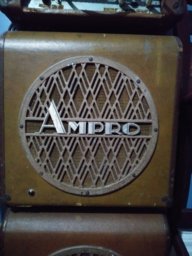
Would this be the SB12?....cool.
If by *the* SB2 you mean Ampeg SB-12, then, yes. I think it would be a good tribute to *big brother*. If you work something up for a 2X6, please share. For some reason I can't get WinISD to work on Vista.

TalkBass has been independent since 1998. Add your voice.
Create a free account to reply to discussions, view embedded media, and browse with fewer display ads.
Join free Log in
Want zero display ads or expanded classifieds tools? Compare plans.
Would this be the SB12?....cool.

I'll throw up here whatever I come up with ...it's no big secret or nothin'. I would assume that's a clearance price on those drivers? As in, they won't be stocking any more? Looks like they listed for $30-$40, which would be more in line with their performance, just off the cuff, have to model at home. This phone can do some cool stuff, including grab that pdf, but doesn't run cab modelers.

I run my bass into a Vox Pathfinder 15 (I know, try not to bash me for using a guitar amp, I just LOOOVE the tone) And usually run the internal speaker (it has no ext. speaker jack, so I have to rig the speaker wires to an output jack to run it into a cab) but, every 2-3 months the speaker in it farts out/the voice coil overheats (I believe thats the term, I'm not great with speakers), so it becomes unusable. So, I was wondering if there are any 6.5" speaker for bass? I don't mean a 6.5" running the mids/high, I mean the 6.5" will be running the entire bass. I'd like to keep this cheap (I know the speakers I put in it were dirt cheap) and have okay tones. Any thoughts?

There are several things you can do. Maybe the best is just leave the guitar speaker in the cab and use it for a guitar amp when you need it. You can also install a wideband PA speaker and use it vocals.
The best way to get good bass response it to get an audiophile loudspeaker with blown drivers for a giveaway price. A sealed enclosure is the easiest to design around, but by plugging the port of a bass reflex cab you have a sealed cab. BETTER YET, you can install a Dynaudio or Scan-Speak variovent which converts a sealed enclosure into something that acts like a transmission line speaker without the size and internal line design and acoustic stuffing issues. Install an extension cab jack in your combo and a switch to select a speaker, or you can install a switching jack and forget the selector switch. It will switch to external cab when you plug it in, like in the AVT20. Most small combos are limited to 8 ohm loads.
Go for a cabinet with a 10" or 12" woofer as you have more speaker choices. Get rid of the mids and tweeters and plug the holes, or leave them in but disconnected, or install a switch to select them if you want. Now decide if you want a bass guitar or PA/keyboard type of driver. The Eminence B102 is 92 dB efficient and will only suffice for quiet practice with a low power amp but has the widest, flattest response, the Eminence Beta 10A is at least 95 up to 97 dB efficient and will at least double the apparent power of your amp, but low extension will suffer a bit. I have used both of those drivers with a Marshall AVT20 guitar amp, and they turn it into a killer mini vintage tube bass amp emulator. I prefer the Eminence Beta 10A for the greater efficiency.
If you get a cab for 12" speakers, then you have the Eminence Alpha 12A, Beta 12A, and Kappa Pro 12A in the pro sound PA line of drivers. The Kappa Pro 12A is very similar to an Electro Voice EVM12L, which is one of the kings of bass guitar but at half the EV price, but still costly.
In the Eminence bass guitar line you have a 12" speaker, but most of them are 10" or 15". Personally I would go with the Kappa Pro 12A in the pro sound audio line for its 99 dB efficiency if I could spend the money. 15 watts will get you about 110 dB of sound level. If the cost and weight is too much, I would go with the Eminence Beta 12A because it still has very high efficiency and better than a Beta 10A if loudness is a major goal, and should cost about $80 delivered. Beta 10A is $70 delivered, and B102 at least $90 delivered.
Scan-Speak and Dynaudio variovents and acoustic stuffing are available from Madisound and other audiophile speaker builder suppliers. You should fill the speaker cavity about 2/3 full of acoustic stuffing and leave a clear path to the variovent. It brings the resonance peak down and allows much better power transfer and a tighter sound and more extended bass. I use polyester polyfill, but fiberglass batting can also be used in a speaker cabinet if you have some old insulation scraps laying around. But polyfill is cheap and no itching and scratching for days afterward.
Phil
Markbass Minimark, check it out.
Size: Price:  Thin wallet:
Features:

Here's something folks should be able to do at home.
Make a box that measures internally 10" wide by 10" deep by 14" high. That comes to .81 cubic feet or so, figure .75 net when it's all together.
This is for 2 of these drivers. Tune it to ~48hz or so using 2 tubes 1.5" in diameter by 4.5" long. Some of you may recognize that as being a standard size empty toilet paper roll. Shouldn't have much trouble finding a couple of those.
This gives a 2db bump centered around 110hz, a -3db point of 63hz and a -10db point of 40hz. Excursion limited power handling is 45 watts down to 40hz. Should handle whatever your bedroom practice amp can throw at it, probably including diming knobs.
Plenty of room in there to try different port lengths and tune it by ear to your liking. Oddly, paper towel rolls are the same diameter. Use those and try different lengths until you hit something your ear likes.
Seal the same box and you get even response to 107hz. -3db of 83hz and -10db of 56hz. Excursion limited power handling flattens out at about 25 watts as low as you can go.
Considering your average bedroom combo might be lucky to reach 100hz, the ported version, no matter how you adjust the tuning would sound quite bassy by comparison.
Double the box size and number of ports, keeping the ports the same length for a 4x, quadruple for an 8x, etc.
For $9 each, I might just try this.
Here's something folks should be able to do at home.
Make a box that measures internally 10" wide by 10" deep by 14" high. That comes to .81 cubic feet or so, figure .75 net when it's all together.
This is for 2 of these drivers. Tune it to ~48hz or so using 2 tubes 1.5" in diameter by 4.5" long. Some of you may recognize that as being a standard size empty toilet paper roll. Shouldn't have much trouble finding a couple of those.
This gives a 2db bump centered around 110hz, a -3db point of 63hz and a -10db point of 40hz. Excursion limited power handling is 45 watts down to 40hz. Should handle whatever your bedroom practice amp can throw at it, probably including diming knobs.
Plenty of room in there to try different port lengths and tune it by ear to your liking. Oddly, paper towel rolls are the same diameter. Use those and try different lengths until you hit something your ear likes.
Seal the same box and you get even response to 107hz. -3db of 83hz and -10db of 56hz. Excursion limited power handling flattens out at about 25 watts as low as you can go.
Considering your average bedroom combo might be lucky to reach 100hz, the ported version, no matter how you adjust the tuning would sound quite bassy by comparison.
Double the box size and number of ports, keeping the ports the same length for a 4x, quadruple for an 8x, etc.
For $9 each, I might just try this.

...Make a box that measures internally 10" wide by 10" deep by 14" high. That comes to .81 cubic feet or so, figure .75 net when it's all together.