• TalkBass has been independent since 1998. Add your voice.
    Create a free account to reply to discussions, view embedded media, and browse with fewer display ads.
    Join freeLog in
    Want zero display ads or expanded classifieds tools? Compare plans.

'62 Precision vs '72 Precision: can you hear the difference?

Which track is the '62 Precision Bass?

  • Track A is the '62 & Track B is the '72

    Votes: 108 39.3%
  • Track B is the '62 & Track A is the '72

    Votes: 116 42.2%
  • Track C is probably carrots (I have no idea)

    Votes: 51 18.5%

  • Total voters
    275
  • Poll closed .
Very true. My '75 has 40+ y/o flats on it. Those are as much part of my instrument's sound than anything else.


Great idea and one that I have tried.
I have an original 1960 and a 73'. I find the age of the strings makes a greater difference.
If your two are like mine, the B track would be 70's. Slightly brighter upper mids.
Or I could be wrong!
 
  • Like
Reactions: Michael Bauer
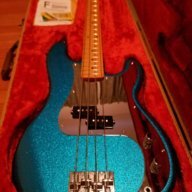
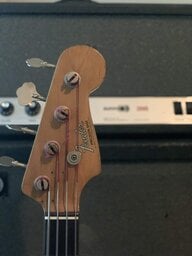
My friend Robert Strickland and I decided to conduct an experiment to determine the difference in tone between our Fender Precision Basses, his being a coveted pre-CBS instrument from 1962 and mine being a 1972 model. Both basses have rosewood fingerboards and are completely stock with their original electronics and hardware. They are both strung with La Bella light-gauge flatwounds that have been on their respective instruments for the same length of time, and neither bass has a foam mute. For this experiment, I chose to play a portion of James Jamerson’s classic bass part from Marvin Gaye’s “What’s Going On” along with an instrumental backing track, the bass featured prominently in the mix. Both instruments were recorded directly into Audacity with no compression or effects. The basses were played finger-style and the volume and tone controls were up all the way. We would like the members of this group to listen to both tracks and see if they can determine which bass is being played. We will reveal the answer at a later date.

Track A

Track B

View attachment 3762364

- Steve

Awesome execution of one of my favorite Jamerson parts. Truly well done!

It seems to me like track two is slightly darker and not as clear, probably due to the age or difference of the caps. I wouldn’t throw either one out of bed however.
 
I have no clue which is which. I think the differences between 60's Fenders and CBS era Fenders are reflected in over all construction and cost saving changes made to the designs rather than the actual sound.

All basses sound unique generally speaking. I have a '65 and a couple of new AV RI Precisions and they all sound great and slightly different. I had a '75 once and it was a piece of crap. It sounded thin, weighed a ton and started falling apart a few months after I brought it home. A friend had a '73 that sounded and played really good but the head stock was an eighth of an inch thicker at the top than down at the nut.

The two basses in the sound clips sound great. They even share the dead spot on the G string, just like Jamerson's! A good Fender is a good Fender no matter when it was built.
 
This is totally a 50/50 proposition, but my sense was Track B was the ‘62... like most people (judging by responses), I voted with my preconceived notion of what a 60s vs 70s P bass “should” sound like :) which is rather ironic given that my notion of a 70s P bass is a late 70s, heavy ash P with a maple fretboard :)

In fact, I’m surprised to read we have such different notions of what each bass was supposed to sound like (including descriptions of the sounds we hear). My guess is this is mostly a mind game.

which does beg the question - did OP play them slightly differently because of his preconceptions, altering the sound subtly to conform to those preconceptions?
 
Two thoughts.

1. The lkely QC controls became much more prevalent in the mid 70s.
2. Most issues were less in the sound, but looks/playability (heavier Northern Ash, sloppy neck pockets, sloppy routing due to worn out jigs, change in finishes, sloppy woodworking in general due to emphasis in increased production and less care in things like body grain match and number of pieces of wood per body).
 
I don't know how they are supposed to sound according to year, but Track A seems to have a little more bite to it, so I would guess that is the 70's P. Very nice playing, by the way !
 
  • Like
Reactions: Steve Boisen
My friend Robert Strickland and I decided to conduct an experiment to determine the difference in tone between our Fender Precision Basses, his being a coveted pre-CBS instrument from 1962 and mine being a 1972 model. Both basses have rosewood fingerboards and are completely stock with their original electronics and hardware. They are both strung with La Bella light-gauge flatwounds that have been on their respective instruments for the same length of time, and neither bass has a foam mute. For this experiment, I chose to play a portion of James Jamerson’s classic bass part from Marvin Gaye’s “What’s Going On” along with an instrumental backing track, the bass featured prominently in the mix. Both instruments were recorded directly into Audacity with no compression or effects. The basses were played finger-style and the volume and tone controls were up all the way. We would like the members of this group to listen to both tracks and see if they can determine which bass is being played. We will reveal the answer at a later date.

Track A

Track B

View attachment 3762364

- Steve

B sounds better in the lower registers, A better in the upper.
 
Most people can't even identify a P bass and a Jazz bass soloing the front PU in a blind test much better than random chance, if they can detect a difference in the sound at all. In fact, even in those cases, the only way it becomes noticeable is after the fact, once the basses are revealed to the listeners. And even then there will still be a brawl about it loud enough that the neighbors will have to call the cops.

It was many years ago, but back when I had my 70's jazz bass, I got to plink around on another pre-CBS Jazz (I don't remember the year, it was a 62 or 63 I believe) and I couldn't tell the difference between it and my JB. Even with the rear pickup in the two different places, I coudnt really detect the difference in tone, though I didn't pluck over the rear PU back then the way I do now.

In other words, any difference in the instruments themselves is going to be way down in the noise of other factors, like strings, eq, volume settings and even variations in how you play the two passages from one performance to the next.

Finally, if I had a pre-CBS Jazz or Precision, no way no how would I even think about gigging with it, not just for the possible loss of value if it's stolen, etc., reasons, but also for the they're not the most well made instruments in the world reasons. The collector's items would stay home....

For gigging, I'd just buy a new one from Fender, which will sound exactly the same and, because it's just better manufactured with modern techniques, better QC on the wood and parts, etc., will be more comfortable to play. The sound guy will never be able tell the difference in sound and neither will you.

L
 
Last edited:
They sound similar. Track B has more mid range and a bit of growl. I'm thinking it's the '72.

Track A sounds like Jamerson's sound. So, I'm guessing it's the '62.

It's good to keep in mind that every Fender wound pickup was different. No computer guided winders back then. Done by human hands and analog machinery. Every pickup was different and every bass sounded different. I don't think it is accurate to stereo type those old Fender basses.
 
  • Like
Reactions: Hammerfield
Most people can't even identify a P bass and a Jazz bass soloing the front PU in a blind test, if they can detect a difference in the sound at all. In fact, even in those cases, the only way it becomes noticeable is after the fact, once the basses are revealed to the listeners. And even then there will still be a brawl about it loud enough that the neighbors will have to call the cops.

It was many years ago, but back when I had my 70's jazz bass, I got to plink around on another pre-CBS Jazz and I couldn't tell the difference between it and my JB. Even with the rear pickup in the two different places, I coudnt really detect the difference in tone, though I didn't pluck over the rear PU back then the way I do now.

In other words, any difference in the instruments themselves is going to be way down in the noise of other factors, like strings, eq, and even variations in how you play the two passages from one performance to the next.

Finally, if I had a pre-CBS Jazz or Precision, no way no how would I even think about gigging with it, not just for the possible loss of value if it's stolen, etc., reasons, but also just they're not the most well made instruments in the world reasons. I'd just buy a new one from Fender and gig with that. The collector's items would stay home....

L

Most people are tone deaf let alone tell the difference between Basses, different versions of the same bass, and or have the ability to mentally recall what they just heard. To find a difference here takes a discerning ear.

To your point, it’s fairly easy to hide an instrument’s identity, but let me add this. I may not have the best ear in the world, if you let me hear a P or a J with all tone controls open, the same strings, played in an amp EQ’d flat, I’ll bet I hit 90% or better on a blind test.
 
  • Like
Reactions: SJan3 and mikeswals