• TalkBass has been independent since 1998. Add your voice.
    Create a free account to reply to discussions, view embedded media, and browse with fewer display ads.
    Join freeLog in
    Want zero display ads or expanded classifieds tools? Compare plans.

A DIY cabinet design for your comments

Playing in a mostly acoustic setting (loud brass and winds, one keyboard or piano, trap drums, and once in a while an electric guitar or violin or something like that), I find that an Omni 12 is usually larger and louder than I need or have room for. I use a Bergantino HT/EX-112 (or one-half of it) most of the time, with adequate head room. I'm sure I could never duplicate the Bergantino performance in a package that small, but I wanted to cook up a somewhat portable two-way cabinet with a 12" woofer and a mid-range cone instead of the Bergantino's tweeter. I'm thinking about a fretless, here.

This really makes sense when I look out in the shop and see that I have a couple of Eminence Alpha 8MR's taking up space. That is all the excuse I need to build another cab.

I have been fooling around with a design for a medium sized, moderately loud, and reasonably deep cabinet. I know I can't have all three, I just don't want to compromise too much on any one of the three elements. I plan to use an Eminence Delta 12LF crossed over to an Alpha 8MR at 800 Hz.

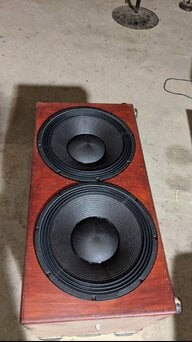
I came up with a 2.84 cu. ft. (total, not net) box, with an Fb of 44.4 Hz and an F3 of 51 Hz. The program I used (Eminence Designer) calls for a 16" wide by 1.5" high by 9.236" deep port. Since I will be using a shelf style port, I will add (1.5" divided by 2) to the port depth. Internal dimensions will be 24" high by 16" wide by 12.78" deep. There will be 2.5" braces running vertically around the sides, top, and bottom, and a couple running vertically up the back. One more brace between the baffle and back panel, and that should do it. I will align the drivers vertically, a few inches off center.

When I first modeled this box, there were some very large impedance peaks. I changed the fill from minimal (two sides and the back) to normal, and that seemed to calm down the impedance peaks a bit. There will be about 3.5" clearance between the end of the shelf port and the back of the cab, which feels a little tight. Otherwise, it looks like a low cost cab that will go deep enough to at least fake a B string, at adequate volume for me, without being too large. I wish it was about 30% smaller, but I don't know how to make that happen without compromising the bottom end too much.

I am a math challenged amatuer, and I am having a heck of a time getting through Dickason's Loudspeaker Design Cookbook. That being the case, I would like to know what you experts think I should do with the design, bearing in mind that I have the Alpha 8 MR's and want to keep the size no larger than the 2.8 cubic feet I'm looking at now. I think the port design could be improved, but I don't know how to do it!

Any help would be greatly appreciated!

 
I can't see a way to do much better with the Delta 12LF - it prefers a larger cab volume but it works ok in there. The DeltaLiteII 2512 performs similarly so is worth considering for a weight saving. An alternate approach would be to squeeze a Kappalite 3015LF into a 60 lite box, tune it to 40Hz, and then add 6dB boost at 40Hz to get back the extension the small box loses. Due to its greater excusion, surface area and efficiency it can play louder, even with all that bass boost.

What about the crossover? I like the idea of using 1st order bandpassing on the Alpha 8MR to smooth out its peaks at either end of its response range. You easily could add a few piezo tweeters to get fullrange response.

Alex
 
Thanks a lot for the reply, Alex! Does the vent look O.K. to you?

I will model the 2512 and 3015LF and compare them to the Delta 12LF. The weight savings is certainly attractive. The 3015LF in a 60 liter box is intriguing. As far as the piezos are concerned, I have used the Alpha 8MR with no tweeter in the past, and I like the way it presents a fretless with piezo pickups. The treble topography sounds better than anything else I've tried with those basses!

I will look at the crossover per your suggestion. It won't take long to try it out, and the details seem to be very important in this moderate volume/acoustic instrument environment.
 
Can't be 100% sure on the vent without knowing the internal volume more precisely. I'm leaning towards plastic pipe vents for my designs as they're easier to tune because you never know exactly how the vent length and cab volume will be perceived. Be careful not to overinsulate the cab or you'll diminish the port output. As you like the sound of the Alpha 8MR I wouldn't follow my 1st order bandpass suggestion - I can see that 3kHz peak working well on fretless though I suspect it might be a little vicious on a brighter fretted bass.

For my custom cab design I'm working on (though it's done conceptually, just need bigger house with workshop space to build it in!) I'm aiming for near flat response, and to achieve that requires some crossover trickery with a pair of Alpha 8MRs, a piezo tweeter array, and a 3015LF in 100 litres tuned to 37Hz. If it works out, I'll see how the UK market likes them.

I've also spent some time kicking around more compact designs but it's hard to get good bass response without custom drivers like the Acme 10"s and they're not available in neo yet.

By the way, how do the Bergs and Omnis compare, sound-wise?

Alex
 
I am going to try these "tinker toy" vent parts from Parts Express.

[Invalid or Expired Link Removed]

This looks like a convenient way to fine tune! They have elbows, inside and outside flares, and straight sections in 3" and 4" sizes.

I hear you on the bigger shop issue. I recently got my garage "Shop" half cleared out, and sprang for a new table saw. Suddenly, I can cobble together a box safely, precisely, and much more quickly than I used to. Leaves a lot more time and energy to struggle with design and evaluation.

Your custom design sounds formidable! After tasting a three way, I can't figure out where we have all been! There are such enormous possibilities that the commercial builders seem to have neglected.

I wonder why the driver manufacturers haven't made the magic drivers suited for smaller boxes available to the DIY market. Is that market too small to bear the marketing costs?

As far as the Omni and the Bergantino's, I would have to say that life is pretty gosh darned good. They both sound wonderful to me, but they are very different in their timbre, and I like to check different basses with each before loading the sled. The Bergantino's seem to want to "crap out" before the Omni does, as we get into louder volumes. I think the Omni does the low B a little better. The Omni being physically larger makes the Bergantino's a more attractive choice for most of the stuff I do, but that's all about my lower back!

I've got an Omni 10 about half done. I am very interested in how that will stack up against the Bergantino's. The Omni 12's replaced my Epifani T-212, but not the Bergantino's because of the size difference. It will be interesting to see if the Omni 10 supplants the Bergantino's.

I wrote a review of the Omni 12 in which I compared it to the Bergantino mini stack, and I will track down the link for you.

Thanks again for the help. Users like me really appreciate it.
 
I'd like to see more cabs that are taller and possibly angled, for single cab use. Even when companies do three-ways they tend to make squat boxes that you either have to take multiples to gig, or place them way off the floor, or just grow ears on the back of your legs. So a lot of the design problems I've been attempting to solve encompass this as well as getting smooth and extended frequency and polar response, with xmax hopefully somewhere in the same range as RMS ratings instead of 1/4 as much ; } ... Some of my concern there is I actually enjoy having a low F# string around, or a Hipshot B/A.

Finding modern neo drivers that can do this and match my existing power amps' output in sizes that one can build compact yet get up above 30 inches tall is difficult. In this respect people like Andy Lewis are ahead of the game. If I build a one-off I can't afford to get say a small four-ohm driver with a lot of excursion.
 
Although the Omni 15 doesn't put out below 40Hz, it has huge output down to that point, and with a little cunning could be rearranged with the woofer horn being aligned vertically up the side of the cab to give you a taller thinner design. One of the nice things about these Omni cabs is they're sufficiently sensitive that their non-ideal (only in the sense of getting max power from your amp) 8 ohm load matters very little.

One thing I have been wondering is how the sound of the Omni 12's midrange differs from that of a non-horn-loaded Alpha 8MR?

Alex
 
One thing I have been wondering is how the sound of the Omni 12's midrange differs from that of a non-horn-loaded Alpha 8MR?
Compare the response of the O12 from 500 to 2.5kHz to that of a baffle loaded A8MR (on the Eminence spec sheet) and you'll see there is no comparison.

I wonder why the driver manufacturers haven't made the magic drivers suited for smaller boxes available to the DIY market.
Because there aren't any. Some manufacturers claim specs that would require magic drivers, but they only exist in the fantasy world of marketing.
 
One thing I have been wondering is how the sound of the Omni 12's midrange differs from that of a non-horn-loaded Alpha 8MR?

Alex


A horn-loaded alpha sounds much more pronounced than a non-loaded one. In the Omni 12 this can be overwhelming at first due to the low sensitivity of the low end in comparison to the 105db average in the mid range. I would assume this is less noticable in the Omni 15.

Once dialed in to preference, I would take a horn-loaded mid any day over direct radiator. Much better tone in the mix.
 
I have a direct radiator with a Delta 12LF crossed over to an Alpha 8MR, in a box of about 2.6 sq. ft. I A/B'ed that cab with an Omni 12 and the baffle-mounted A8MR sounded smaller, and farther away. The tone seemed very similiar, practically indistinguishable, but it sounded just like I expected it to sound. Maybe that's why it sounded like that to me, because I believed it would.

I really agree with fast slapper's comment about the mid-range in the Omni 12 taking some getting used to. It took me several weeks. Then I got unanimous agreement that it sounded better than my Epifani and my Edens as soon as I started to take it around, and it has never let me down. Very authoritative, coming out of that little horn. It still amazes me that the driver costs less than a tank of gas.
 
I really agree with fast slapper's comment about the mid-range in the Omni 12 taking some getting used to. It took me several weeks.
Understandable. You get used to what a bass is 'supposed' to sound like, ie., no midrange, when every speaker you've ever played through is incapable of good midrange reproduction. Then when you finally play through a cab that does have smooth midrange it seems strange, and it takes time to get used to it. Once you do and you go back to the same old same old you wonder how you managed to stand that sterile sound for all those years.

the baffle-mounted A8MR sounded smaller, and farther away.
Baffle mounted the A8MR response is very ragged, with a mediocre +,- 4dB range; a 4dB dip at 2.2kHz kills presence. Horn loaded it smooths out to a hi-fi +,-1.5dB from 500-2.5kHz, and you hear the tone that your bass is capable of.
 
Compare both by hooking them up to your stereo, and playing some well known full range material. The differences will be obvious.

As is always the case with tone, YMMV. Some players want the speakers to contribute (add color) to their sound. Other players want the speakers to produce the sound of their bass. There is no "best" in personal preference.
 
Baffle mounted the A8MR response is very ragged, with a mediocre +,- 4dB range; a 4dB dip at 2.2kHz kills presence. Horn loaded it smooths out to a hi-fi +,-1.5dB from 500-2.5kHz, and you hear the tone that your bass is capable of.

Interesting. That same ragged response had put me off the A8MR until I did some experimenting with crossover points and slopes and found that 1st order bandpassing at 1kHz and 3kHz removed the large peaks in response and thus made the 2.2kHz dip much shallower. The downside is the drop in sensitivity but it's such a sensitive speaker that it would otherwise need padding back to match typical woofer sensitivity.

I wonder how the performance of two series connected Alpha 8MR baffle mounted with these crossovers will compare to the horn-loaded single driver. The cost of the extra driver is offset by the removal of the need for a low pass filter on the woofer to maintain correct impedance (due to series midranges and 1kHz crossover point) and the build time would be less.

What is the off-axis response of the Omni 12/15 midrange horn? Is it a constant-directivity horn?

Alex
 
The DeltaLite II 2512 modeled bass response similiar to the Delta 12LF in the mid-sized vented cab. When I weigh the weight savings of the 2512 against the higher power handling of the Delta 12LF I will have a woofer!

Since it is raining today, and I can't go out and play, I might as well go rev up the table saw.

I hope to see more basement experimentation with small cabinets. I suspect that forum users are probably reaching for small cabs more often than before, and we want alternatives. I have high hopes for the Omni 10 taking shape in my garage. I still love the Bergantino's, but two of them start running into more weight than I want to hump. Give me a couple of weeks and I'll A/B the Omni 10 and the HT/EX-112.
 
I wonder how the performance of two series connected Alpha 8MR baffle mounted with these crossovers will compare to the horn-loaded single driver.
They'll be flatter, but not near as flat as a horn. You can fix the A8MR with passive filtering, but when you do you sacrifice sensitivity, and that goes against my grain. Fix it with four small pieces of plywood and it's both flat and loud. Too sensitive? That's why we have 31 band EQs. Back off on the midrange and HF, boost up the bottom. A goodly deal of the power you need to fatten the bottom up is saved by backing off elsewhere with EQ, where as with passive rolloff that power is wasted.

What is the off-axis response of the Omni 12/15 midrange horn?
It's 90x90 degrees -6dB.
 
It's also a much more difficult box to build. Worth it if you can, though.

Change that to much more difficult box to build.
Change that to much more worth it if you can.

The DR boxes are really where it's at, if you can do the build. If you want a stand-alone box, and play 5-string, the DR280 is the ticket. Otherwise, a DR250 plus T39 is reported by those who have built them, to be the killer combination.
 
What caught my attention is the comments from people who say the DR250 doesn't necessarily need a sub cab. One commented they would rather just have a second DR250. I'll be ordering my DR250 plans as soon as I get home from an extended work shift this weekend. I'm really looking forward to just reading the process for awhile to get my bearings. Another point of interest is the fact that you can build it vented and then simply plug up the vent holes for when I want to play around with a sealed cab tone.
 

Latest posts