Background
In my youth I had my first bass guitar de-fretted and lined. In those years, my first two serious bass guitar teachers were professional musicians and formidable fretless players, one playing only fretless. Though even while I studied with those teachers I was becoming a fretted player, in the years that followed, often I owned a fretless bass. In later years those were 5-string basses, probably because of my longtime admiration of the playing and music of Percy Jones, who by then played only 5-string basses.
But make no mistake: I am not a real fretless bass player. I have the love and the touch, but with me it is ’no lines, no dice’.
Advent
Recently, luckily I noticed for sale here a lined fretless Warmoth neck with the HG Thor epoxy coating. More luckily still, I was able to buy it. Best of all I met the seller, TalkBass-er @wmcran, who turned out to be a fascinating and very cool person.
Since the current wait time for an HG Thor epoxy fingerboard treatment is rumored to be five years, and since after that long I may be either insolvent or not viable, I thank @wmcran for the chance to have this bass neck now. Also, my thanks to Warmoth and HG Thor for their work of some 13 years ago.
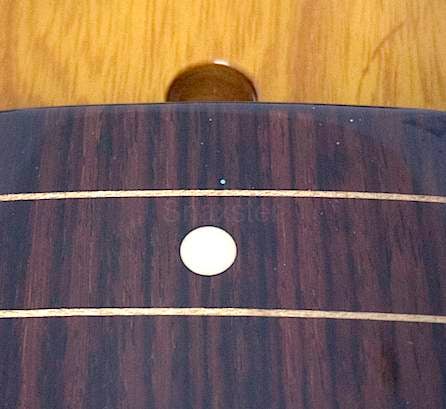
The HG Thor hologram dot (the tiny one, above the position marker and the last line)
First try
When initially I swapped this neck onto a bass, the result was good, but not what I was after. That bass had an ash body. Also its pickups were excellent, but they sounded slightly more modern than my target.
Prepping the neck for that assembly, I smoothed two defects on its back’s finish. (Probably pointless, since someday I may sand off the gloss from back of this neck's finish.) In the epoxy coat were roundwound string marks and a few other scratches. In multiple passes, I used Flitz polish to soften them a little, which I believe restored the gloss finish somewhat, too.
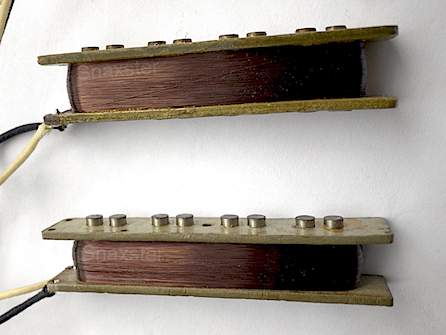
1965 Fender/O.C. Duff pickups set
Pivot
A week later, the stars aligned: another rarity came up for sale, a Fender Custom Shop Jazz Bass body made of alder and bearing the yellow sunburst paint I wanted on an American made Fender bass for some time. Buying it, I realized that now I had the makings of not only the fretless bass guitar sound I sought, but also of a Jaco Pastorius tribute bass. Not an attempt at a re-creation, but a tribute.
My goal was a reasonably authentic vintage sound plus the instrument mechanics of Jaco’s signature fingered note envelope. I acknowledge that Jaco’s innovation of the mechanics of his instrument was key; but I feel that most important to his bass sound was his touch: how he used the mechanics to best aesthetic advantage.
Thus I based my goal for this project on that distinction. I was to assemble a bass guitar whose mechanics resembled that of Jaco Pastorius's instruments, but without the expectation that I would then “sound like Jaco” when I played it.
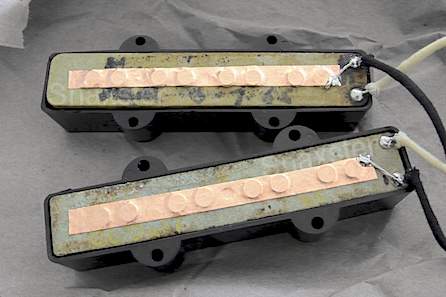
The pickups with pole pieces grounded
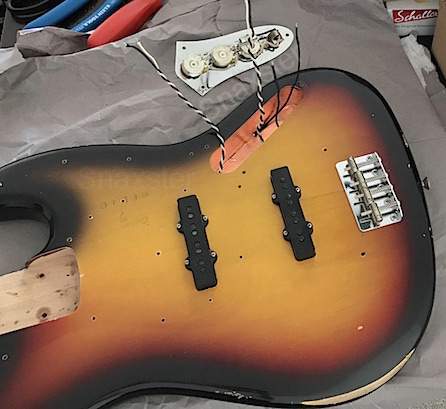
Ready to solder the control plate in
Specs
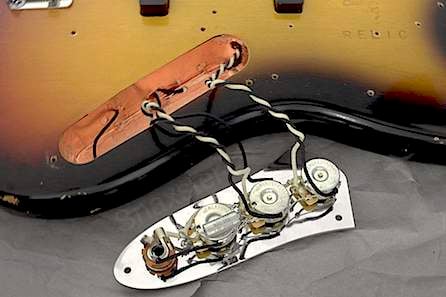
Electronics complete
Assembly and setup
A week ago, waiting for the bass body to arrive, I compiled a project box of parts I owned, ordered parts I didn't own, and wired up the passive control plate. The 1965 Fender/O.C. Duff pickups set I chose for this project seemed predestined for it. My thanks go to Owen Duffy of O.C. Duff Pickups for his expertise, patience, care, and excellent craft in re-creating these pickups.
Yesterday I assembled the Jaco tribute bass.
Prepping the epoxied fretless neck, I reduced the relief as much as I dared, then swapped on the chrome tuners and string retainer. Prepping the bass body, I applied grounded shielding to its cavities, then mounted the bridge and pickups. Lastly I soldered the control plate in, did a successful “tap test” for the electronics, then mounted the control plate. The neck fit the body well, as did the neck plate, which fastened nicely.
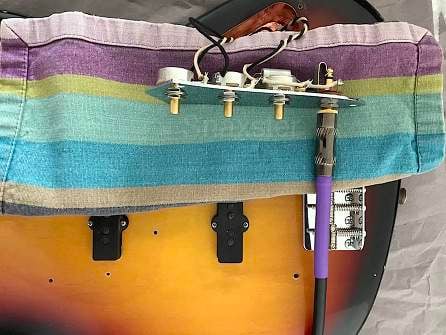
Tap test all good!
Speaking of tap tests, I thought to do the other kind, a “wood tap test” with the empty, lightweight, alder Custom Shop bass body. It. sounded. great! Like a little resonant instrument unto itself, this body sang with a sweet, melodious, harmonically detailed voice when I tapped it. Thank you, Fender Custom Shop.
I must say that in this build I benefited from all the little lessons about bass guitar assembly that I learned during the past several years. The outcome was more ease, precision, quality, and speed. Notable among the techniques I used was prepping each screw with dry soap before installing it. Yes, in the past I tried assembly without the help of soap or wax… and it was awful.
[Please, no jokes about screwing without lubrication. Thank you!]
One lesson I can’t recall learning was how to set intonation on a fretless bass. For this setup I used a digital tuner, of course, and also the crutch of the fingerboard lines. But how it is done without the lines is a mystery to me. Likewise for all traditional fretless string instruments. It must be that in the task of intonation, the player’s knowledge of finger positions functions exactly equivalently to frets.
Happily my neck relief adjustment proved to be good and useful for my goal. In a few passes, I discovered how to set both the bridge and the pickups for the goal of maximum fingered note envelope.
Already particular about pickup heights, nonetheless it was news to me that too high a bridge pickup detracted from the desired note envelope sound. In hindsight it makes sense. Related to that was learning that the ‘both J pickups at equal volume’ scooped sound practically erases the fretless fingered note envelope, since it robs the sound of midrange frequencies essential to its production.
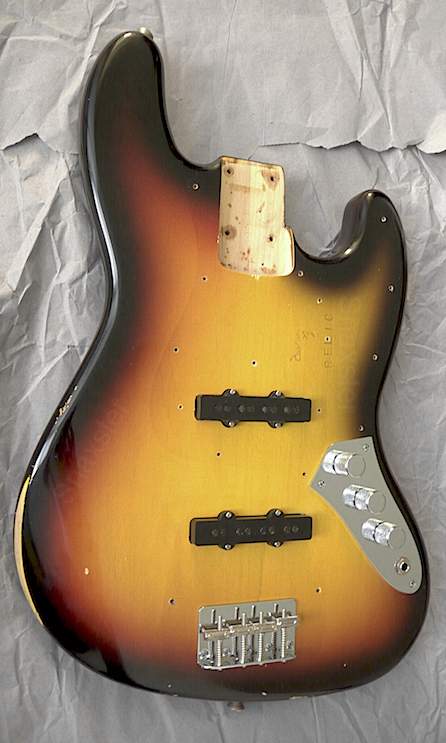
Loaded
Refinement
Unsurprisingly, today I revisited this bass. Playing it un-amplified, I had a new hunch. I noticed that its acoustic sound featured its most extreme fingered note envelope. That meant that something in the electronics path, from the pickups out to the headphones (where I do foundational sound design) was not conveying it as much as might be.
Allowing that there are other aspects of the instrument’s electric sound, still I wondered if more of the envelope could be conveyed in audio.
I plugged directly into a 3Leaf Audio The Enabler, which I use mainly as a headphone amp, but also for quick EQ tests. Though warm for a solid state preamp, it is colder and flatter, and offers better midrange adjustment than the Kern IP-777 preamp I used previously as a main preamp during this build. This change did present the note envelope more clearly, as did boosting the upper midrange a little on The Enabler.
Then flattening The Enabler and reverting to the Kern as a main preamp, I decided to lower the neck pickup a bit. I should note that sound of the neck pickup in this set has a most delicate sibilance, compared to the bridge pickup’s stronger midrange and less fine high frequencies (even factoring in their different positions in the bass guitar). I noticed this at once in the tap test.
This proved significant for the neck pickup, which along with its thick, wooly bass presented the fingered note envelope beautifully all along. After I adjusted the neck pickup’s height today, in alternating comparisons with the bridge pickup, playing something like a raga, I was moved almost to tears; so deep and emotive was the neck pickup’s sound. Formally it reminded me of double bass or surbahar, and it evoked the melancholy voice of a living thing. How sad are the depths of worldly existence.
And there’s music for you.
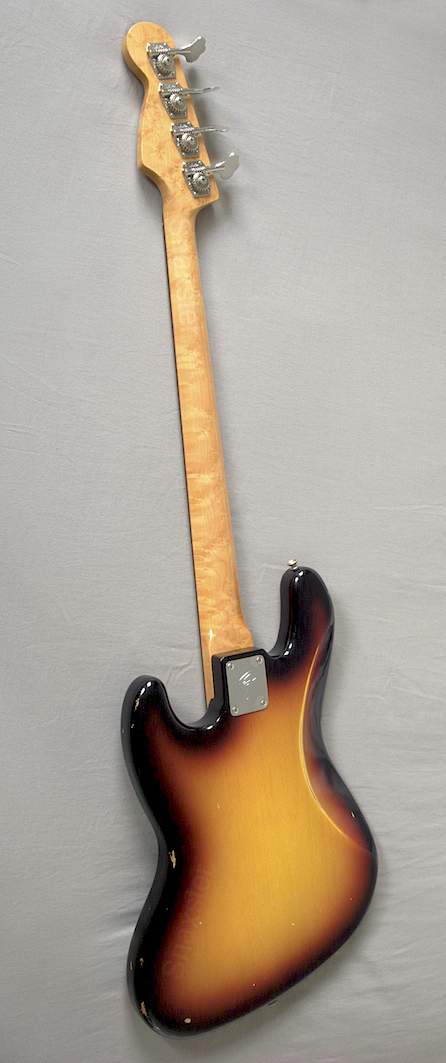
The completed instrument, back
Result
With the last pickup height adjustment, I decided that this bass was complete and that I was successful. The Jaco Pastorius tribute bass played well and sounded wonderful. Sonorous, raw, expressive. Thick and wooly, or nasal and percussive, or tough and metallic. This was a very good J bass, and it had the extreme fretless “mwah” sound (there… I used the term!)
Jaco probably would have thought its neck far too heavy and thick, though he might have liked its long fingerboard. Also he might have liked its body and pickups. There is the prominent “[logo] RELIC” embossed on the body face. Visible without a pickguard, it is kind of goofy. But I like to believe that Jaco would have thought it amusing and enjoyed playing this bass with it there.
The last fretless bass I owned, I bought and sold within two years several years ago. Secretly I wanted a fretless bass during these past two years, but I always stopped short of buying one. This fretless bass is perfect for the likes of me. Though not professionally built, most of its critical fitment already was done by professionals, so I only had to retrace their work.
Finding the sound in this build was a valuable chance for me to learn. Through imitation of the techniques he innovated, I was afforded a glimpse into the awareness space that was Jaco’s incomparable mind.
Thank you, Mr. Pastorius.
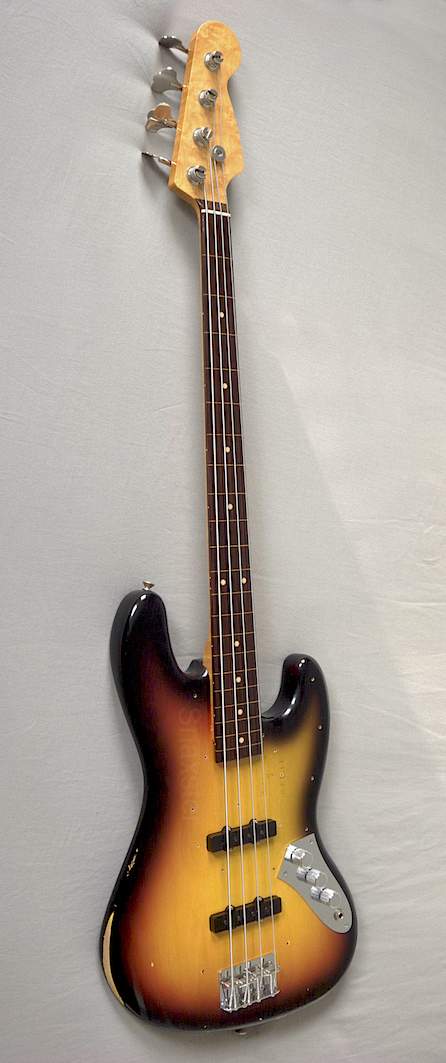
The completed instrument, front
In my youth I had my first bass guitar de-fretted and lined. In those years, my first two serious bass guitar teachers were professional musicians and formidable fretless players, one playing only fretless. Though even while I studied with those teachers I was becoming a fretted player, in the years that followed, often I owned a fretless bass. In later years those were 5-string basses, probably because of my longtime admiration of the playing and music of Percy Jones, who by then played only 5-string basses.
But make no mistake: I am not a real fretless bass player. I have the love and the touch, but with me it is ’no lines, no dice’.
Advent
Recently, luckily I noticed for sale here a lined fretless Warmoth neck with the HG Thor epoxy coating. More luckily still, I was able to buy it. Best of all I met the seller, TalkBass-er @wmcran, who turned out to be a fascinating and very cool person.
Since the current wait time for an HG Thor epoxy fingerboard treatment is rumored to be five years, and since after that long I may be either insolvent or not viable, I thank @wmcran for the chance to have this bass neck now. Also, my thanks to Warmoth and HG Thor for their work of some 13 years ago.
The HG Thor hologram dot (the tiny one, above the position marker and the last line)
First try
When initially I swapped this neck onto a bass, the result was good, but not what I was after. That bass had an ash body. Also its pickups were excellent, but they sounded slightly more modern than my target.
Prepping the neck for that assembly, I smoothed two defects on its back’s finish. (Probably pointless, since someday I may sand off the gloss from back of this neck's finish.) In the epoxy coat were roundwound string marks and a few other scratches. In multiple passes, I used Flitz polish to soften them a little, which I believe restored the gloss finish somewhat, too.
1965 Fender/O.C. Duff pickups set
Pivot
A week later, the stars aligned: another rarity came up for sale, a Fender Custom Shop Jazz Bass body made of alder and bearing the yellow sunburst paint I wanted on an American made Fender bass for some time. Buying it, I realized that now I had the makings of not only the fretless bass guitar sound I sought, but also of a Jaco Pastorius tribute bass. Not an attempt at a re-creation, but a tribute.
My goal was a reasonably authentic vintage sound plus the instrument mechanics of Jaco’s signature fingered note envelope. I acknowledge that Jaco’s innovation of the mechanics of his instrument was key; but I feel that most important to his bass sound was his touch: how he used the mechanics to best aesthetic advantage.
Thus I based my goal for this project on that distinction. I was to assemble a bass guitar whose mechanics resembled that of Jaco Pastorius's instruments, but without the expectation that I would then “sound like Jaco” when I played it.
The pickups with pole pieces grounded
A sidebar about terminology
For some years now, bass guitar culture has used the term “mwah” to describe the slow, vocal, dramatic fretless bass guitar fingered note envelope first developed to distinctiveness by Jaco Pastorius. Initially I accepted that term as being suitable, but eventually I thought it was a poor descriptor. On completing and playing this tribute bass, I carefully considered why that was.
The answer that presented itself was that the envelope is characterized by a downward filter sweep-type sound, starting with a tiny sucking or kissing sound. I was reminded of an envelope filter set to reverse sweep. As such, the term might be “tyow” (tee-OW) rather than “mwah”. There is more to the envelope, but that’s the aspect of it I noticed first. Since the onset of the envelope is not the extent of it, especially when a note is sustained, maybe the term should be “tyah” (tee-AH) or “tyowah” (tee-OW-ahhhh).
While homing in on this bass’s setup, committed to setting it for maximum envelope, I realized that [Invalid or Expired Link Removed] got it right all those years ago. He saw that the same behavior that was undesirable “fret buzz” on a fretted bass was desirable, indeed essential on a fretless bass that was set up to produce the Jaco note envelope. Clear to me was that Pedulla correctly named his [Invalid or Expired Link Removed] accordingly. I noted that this fretless buzz included a raspy and breathy sound. In a first pass, I avoided it as when setting up a fretted bass. In later tries, in my I turn stumbled on Pedulla’s buzz discovery and it was a sprint to the finish.
For some years now, bass guitar culture has used the term “mwah” to describe the slow, vocal, dramatic fretless bass guitar fingered note envelope first developed to distinctiveness by Jaco Pastorius. Initially I accepted that term as being suitable, but eventually I thought it was a poor descriptor. On completing and playing this tribute bass, I carefully considered why that was.
The answer that presented itself was that the envelope is characterized by a downward filter sweep-type sound, starting with a tiny sucking or kissing sound. I was reminded of an envelope filter set to reverse sweep. As such, the term might be “tyow” (tee-OW) rather than “mwah”. There is more to the envelope, but that’s the aspect of it I noticed first. Since the onset of the envelope is not the extent of it, especially when a note is sustained, maybe the term should be “tyah” (tee-AH) or “tyowah” (tee-OW-ahhhh).
While homing in on this bass’s setup, committed to setting it for maximum envelope, I realized that [Invalid or Expired Link Removed] got it right all those years ago. He saw that the same behavior that was undesirable “fret buzz” on a fretted bass was desirable, indeed essential on a fretless bass that was set up to produce the Jaco note envelope. Clear to me was that Pedulla correctly named his [Invalid or Expired Link Removed] accordingly. I noted that this fretless buzz included a raspy and breathy sound. In a first pass, I avoided it as when setting up a fretted bass. In later tries, in my I turn stumbled on Pedulla’s buzz discovery and it was a sprint to the finish.
Ready to solder the control plate in
Specs
- neck: Warmoth, birdseye maple/Indian rosewood, lined fretless, thin profile, 21 “frets”
- fingerboard coating: 2004 HG Thor epoxy
- body: 2008 Fender Custom Shop ’64 Jazz Bass relic, alder, yellow sunburst nitro
- pickups: Alnico 5 magnets, plain enamel coil wire, RWRP set
- 1965 Fender Jazz Bass neck pickup, rewound by O.C. Duff Pickups
- matched re-creation of a 1965 Fender Jazz Bass bridge pickup by O.C. Duff Pickups
- strings: Dark Horse stainless steel roundwound
- tuning machines: Schaller BM 10250301
- bridge: Allparts, Japan
- other hardware: Fender
- pots: CTS 450G “dish back”, solid shaft, 250k
- jack: Switchcraft
- wire: Gavitt tinned, cloth covered
- tone cap: vintage TRW .047uF %10 paper-in-oil
- solder: vintage Kester “44” resin core
- copper foil: 3M adhesive backed tape
- weight: 9 lb 10 oz
Electronics complete
Assembly and setup
A week ago, waiting for the bass body to arrive, I compiled a project box of parts I owned, ordered parts I didn't own, and wired up the passive control plate. The 1965 Fender/O.C. Duff pickups set I chose for this project seemed predestined for it. My thanks go to Owen Duffy of O.C. Duff Pickups for his expertise, patience, care, and excellent craft in re-creating these pickups.
Yesterday I assembled the Jaco tribute bass.
Prepping the epoxied fretless neck, I reduced the relief as much as I dared, then swapped on the chrome tuners and string retainer. Prepping the bass body, I applied grounded shielding to its cavities, then mounted the bridge and pickups. Lastly I soldered the control plate in, did a successful “tap test” for the electronics, then mounted the control plate. The neck fit the body well, as did the neck plate, which fastened nicely.
Tap test all good!
Speaking of tap tests, I thought to do the other kind, a “wood tap test” with the empty, lightweight, alder Custom Shop bass body. It. sounded. great! Like a little resonant instrument unto itself, this body sang with a sweet, melodious, harmonically detailed voice when I tapped it. Thank you, Fender Custom Shop.
I must say that in this build I benefited from all the little lessons about bass guitar assembly that I learned during the past several years. The outcome was more ease, precision, quality, and speed. Notable among the techniques I used was prepping each screw with dry soap before installing it. Yes, in the past I tried assembly without the help of soap or wax… and it was awful.
[Please, no jokes about screwing without lubrication. Thank you!]
One lesson I can’t recall learning was how to set intonation on a fretless bass. For this setup I used a digital tuner, of course, and also the crutch of the fingerboard lines. But how it is done without the lines is a mystery to me. Likewise for all traditional fretless string instruments. It must be that in the task of intonation, the player’s knowledge of finger positions functions exactly equivalently to frets.
Happily my neck relief adjustment proved to be good and useful for my goal. In a few passes, I discovered how to set both the bridge and the pickups for the goal of maximum fingered note envelope.
Already particular about pickup heights, nonetheless it was news to me that too high a bridge pickup detracted from the desired note envelope sound. In hindsight it makes sense. Related to that was learning that the ‘both J pickups at equal volume’ scooped sound practically erases the fretless fingered note envelope, since it robs the sound of midrange frequencies essential to its production.
Loaded
Refinement
Unsurprisingly, today I revisited this bass. Playing it un-amplified, I had a new hunch. I noticed that its acoustic sound featured its most extreme fingered note envelope. That meant that something in the electronics path, from the pickups out to the headphones (where I do foundational sound design) was not conveying it as much as might be.
Allowing that there are other aspects of the instrument’s electric sound, still I wondered if more of the envelope could be conveyed in audio.
I plugged directly into a 3Leaf Audio The Enabler, which I use mainly as a headphone amp, but also for quick EQ tests. Though warm for a solid state preamp, it is colder and flatter, and offers better midrange adjustment than the Kern IP-777 preamp I used previously as a main preamp during this build. This change did present the note envelope more clearly, as did boosting the upper midrange a little on The Enabler.
Then flattening The Enabler and reverting to the Kern as a main preamp, I decided to lower the neck pickup a bit. I should note that sound of the neck pickup in this set has a most delicate sibilance, compared to the bridge pickup’s stronger midrange and less fine high frequencies (even factoring in their different positions in the bass guitar). I noticed this at once in the tap test.
This proved significant for the neck pickup, which along with its thick, wooly bass presented the fingered note envelope beautifully all along. After I adjusted the neck pickup’s height today, in alternating comparisons with the bridge pickup, playing something like a raga, I was moved almost to tears; so deep and emotive was the neck pickup’s sound. Formally it reminded me of double bass or surbahar, and it evoked the melancholy voice of a living thing. How sad are the depths of worldly existence.
And there’s music for you.
The completed instrument, back
Result
With the last pickup height adjustment, I decided that this bass was complete and that I was successful. The Jaco Pastorius tribute bass played well and sounded wonderful. Sonorous, raw, expressive. Thick and wooly, or nasal and percussive, or tough and metallic. This was a very good J bass, and it had the extreme fretless “mwah” sound (there… I used the term!)
Jaco probably would have thought its neck far too heavy and thick, though he might have liked its long fingerboard. Also he might have liked its body and pickups. There is the prominent “[logo] RELIC” embossed on the body face. Visible without a pickguard, it is kind of goofy. But I like to believe that Jaco would have thought it amusing and enjoyed playing this bass with it there.
The last fretless bass I owned, I bought and sold within two years several years ago. Secretly I wanted a fretless bass during these past two years, but I always stopped short of buying one. This fretless bass is perfect for the likes of me. Though not professionally built, most of its critical fitment already was done by professionals, so I only had to retrace their work.
Finding the sound in this build was a valuable chance for me to learn. Through imitation of the techniques he innovated, I was afforded a glimpse into the awareness space that was Jaco’s incomparable mind.
Thank you, Mr. Pastorius.
The completed instrument, front
Last edited:


 Could you provide a little more detail?