• TalkBass has been independent since 1998. Add your voice.
    Create a free account to reply to discussions, view embedded media, and browse with fewer display ads.
    Join freeLog in
    Want zero display ads or expanded classifieds tools? Compare plans.

A physics-defying speaker array(?)

I'm going to bump this. Hopefully we can get some more information. Mr. Bromer, is there any chance you could post a 1w/1M SPL chart for your cabinet? That would be a great way for you to show us that there's something to this. Also, I'll second the request for some sort of pricing idea - can you give us a ballpark figure?

Here's another question I was thinking about: It seems like the surface that the cabinet is on might be involved in the "symmetry" thing, is that the case? In other words, is it necessary to have a flat, smooth surface for the cabinet to sit on so that the array acts like a circle rather than a semi-circle (which seems to be an important aspect of the design, but I could be wrong there)? Would the performance be effected if the cab were placed on a carpeted stage?
 
I'm going to bump this. Hopefully we can get some more information. Mr. Bromer, is there any chance you could post a 1w/1M SPL chart for your cabinet? That would be a great way for you to show us that there's something to this. Also, I'll second the request for some sort of pricing idea - can you give us a ballpark figure?
Ditto. A Patent application number would also be useful.
 
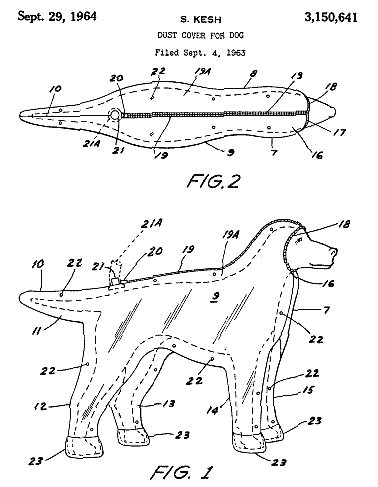
Other patented "woofer" improvements :)
patent-dog.gif

You just made me wet myself!!! Dang, I hate getin' old <sigh>

Paul
 
Wonder if it's a variation on Danley's Unity.
Not even close, as the Unity is horn loaded. The Unity also employs proper driver spacing vis-a-vis phase summing with multiple drivers, which this does not appear to do. Not knowing specific claims it's impossible to say whether this rig can realize them, but the distance between the drivers does not bode well for response above a few hundred Hz.

 
Not even close, as the Unity is horn loaded. The Unity also employs proper driver spacing vis-a-vis phase summing with multiple drivers, which this does not appear to do. Not knowing specific claims it's impossible to say whether this rig can realize them, but the distance between the drivers does not bode well for response above a few hundred Hz.

I thought it was in some sort of flare, hence the Unity comment. I also pondered if it might have the driver's spacing staggered the 'average out' differences etc.
 
Hello again and thanks for your continued interest.

As we mentioned on our web site, the patent is “allowed” but the number has not yet issued. In early March you should be able to search for the patent on the www.uspto.gov web site. You can search either by my last name, Bromer, or the title of the patent, “Large-Diameter Arcuate Speaker.”

As soon as the patent was “allowed” we rushed to get ready for NAMM at the last minute (mid December). We are still working out some fine details like price. We expect to have that worked out in early March also.

The patent has broad coverage on the configuration of the speakers. We can make the cabinet with any size or type of speakers and still get the same great bass response. The power handling and the SPL depend on the individual speakers, the same as with any multi-speaker cabinet. Our configuration makes the speakers “bigger” acoustically, but does not change the SPL or power handling of the cabinet.

The bass cutoff is controlled entirely by the effective diameter. The fall-off of sound radiation efficiency with decreasing diameter is well established, and the only way my speaker differs from the textbook examples is in using a ring instead of a solid speaker.

You can hear the bass response at Donnavision.com.

In regard to question about the interference problems above a few hundred Hz, there are no problems because the spacing of the speakers from the listener is not regular. With the circular array, the increment of the distance from the listener to the speaker between one speaker and the next constantly changes; it's as if you scattered the speakers on the ground. There is no interference or cancellation.

As to the quality of the surface on which the cabinet rests, I don't believe that it has an appreciable effect on the sound.
 
The patent for this thing has been issued.

Invalid Link Removed

Hopefully those of you with some knowledge on this subject can explain what it is doing and whether it can actually work.

Here is my question: what is the point? Is this thing designed to be as good as standard cabinets, but significantly smaller? Is it supposed to outperform standard cabs? Is it flat to a lower frequency? Is it supposed to be cheaper? In what way is it better than what is currently available?
 
Just my opinion:
It's actually a little sad.
It's not the patent office to say if an invention works or not.
It's not the patent attorney's job.
Still the attorney makes money whether it works or not.
All these screwball patents are overloading the patent office. And scams created by creating a patent application to fool investors.
Invalid Link Removed
 
Just my opinion:
It's actually a little sad.
It's not the patent office to say if an invention works or not.
It's not the patent attorney's job.
Still the attorney makes money whether it works or not.
All these screwball patents are overloading the patent office. And scams created by creating a patent application to fool investors.
Invalid Link Removed
Yeah, but it's not the patent office's job to legislate morality. The copyright office issues registered copyrights for crappy songs and bands who rip off investors as well. And I want to make it clear that I'm not accusing Bromer of ripping people off, but whether he is or not is not for the patent office to decide.
 
Hi everyone.

In answer to Conical Johnson, the main advantage of the speaker is that it is flat to a lower frequency. When the frequency goes below where the individual speakers radiate sound, then the loudness drops off a few dB. However, it doesn't keep going down; it stays constant until the frequency corresponding to the overall diameter of the speaker is reached (about 40 Hz) and then it starts to drop off more. This "plateau" is due to the frontal area being only partly covered in speakers. If the entire front side were covered with speakers, there would be no plateau drop-off, but the cabinet would be heavier and more expensive. As it is, the plateau can be compensated for easily.

(It's quite possible to build a cabinet that would be perfectly flat from subsonic up to speaker cone breakup, say 6 kHz with six-inch speakers or 10khz with smaller ones.)

Our cabinet is about half as heavy and half as long (when folded) as a typical 8-speaker cabinet of similar power rating.

I think the sound is probably cleaner, because the speakers are small and the cones can go to higher frequencies without breakup. But my ear is not very good.

In answer to seamonkey: Don't be sad, be happy, because a patent lawyer lost money on this patent instead of making money. I am a patent attorney, and I had to pay the Patent Office fees.

To Jimmy M: Thanks for the benefit of the doubt.

Nick Bromer
 
Good science is good theory and good measurements.
If you truly believe this works it wouldn't take much to actually do some real measurements, with a reference to a standard line array made with the same drivers.

This of course wouldn't be needed for the market place, witness cable discussions, Bose, etc.