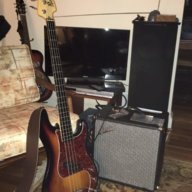
Personally, I'm really apprehensive about adding the sub. I think it introduces another variable, and can really screw up our audience volume and listening experience
If you are clueless about using subs, maybe. If you take the time and effort to learn HOW to use them properly, as a constructive tool, that's an entirely different matter.
In my experience subs may be happy-making out front, but only confuse stage sound, usually causing phase-crossing that can eat up the amp sound. So your amp may be coming through the PA but not back to you. Subs without a sound tech to run them is pretty well a guaranteed disaster in my book. Subs should always be mixed on an aux output, and if they interfere with the bass I insist it be taken out of that mix. Trying to hear my bass through a sub is impossible, the freqs just aren't there to provide note definition, harmonics or articulation. Subs emphasize certain freqs, that's all, they are for subliminal thump, not music. Move bass output into just the mains, get some bass going in the monitors, THEN determine whether your rig is up to what you need.
That's not at all what subs CAN be used for when used properly for reinforcement. Different types of music and different mixing approaches can (and do) incorporate subs in ways that make the low end more articulate when combined with appropriately matched and tuned tops. They CAN be used to add some thump (essential for some music types) but they can also be used to provide controlled low frequency extension that the tops (and a bass rig like the OPs) can't possibly achieve. The "phase-crossing" comment makes no sense.
I couldn't have said it better. If you can hear that there's a subwoofer then it's too loud. We heard Jacob Collier at Lincoln Center in NYC and when he played the lower end of his Nord it was nice and full but it brought no attention to the subwoofer. That's the correct use.
That's YOUR opinion for THAT type of music, but you might also be surprised at how much sub was used to provide the LF extension too.
When I was mixing touring acts, each genre and even each act within the genre could be mixed differently and with a different emphasis on low frequency content and extension. For example, when mixing and act like Wynton Marsalis or Herbie Hancock, the use of subs indoors was more like you describe, yet when mixing outdoors for a larger audience it takes a lot more sub to cover the upright, kick and piano. Because of this, we would also typically provide a sidefill mix to fill in on the stage what isn't reflected back from the stagehouse walls, shell (if there was one) and room. This side fill mix may be high passed to reduce the content that may also be present in the energy from sub wraparound.
On the other side, when I would mix an act in some genres of world music, zydeco, R&B, rock, etc., the sub tended to be mixed in a little heavier to provide more of the low end energy. This was done as much for feel and impact, to emphasize the groove and provide "momentum" as for "tone". Since the acts I mixed were all well established acts, it was relatively easy to grasp from their recordings what the act was trying to achieve with their music.
A genre that may surprise you with the application of subs is Americana and American Folk/Folk-rock. As these acts developed, they began to appreciate how subs could add and subtract the impact and intimacy of their live performances. For example, when I mixed acts like Don McClean, Gordon Lightfoot, New Riders (of the Purple Sage), Kate Wolf, John Prine, the arrangements would often provide the opportunities to emphasize low frequency extension and level on higher energy songs. This allowed the mix to sound fuller without getting too much louder, added the drive and "bigness" without getting in the way of the rest of the mix.
When you get into the modern genres like metal, modern rock, big pop, the integration of subs in the mix can be much more aggressive with the low end driving the mix and everything else sitting around the low end rather than within. It's a style that I'm not terribly fond of because it's not the types of acts I typically mixed, BUT I respect why they do this and given the success in this genre I'm not in the position to argue against their position. Even though I didn't often mix these kinds of shows, there was one memorable act that I did a short tour with, an act that really established the foundation that metal was built on. This was the band Anvil, and IMO they were really quite good but were simply about 5 years too early to achieve the success that Metallica (who credits Anvil as the precursor of the genre) achieved.
So, from somebody who was in the trenches for 40 years and experienced firsthand the evolution of sound systems from simpler reinforcement without subs to more comprehensive systems with wider bandwidth and higher clean output, this opened up additional possibilities for improved and different interpretations with the new tools that were simply not possible even though they were desired much earlier than they became available.









 Kidding of course, you are entitled to your opinion and I respect it. My suggestion not being right for you doesn't make it wrong.