• TalkBass has been independent since 1998. Add your voice.
    Create a free account to reply to discussions, view embedded media, and browse with fewer display ads.
    Join freeLog in
    Want zero display ads or expanded classifieds tools? Compare plans.

Adam Nitti Signature model- seriously?

One of the reasons basses are occasionally named for less known musicians is that those musicians, having
lower net worth, probably tend to be a lot more cooperative and enthusiastic and require a lot less in return.

Try getting Paul McCartney on the phone to pitch the idea....then negotiate with his "legal team"......
.....uhhhhh......I think Adam is available with substantially less cost and hassle, LOL.
 
Last edited:
Makes no sense to me. Some the best basses I know were named after people I didn't know at first like the Fender Reggie Hamilton Jazz. By the way, I looked up Reggie Hamilton, and realized I had heard a bunch of his music without knowing it.
Seriously, I wasn't being serious!
As for not knowing certain bassists, hey, I like a lot of Motown, but when I was growing up I didn't know who was playing bass on so many great hits.
 
I don't agree. The bass is a neck-through with higher end electronics (passive Bartolini® xxM56C pups in the bridge and neck and a custom Bart 3-band EQ...the pups and pre-amp alone are 700 bucks) and a figured maple top, that you will not find in a 600 buck axe. You really mean it's a low-to-mid spec?


Agreed. I would pay a lot more, actually. As much as I could afford, to be honest. drool

The bass also has a ton of purpleheart too. The key fact is that the bass is master built by a single luthier. Fender charges similar prices for CS Jazz Basses and Precisions that are master built too.
 
  • Like
Reactions: FerK
I don't agree. The bass is a neck-through with higher end electronics (passive Bartolini® xxM56C pups in the bridge and neck and a custom Bart 3-band EQ) and a figured maple top, that you will not find in a 600 buck axe. You really mean it's a low-to-mid spec?


Agreed. I would pay a lot more, actually. As much as I could afford, to be honest. drool
I was talking about visual-wise, if there is no price tag, and I don't know the specification, I would think It's a 600-1000 bass, It does sounds amazing, but 7k, :rollno:...
 
The key fact is that the bass is master built by a single luthier. Fender charges similar prices for CS Jazz Basses and Precisions that are master built too.

Wow, that explains a LOT of the price tag. It's quite simple math, really. If a senior luthier spends 80 hours working on each single instrument (as it's not made in a semi-automatic assembly line with mostly CNC equipment), Ibanez also needs to make a bit of money on the labor alone...that's easily a few grand off the price tag.
 
  • Like
Reactions: Dr. Cheese
Wow, that explains a LOT of the price tag. It's quite simple math, really. If a senior luthier spends 80 hours working on each single instrument (as it's not made in a semi-automatic assembly line with mostly CNC equipment), Ibanez also needs to make a bit of money on the labor alone...that's easily a few grand off the price tag.

Skilled labor in a first world country is expensive. This summer I bought one of those cans of freon and lube with a gauge and hose for my wife's auto ac because I knew a mechanic would do the same thing, plus add $80 for his labor.
 
Wow, that explains a LOT of the price tag. It's quite simple math, really. If a senior luthier spends 80 hours working on each single instrument (as it's not made in a semi-automatic assembly line with mostly CNC equipment), Ibanez also needs to make a bit of money on the labor alone...that's easily a few grand off the price tag.

If that same bass were CNC made in Indonesia, it would be $2,200 street, give or take a few hundred dollars.
 
Who is Adam Nitti?

Adam Nitti is a rather fantastic fusion player who also leads many of his own projects and sometimes performs solo as well. I like his stuff a lot and would suggest checking out his records to anyone who likes Fusion and killer technique. Of course, a quick google search can provide more info, but whatever.

Now, is the bass worth 7k? Doubt it. I have yet to play one boutique bass that make me even want to spend 5k, to be quite honest. That being said, I have a feeling this bass is incredible and would play like a dream. It's most likely handmade with super clean wiring and the tone should be noise free, sound optimal for slap AND finger style and record perfectly. That would be my bare minimum expectations for a bass of this caliber.
 
Adam has actually talked about this. They are supposed to be issuing a production model, but not sure when. He thinks that street price should be around $2,000. So, still "high" by some peoples standards, but within reach for others. To each their own......I think what's throwing people with this one is not that this bass is hand crafted, but the name is "Ibanez". If you get a new custom Fodera you will be dropping $6-7K++++++.
 
I've been thinking about this for the last few hours. Let me give you my first thoughts as a marketing executive: you don't always introduce new products only due to forecasted sales figures. Ibanez knows the 6-string market as well as anyone in this community, and their forecast probably reflects a realistic sales expectation. But I bet the introduction of a very high-end Signature version is much more a positioning effort (which probably will not have direct payback in the short or long term) coming off sales, but rather from brand image.

I assume that they intend to take steps to widen their brand footprint, and believe they can have a better presence in all segments, from today's already strong entry-level instruments and mid-priced high quality bass guitars. Now they start to stretch it to higher-end professional-grade, boutique-like instruments. Think of it as the natural extension from their last few years of launches: from standard SRs, ATKs, Groovelines and BTBs, then to the "newer" SR Premiums and Prestiges (and their BTB single-cuts, that I didn't know they offered), more recently through their Workshop, fanned-fret models, now to the super high-end Nitti model.

Perhaps this is also a good attempt to make sure they're not cornered into a position they seem to have put themselves into: too much focus on budget. I hate to say this, but I believe Ibanez offers too many models with too much of a value-for-money. Think of it this way:

KHyFHxN.jpg


All products positioned rigt on the green line have the same perceived value-for-money. An economical, low priced bass (e.g. a GSR200), has great value for money, because it delivers what it's expected to, at a very low price. A Fodera Ying-Yang, which costs about 25 times more, might be seen as having the exact same value-for-money. It does cost 25 times more, but it has much more of whatever to want to assign to it, from workmanship, components quality, status, etc.

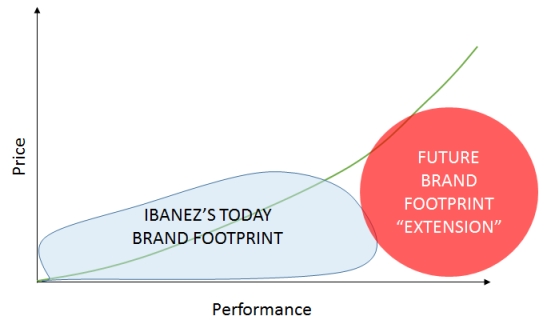
Where do I believe Ibanez wants to position itself with most of their non-entry level instruments? BELOW the green line. They try to deliver the same performance (call it quality, versatility, modern design, or whatever you appreciate in your axe) for a lower price than their more direct competitor in each segment. All products positioned below the green line have a better value-for-money than the products above the green line (which cost more, to deliver the same performance). Ibanez has been caught in a bit of a trap of staying for too long on the lower half of the chart. I guess they would love to own a bit more of the very profitable right-end of the chart, where production cost doesn't have a 1:1 correlation with price, and therefore much higher margins:
MJBxvQ3.jpg


Wow, I wrote too much. I guess this post will get quite a few TL/DR, but I wanted to get it off my chest. I've been expecting this kind of move from my favorite bass guitar maker, and I may be seeing strategy where there's none, but it would make perfect sense for them.


No, no, not too much. We need more economic education in here (and everywhere) to stop guess work from the bitter and to counter the negative ideas that they spread and which will hold others back in life.
 
Ibanez has done the same with other signature basses. There are $7,000 versions of both the Gary Willis and Gerald Veasley basses. Then shortly after they were released, Ibanez came out with a lower priced version.

The $7,000 bass will be for the named endorser and if they can sell a few, it'll help offset development costs. Everybody else will buy/play the lower priced version. I've owned the lower priced Veasley six string. Other than crappy electronics (which can be easily changed), it was an amazing bass.
 
I assume that they intend to take steps to widen their brand footprint, and believe they can have a better presence in all segments, from today's already strong entry-level instruments and mid-priced high quality bass guitars. Now they start to stretch it to higher-end professional-grade, boutique-like instruments.

I have never studied or worked in marketing, and you proved with your post that you have a much greater understanding of it than I do. With that said, I spent many years working in a mid-to-high end/professional musical instruments shop while at uni and like to think I have a fair idea of how music retail works in the real world. In the real world, guys who want high end, boutique-like instruments (I emitted professional there as in my experience most pro's tend to stick to your Gibson or Fender's) do not want an Ibanez. They want something with a logo they're not going to see everywhere else. I have no doubt that this is a low-production run that will be bought by a few eccentric people (much like some of the signature stuff ESP do), but for dealers it makes no sense and I highly doubt it will do anything for their brand perception amongst 99% of players.

I love some of the hot hatch stuff that Ford do and my current mkII Focus will be replaced by an RS one day (I hope), but would I pay Ferrari dollars for something with a Ford badge? Not in a million years.
 
  • Like
Reactions: 20db pad