• TalkBass has been independent since 1998. Add your voice.
    Create a free account to reply to discussions, view embedded media, and browse with fewer display ads.
    Join freeLog in
    Want zero display ads or expanded classifieds tools? Compare plans.

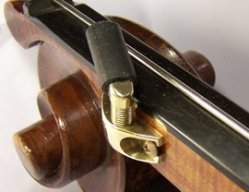
Double Bass adjustable soundpost – Anima Nova

Has anyone thought of experimenting with the concept of an adjustable sound post? For instance, cutting a traditional wooden sound post in half, drilling/tapping both halves, and installing a piece of threaded material (epoxying 1 side), so that the tension might be able to be slightly increased or decreased while in position inside the bass. Similar to an adjustable bridge. ( I did a quick search here - no past discussions.)
Isn't the (fit) tension of the post as important as the location/placement of the post?
If I ever win the lottery (sorry, "play" the lottery and win), I have a variety of schemes/experiments waiting to be tried to quickly return me to my current economic $tatu$.
Thanks.
 
  • Like
Reactions: Jason Hollar
Also - What purpose(s) does the sound post serve? Is this a knowable known?
Is it solely to support the top plate against the downforce of the strings upon the top plate at the bridge foot (lacking a bass-bar)?
Does it acoustically couple the top plate to the back plate? (I recall reading the results of an experiment showing that the top and back are acoustically coupled via the ribs.) Does it inadvertently "mute" the top plate as it supports and stiffens that area of the top plate? If it is too tight, might it be muting and inhibiting the vibrations of the top plate?
Does is act as a relatively stable "hinge", allowing the E side (bass-bar) side of the bridge to move?
What if there were NO sound post, but another (second) bass-bar in it's place to add strength to the top plate, without the possible muting effect of a soundpost? Doesn't a drum rely on both drum heads to work together to produce the sound?
Do I need to switch to Decaf?
Thanks.
 
Last edited:
Don, switch to Decaf. I tried asking questions about possible applications for this, and apparently it isn't that kind of thread.

To take a stab at your wooden adjustable soundpost, fit/tension and location/placement are indeed both important. The problem I see with an adjustable soundpost with a threaded mechanism is that you would only ever be able to adjust by complete rotations on a round back instrument. Both the top and bottom of the post match the arching of the top and back of the instrument, so a half turn wouldn't be possible. Even if you did create a threaded mechanism with a very narrow pitch, you would lose the precision you can achieve with hand tools and cutting the post to length. The top and bottom of the post would still need to be fit to the arch, and since the arch is asymmetrical (non continuous? compound?) there is really only one place it could be correctly fit. If you fit the post to the correct location by properly cutting both ends of the post, you have no need for an adjustment mechanism, and if you use the adjustment mechanism, it's not going to fit properly.

With that said, and taking a stab at my own question, some basses dramatically shift from winter to summer, or in new climates to the point where a new soundpost is needed. Some basses have a winter and a summer post if they are in a part of the world that experiences big seasonal shifts, (a dry and rainy season post in parts of the world where that applies?) and often if a bass moves from one climate to another it needs some adjustments as it acclimates. For the touring musician, someone flying to a different place for an audition, etc. I could see an adjustable post, or multiple posts in the case being beneficial. That is assuming that the bassist in question is competent enough to move/remove/replace a soundpost well enough to enact a positive change. If you've never moved a soundpost before and you're on tour/travelling where you have limited time with your instrument before performance, you likely want to be warming up instead of hoping you get the soundpost standing again before you run out of time. In that case, the slightly less than optimal soundpost fit/location for your current conditions you flew in with is likely better than having it knocked over and not being able to get it back up in time.

I would also be worried about the mechanism rattling, bending/not being installed perfectly straight, or failing/stripping. Then you're equally sunk.

The soundpost in question here addresses a few of those concerns, with feet that pivot, and one can assume a precise mechanism that wouldn't be subject to the failure of a glue joint, milling out too much post to fit the mechanism, the wood warping etc. but at the same time you are stuck with the default arch (if there even is arch) to the top and bottom of the post, because there isn't enough material to adjust.

So a lot of guessing/thinking out loud, but I'm going to assume that the space age advances in materials and adjustability still doesn't measure up to a well fitted wooden post. Take all of that with a grain of salt, and hopefully someone else will chime in on why it isn't very popular with our luthier friends.
 
  • Like
Reactions: gnypp45 and DC Bass
Has anyone thought of experimenting with the concept of an adjustable sound post? For instance, cutting a traditional wooden sound post in half, drilling/tapping both halves, and installing a piece of threaded material (epoxying 1 side), so that the tension might be able to be slightly increased or decreased while in position inside the bass. Similar to an adjustable bridge. ( I did a quick search here - no past discussions.)

Hello Don,

I'm in your corner, friend, it's the establishment that's keeping our ingenuity from saving humankind.

Years ago, while ingesting significant quantities of beer with two well known luthier friends in the Midwest, somehow a discussion of the finer points of sound post fit intruded into an otherwise idyllic afternoon. At some hazy point, I proposed an adjustable sound post which could be made simply by cutting a section out of an existing post and drilling + tapping the halves of the post for a standard bridge adjuster. Once the post is fitted and installed in the optimum (ha) position, one need only nudge the adjuster wheel to compensate for seasonal variation etc. My brilliant proposal was received with mirthful scoffing-- “Oh sure, and here’s how you adjust it: turn the wheel until you hear a loud CRACK!, then back off about ¼ turn. Then bring it to me along with your checkbook.” Despite their merciless ridicule and derision, I’ve long held onto the hope that it Just. Might. Work.

The Anima Nova is a beautiful and admirable realization of the concept. But for that price, feller could buy a helluvalotta broomsticks.
 
Jokes aside, a friend of mine made a DIY adjustable soundpost from $5 worth of Home Depot fixtures. He says it resists feedback better than a wooden post.
10401423_10154325707895441_6681883650715046483_n.jpg
 
This whole "soundpost" issue has had my attention for many years ( hey - "Sometimes a Soundpost is just a Soundpost" - Dr. Sigmund Freud).
In addition to my previous questions, (unanswered, so far), is the material that the post is made of a significant factor, OR, is it simply the location, tension and structural support that is most important? - I'm convinced that the location is the primary factor, followed by tension, as a close 2nd place. - but I could be wrong.
Until I know what the primary function(s) is/are, I am undecided as to the possible effect that the choice of material (that the post is made of), has. I suspect that there has been very little experimentation, other than various species of "wood". (Although the "$5 turnbuckle...." gizmo shown in KFS post above is genius (of some sort...).
Carbon Fibre is just around the corner, I would guess.
I really wish I owned a "beater/Patient Zero" bass for this kind of "research".
BTW - they were out of Decaf, today.
Thanks.
 
Last edited:
You really gotta watch what you say around here. Anybody feel like Joe Biden right now?:rolleyes:


robo: well........the conquest of Mt Everest was monumental achievement! People who want to rewrite history on a public forum to suit their own unfounded assumptions should expect to be called out .
I would never have expected this kind of thing here on TB....but then I suppose James never thought a lowly hillbilly double bass player (me) would have had the opportunity to chat about stuff with Edmund Hillary.
You just never know.;)
 
To take a stab at your wooden adjustable soundpost, fit/tension and location/placement are indeed both important. The problem I see with an adjustable soundpost with a threaded mechanism is that you would only ever be able to adjust by complete rotations on a round back instrument. Both the top and bottom of the post match the arching of the top and back of the instrument, so a half turn wouldn't be possible. Even if you did create a threaded mechanism with a very narrow pitch, you would lose the precision you can achieve with hand tools and cutting the post to length. The top and bottom of the post would still need to be fit to the arch, and since the arch is asymmetrical (non continuous? compound?) there is really only one place it could be correctly fit. If you fit the post to the correct location by properly cutting both ends of the post, you have no need for an adjustment mechanism, and if you use the adjustment mechanism, it's not going to fit properly.

Mike,
I had considered this earlier, but did not mention this possible solution: the top half of the post would be fitted to the arch of the top, as a normal post would be, and would be stationary. The threaded rod/material would be epoxied (for strength and acoustic coupling - NO slop allowed), into this top half so that only the bottom half would be able to be turn. The bottom end of the lower half, (the end meeting the back), would be slightly rounded, (not pointed) with a small, flat area that would be able to accommodate any fraction of a full turn, while still making full contact with the arch of a rounded back. (Chuck Traeger's book describes this as a possible option when fitting a soundpost on pg. 38.)
I neglected to mention that my idea would start with a conventionally fitted wooden soundpost, which would then be modified by cutting it in half, (driling/tapping) to first accept the threaded material, then epoxied to allow one to become the "moving" half, and finally, by modifying/shaping the bottom half, into a (mostly rounded) end of the post.
Similar to first cutting/fitting a 1 piece bridge before installing adjusters.

Other caffeinated thoughts:
What would be the effect of a thin piece of leather or CF material be, as a buffer between the bottom of the post and the back, to soften the now (slightly) rounded end of the post? How would this change the sound? I need to know.
How about cutting the soundpost into 3rds, (how Musical!), and installing both RH and LH threads, which would make the "middle" third function as the movable adjuster, while both the top and bottom 3rds remain stationary (non-rotating)?
Was a soundpost an inherent design component in the first violins, or was it an afterthought, added to address a specific structural problem, possibly the downforce of the (gut) and later Metal strings upon the top? Is this known?
Thanks.
 
Also - What purpose(s) does the sound post serve? Is this a knowable known?
I believe it's been known for, at least. decades. It affects the vibrational modes on the top. IIRC, it creates a null. Look here, among many.

Check here too, and here.

Here's a fine overall source.

Oh yes, and [Invalid or Expired Link Removed]as well. There's a whole science of string instrument acoustics out there.
 
Last edited:
  • Like
Reactions: Tom Lane

Latest posts