An overlaid soundpost would be appropriate and acoustically invisible if done well. It will be critical that you set the grain of the patch at least 45 degrees offset from the top grain.

TalkBass has been independent since 1998. Add your voice.
Create a free account to reply to discussions, view embedded media, and browse with fewer display ads.
Join free Log in
Want zero display ads or expanded classifieds tools? Compare plans.


if I put cut a thin piece of spruce - say 1 or 2mm thick, cut to a circle perhaps 50mm in diameter - and put it right right above the soundpost (inside the belly), and shorten the soundpost by the same amount, would that be disastrous for the sound?
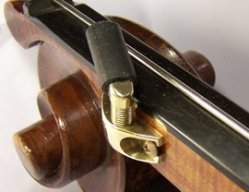

I think robobass has got it there - it seems to me that somewhere around 5° or 10° will be the best compromise between the strength of the repair and maintaining the natural movement of the wood. Anyone have a good reason to use a greater angle?
I've ordered a new bridge and strings (things take forever to arrive in New Zealand), and I'll begin as soon as they arrive. The first job though, is to dismantle a piano to get the spruce for the repair!
FWIW I've given her a name - she's "the Bride". As in the Bride of Frankenstein (she's being brought back to life, she'll have scars and bolts in her neck). Also references to Duchamp and Tarrantino.
OK, here's the situation. I'm a sax player who's just fallen in love with double bass. The only problem is I can't afford to buy a decent one. What I do have is a 1950s German student-level bass that has serious problems. Despite these problems, I find I'm picking the instrument up quite quickly - I play a little bass guitar, so a lot of musical skills transfer, and I'm doing OK. And I'm loving playing it. But the bass... well...
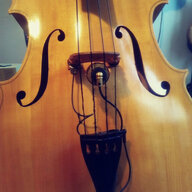
The first problem is that there are two cracks behind the bridge, above the soundpost. (I've attached a photo).
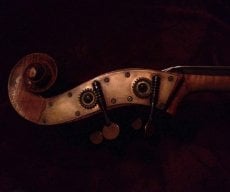
The second is that the neck is bowed, and/or perhaps on the wrong angle. This means that the bridge (which is deformed) is as low as it can be taken, yet the strings are too high in the middle of the fingerboard.
She does look pretty, in a distressed kind of way though.
The local luthier points out that it was never a great instrument: fingerboard made of non-ebony mystery wood, plywood back and sides (but carved spruce top). To repair it properly will cost far more than it is worth.
Now here's what I'm planning to do. I'm asking your advice if there are better ways to approach these problems or if what I'm intending to do is completely doomed. But please remember - I can't afford to do the obvious thing and buy a new Chinese student bass (i.e. my wife won't let me). I do have time, tools, and some skills at repairing guitars and saxophones.
The cracks: Yes, I know the approved method is to take the belly off, make a plaster cast to support it, and carve out and replace the wood from the inside. That's beyond me. So what I'm planning on doing is making the repair from the outside. She's not a pristine instrument, so a visible patch on her belly might just look funky in a frankensteinian way. I have an old piano soundboard (100 year old spruce!) that I can use for the wood. I'll shave half the thickness of the wood away, in a rectangular shape over both cracks, and glue a new insert in, then use a scraper to take the new piece down until it's flush. I could also put studs on the inside. Another idea might be to use harder wood (maple?), but I'm guessing that this area of the belly is pretty critical in terms of sound production.
The neck - my intention is to use a scraper and sandpaper to try and even out the relief on the fingerboard - effectively shaping the fingerboard to compensate for the bowed neck. If I take 2 or 3 mm off at the nut, then I think I'll be able to get a bridge to sit right. The bridge needs to be replaced anyway.
I'm a blues and jazz player, so a wierd-looking bass is not a problem for me, and she will mainly be heard through a pickup anyway, so the acoustic sound is not as critical as if I was an orchestral player. And have you ever noticed Willie Nelson's guitar?