• TalkBass has been independent since 1998. Add your voice.
    Create a free account to reply to discussions, view embedded media, and browse with fewer display ads.
    Join freeLog in
    Want zero display ads or expanded classifieds tools? Compare plans.

Advice please

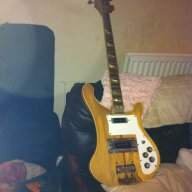
One way to be sure is to remove the pickguard and see if the cavities were plunge routed. If they were, it's probably real. If not, a Japanese knock-off. (They DO have decent value, but I highly doubt this is worth fixing.)
 
I'll go out on a fairly strong limb and say that's a fakenbacker. It was probably one of the nicer Japanese copies from way back when and was probably a nice player.

Basing my opinion solely on the photos and what I feel its condition would be if I examined it in person, I would say that it isn't worth restoring unless you have the skill to do it yourself, and have a supply of replacement parts handy. Using non-Rickenbacker style parts would be cheaper.


+1 to this. It is probably something like 'Maya'.
 
I hope one of the Ric guys steps up and helps out. If it's the real thing, and given the beautiful work you've done restoring the Strat, I would hold on to it and refinish it, considering your skills. Check the auction sites where you can find used parts for considerably cheaper than original. It's a complete bass except for hardware, why break it up? Keep it around and work on it when time and money permit, but like other posters said already, don't spend heaps of money on it. Make it a slow labor of love.
 
If the neck is still straight, how bad can it be? It looks like a copy, maybe a lawsuit area Japanese. Id strip the finish and see how it looks. You can probably get any rust stains off the wood with oxcalic acid. You have nothing to lose, why not give it a shot. If you don't have the time or skills, put it up on CL, hopefully the Rickenwaffen wont notice and hassle you.
 
I did not know that there were copies with two truss rods. I always thought that was a clear way to know a real RIC. I stand corrected.


If it isn't a real Rickenbacker, I retract my advice to make it a player.


Buy a canoe, this would be a cool oar. (And it's already been wet.)


;)
 
Last edited:
If you have the $ and the time why the he// not you already said the neck wasn't warped that is more than half the battle in deciding if it is worth it to restore. Even if this isn't a real Ric the builder took the time to put in two truss rods to make sure he had a quality instrument. I say give it a go and keep us posted on her progress.
 
I'd want the Hipshot replacement bridge instead of what's in there.

Does it have two output jacks (Ric-o-Sound) and do the jack plates have any words and numbers on them? If so, the numbers could be Ric's serial number.

Also, are the wings still firmly attached to the center block? The joint on the left almost looks like a gap.

If you're good at DIY, this would be a cool fixer-upper and, if it turns into a player, give you a lot of satisfaction no doubt.
 
I'd want the Hipshot replacement bridge instead of what's in there.

Does it have two output jacks (Ric-o-Sound) and do the jack plates have any words and numbers on them? If so, the numbers could be Ric's serial number.

Also, are the wings still firmly attached to the center block? The joint on the left almost looks like a gap.

If you're good at DIY, this would be a cool fixer-upper and, if it turns into a player, give you a lot of satisfaction no doubt.

A clone will say Stereo Sound on the dual output jack. A real one will say Rick-O-Sound and have serial numbers as electracoyote states above.
 
  • Like
Reactions: electracoyote
Many of the parts on that bass are not Rickenbacker parts. Either it is a pretty good fake or it is a modified original. Either way that means selling parts from it will not make you money. I say restore it. Any electronics will be suspect due to water and rust damage. If the neck is good then the bass is good.
 
  • Like
Reactions: kcole4001

Latest posts