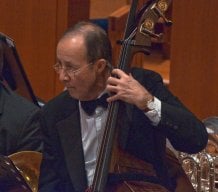
24 poundsShe's a beaut. I'm curious how much this sucker weighs. Anybody know?

TalkBass has been independent since 1998. Add your voice.
Create a free account to reply to discussions, view embedded media, and browse with fewer display ads.
Join free Log in
Want zero display ads or expanded classifieds tools? Compare plans.
24 poundsShe's a beaut. I'm curious how much this sucker weighs. Anybody know?

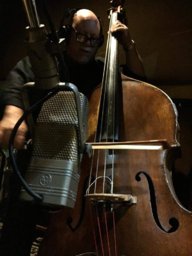

Thoughts:
Well, there's the wood, and then there's everything that's done with it. The wood itself can do only so much. The rest, the lion's share, depends on Arnold.
With nobody home, I pulled out my score and my CD of Tchaikovsky's 5th and went to work. Nothing like the emotional excess of Russian music when trying out a new bass.
First of, there's the tone. It's wonderful. I like a dark sound, and this has it bottom to top. Playing it, I realized how so many basses change character going up in register, from dark to bright. It can be a very pleasing bright, but then I miss a certain depth. Not here. Balls in thumb position.
The shape of the bass is that of a bass attributed to Testore. So what? Its just two thick planks glued together and cut to an outline until somebody starts carving. The luthier planes, measures, and taps, over and over, with a whole lot of intuition and decides when its done. Plates vary in thickness and graduation at the determination of the luthier. Theres no set formula here. No devices. No crossing of fingers.
This is just for starters. You get the picture. There are countless choices made in creating an instrument, and Arnolds choices are superb.
I was fortunate to watch his first ergonomic bass progress from idea to reality. The marvel of that bass is on the inside, not what you see outside. On my visits, he'd excitedly explain each of many intuitive new ideas in construction. That bass won an Honorable Mention for tone at the ISB competition.
Occassionally, Id come by and Arnold would show me wood slabs, saying Im making a Maggini copy for ____ from this Aspen. Its going to sound great. And 8 months later, it would. Once again, the talent of the luthier in recognizing the acoustic potential in raw planks, never mind the physical beauty. Having observed this phenomenon a few times, one day Arnold showed me some walnut planks and expressed the same optimism. Then he said it was the first bass he was making not commissioned by someone. Ha ha. Not for long.
Back to the test:
I mentioned before how easily this produces tone, even starting an up bow ppp from the tip. This widens the available dynamic range. The ease of starting enhances seamless bow changes in multiple tied whole notes. Another thing I noticed was that the bass seems to read my mind when coming to a dynamic change. It was no longer a case of doing a crescendo on this object Im holding, I would simply see crescendo and the bass would become louder. You simply become one with it.
The last movement has a lot of walking fifth figures with occassional minor 6ths and halftone steps in the low register. Precise intonation is necessary, and on this bass, its clear as a bell, without sacrificing bigness or darkness.
Im running out of gas here, as you must be getting tired. Over the years, Ive played (for a few moments) some basses by renowned makers. This is a dream bass. Thanks, Arnold.
One more thing - I've experienced some magnificent arco basses that were lacking at pizz, and vice versa. That does not happen on a Schnitzer bass. With pizz strings the walnut bass kills.
Warning - My Spirocore extended E has arrived, and Im not afraid to use it.
Any bass that makes Dono this loquacious must be a masterpiece indeed. Congrats, and enjoy!


Caoimhín;6149394 said:how come we don't usually see much as much walnut used? Is it as Ken said that it's difficult to find long slabs with relatively straight grain? Or that it's more expensive or difficult to work with?
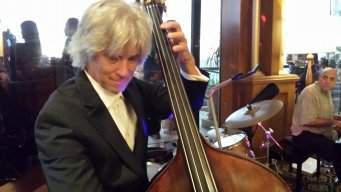
I think I'm actually witnessing bass erotica
Last edited by Treyzer : Today at 04:43 PM. Reason: sticky keypad
Oh dear, sounds messy.....what did you spill?