• TalkBass has been independent since 1998. Add your voice.
    Create a free account to reply to discussions, view embedded media, and browse with fewer display ads.
    Join freeLog in
    Want zero display ads or expanded classifieds tools? Compare plans.

Aesthetic Elements That Put You Off From Purchasing Gear

1. Headstock shape (worst for me is the "rhino" type à-la Moollon/Olinto).
2. Any pointy protrusions of the bass' body (especially the upper horn) and/or headstock.
3. A big humbucking pickup with extra-large, non-tinted, exposed pole-pieces (absolutely unaesthetical).

I don't mind Moollon, Olinto and Suhr bass headstocks but Alleva Coppolo's headstock shape is a nonstarter.
 
There's all kinds of nits to pick, but overall, I would love to see a good industrial designer who was also a musician approach electric basses.

It is a different proposition than guitars, what with the longer dimensions, and I think what has hampered basses is that they've generally been approached as 'big guitars'. In other instruments, piano guys don't design synths, and after it's all said and done, what makes a great guitar designer know much about bass guitars? Two different animals.

Two stick out to me: The classic NS2 Spector as designed by Ned Steinberger, and the TUNE Bass Maniac.

[Invalid or Expired Link Removed]
Anyone who's picked up a Spector for the first time is always struck by two things: There's virtually no hard edges or corners on the thing which imparts a very organic, natural feeling on the strap, and the curved, relieved backside furthers this feeling, even back when I was skinny.


R.3bdeefca268e1bb3f91d3468574d6702

The original TUNE Bass Maniac (surely the father of the Ibanez Soundgears; the first ones were BM clones) completely rethought how small a 34" bass could be if it was reduced the way a streetbike is made into a racebike. The overlapping string runs on the head, the tiny body, and yet it all works, is not neck heavy, and it along with the descendent Soundgears are THE answer for folks who find a full-szied bass too big but don't want a short-scale axe. Fender appropirated the same method for the brilliant, MIJ Precision Bass Lyte.

I can never understand why anyone would deliberately build basses that are just too thick, too heavy, or generally are neck-heavy. I understand wood varies, but these weights and all the other design details can be controlled, and alternative woods would help in this regard. I get tired of huge, open-gear tuners, especially while I'm having to lean on the strap to keep the neck up. There's no point in a 12-15lb instrument.

It just seems to me that a bass designed as a whole, not a woodshop project with random hardware bought strictly on a cost basis, would yield something far more friendlier to the human frame and psyche. And as often as I see forever complaints here about weight, neck heavy, fat necks, etc., it's obvious in a lot of cases, no one's really driving the bus from a design standpoint. To me, most all of them are 'parts' basses, endlessly screwed together as they have been since the 50's. Bo-ring . . . . .

Of course, this would well be a crapshoot against the endless tide of FSO's, but maybe if different and better were out there, it would sell.
 
Last edited:
There's all kinds of nits to pick, but overall, I would love to see a good industrial designer who was also a musician approach electric basses.

It is a different proposition than guitars, what with the longer dimensions, and I think what has hampered basses is that they've generally been approached as 'big guitars'. In other instruments, piano guys don't design synths, and after it's all said and done, what makes a great guitar designer know much about bass guitars? Two different animals.

Two stick out to me: The classic NS2 Spector as designed by Ned Steinberger, and the TUNE Bass Maniac.

[Invalid or Expired Link Removed]
Anyone who's picked up a Spector for the first time is always struck by two things: There's virtually no hard edges or corners on the thing which imparts a very organic, natural feeling on the strap, and the curved, relieved backside furthers this feeling, even back when I was skinny.


R.3bdeefca268e1bb3f91d3468574d6702

The original TUNE Bass Maniac (surely the father of the Ibanez Soundgears; the first ones were BM clones) completely rethought how small a 34" bass could be if it was reduced the way a streetbike is made into a racebike. The overlapping string runs on the head, the tiny body, and yet it all works, is not neck heavy, and it along with the descendent Soundgears are THE answer for folks who find a full-szied bass too big but don't want a short-scale axe. Fender appropirated the same method for the brilliant, MIJ Precision Bass Lyte.

I can never understand why anyone would deliberately build basses that are just too thick, too heavy, or generally are neck-heavy. I understand wood varies, but these weights and all the other design details can be controlled, and alternative woods would help in this regard. I get tired of huge, open-gear tuners, especially while I'm having to lean on the strap to keep the neck up. There's no point in a 12-15lb instrument.

It just seems to me that a bass designed as a whole, not a woodshop project with random hardware bought strictly on a cost basis, would yield something far more friendlier to the human frame and psyche. And as often as I see forever complaints here about weight, neck heavy, fat necks, etc., it's obvious in a lot of cases, no one's really driving the bus from a design standpoint. To me, most all of them are 'parts' basses, endlessly screwed together as they have been since the 50's. Bo-ring . . . . .

Of course, this would well be a crapshoot against the endless tide of FSO's, but maybe if different and better were out there, it would sell.
Funny. I own the VERY 1ST NSCR ever made. I can't get over how AMAZING it is. The build quality, and comfort, tone blows away all (but ONE) of my Spector's... My 1st ever NS-2P.
 
  • Like
Reactions: TNCreature
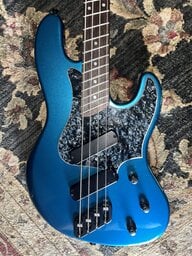
I never thought I'd own a bass in "Mary Kaye Blue" but here I am! It's currently my most live played bass and is one of the only ones that actually gets compliments.

No pointy basses for me, and if there isn't a nice spot to anchor my thumb without the aid of a rest then that's usually a no-go as well.
 
  • Like
Reactions: TNCreature
L2's in shortscale would've been perfect.

Leo was a genius, melding efficiency of materials and keeping equipment affordable.

I knew an old carpenter growing up, he could take a sheet of plywood and the leftovers would minuscule, hardly any waste, Leo Fender reminds of that carpenter. The consumate design engineer.
My choice of basses come from that design concept.
 
  • Like
Reactions: TNCreature