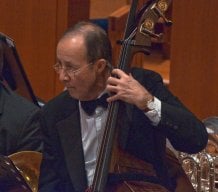
Hmm. I've never seen a bass, or any other musical instrument for that matter, which had the ability to play itself.
Actually, the original quote is from Cicero's defense of Milo, a praetor of Rome, who got into a fight with Clodius, a political rival, on the Appian way, and killed him. Cicero had an uphill battle defending Milo, and used every one of his oratory techniques he could muster. Alas, the evidence was too overwhelming. But instead of execution, Milo did only receive banishment. So maybe the case could be considered a win for Cicero after all.
First, the Latin section 53 of Cicero's speech:
"Videamus nunc (id quod caput est) locus ad insidias ille ipse, ubi congressi sunt, utri tandem fuerit aptior. Id vero, iudices, etiam dubitandum et diutius cogitandum est? Ante fundum Clodi, quo in fundo propter insanas illas substructiones facile hominum mille versabantur valentium, edito adversari atque excelso loco, superiorem se fore putarat Milo, et ob eam rem eum locum ad pugnam potissimum elegerat? an in eo loco est potius exspectatus ab eo qui ipsius loci spe facere impetum cogitarat? Res loquitur ipsa, iudices, quae semper valet plurimum."
And the English translation:
"Let us now consider this which is the main point or all; for which of the two the identical spot where they did meet was the best suited for planting an ambush. But is that, O judges, a matter about which one can possibly doubt or think seriously for a moment? In front of Clodius's farm,that farm in which on account of those absurd erections and excavations for foundations of his, there were pretty well a thousand vigorous men employed,on that high and raised ground belonging to his adversary, did Milo think that he should get the better in the contest, and had he with that view selected that spot above all ethers? Or was he rather waited for in that place by a man who had conceived the idea of attacking, because of the hopes that that particular spot suggested to him? The facts, O judges, speak for themselves; facts, which are always of the greatest weight in a cause."
De gustibus non disputantum!
Actually, this is a urban-legend misquote from Act I of Anton Chekhov's play The Seagull. The character Shamrayev conflates it with the phrase de mortuis nil nisi bonum (in the alternate form: de mortuis, aut bene aut nihil "of the dead, either [speak] good or [say] nothing"). So the actual resulting quote is, "De gustibus aut bene, aut nihil," or, "Let nothing be said of taste but what is good." Which even though I confess to not always following this maxim, I still wish it were followed more on this forum.