• TalkBass has been independent since 1998. Add your voice.
    Create a free account to reply to discussions, view embedded media, and browse with fewer display ads.
    Join freeLog in
    Want zero display ads or expanded classifieds tools? Compare plans.

Am I foolish starting on a 5 stringer.

Actually, that was my second question. I’ve been considering the Yamaha TRBX 505/605, some Ibanez models, and the Solar AB2.5. I like the Solar the most, but it’s more expensive, and I’ve heard the quality of the 2.x series isn’t that great. Also, the AB1.5 only comes in black, which is a big downside for me.
I do not know much of the Solar, you are welcome to share your thoughts on here and make a new post!
Yamaha 500 and 600 are great basses, I personally like the TRB1005J/4 series but they aren't sold new anymore in the US, but you can still find them! TRBX is the successor and just as good and thin necks! Ibanez is great! I would try them all if you could!
 
  • Like
Reactions: JengDoe
Hey guys

So I am a 58 year old beginner. I bought a 5 String Samick Corsair bass from a mate who was upgrading. I was wondering if I was a bit hasty in getting a 5 string over a traditional 4 string. Been teaching myself for a few weeks and wondering if my learning curve would be less steep on a 4 string bass.
I have played piano for many years so music theory is no problem. 58 year old smallish hands do come with extra challenges.
Lastly if I do change to a 4 stringer would a short scale bass be a consideration.
Learning a new instrument is hard, perhaps this concern will be overcome with practise.

Thanks in advance
For perspective, my journey as a bassist began in the late sixties. Knowing what I know now, I would have started playing a five-string from the beginning if they had been available.
Everyone is different. You do you.
 
A lot of people say it only adds 5 lower notes are totally missing the point of a 5 string. Yes, when playing songs (especially tuned down, like drop D or whatever) those lower notes come in handy without also having to downtune.

However, for me, having played 5 string bass for more than 20 years, I can play most songs without ever having to reach way out near the headstock, effectively turning the 5 string into a very short scale and far more comfortable playing bass. Especially after hurting my shoulder on my fretting side.

A 5 string gives the player more positions to work with in addition to the ability to construct bass lines that can come from under the low "E" of a traditional 4 string. Absolutely nothing wrong with 4 string basses as I still play them, but I do love experimenting with additional strings.

Start out with whatever you want. I started out playing guitar 45 years ago.

Precision-PJ2.jpg


SR206-Mark2.jpg

I'm aware of the note placement and the fact that a five will provide the option of staying in a box, but to be honest, that's not what you want to teach a beginner anyway. The fundamentals of any guitar learning experience include being able to travel up and down the neck. The "cheat" of those closely placed notes on a five string bass better serves more seasoned players, but for beginners I believe it's mostly a hindrance.
 
I do not know much of the Solar, you are welcome to share your thoughts on here and make a new post!
Yamaha 500 and 600 are great basses, I personally like the TRB1005J/4 series but they aren't sold new anymore in the US, but you can still find them! TRBX is the successor and just as good and thin necks! Ibanez is great! I would try them all if you could!

TRBX is not exactly a successor of TRB. TRBX is a child of TRB and RBX. AFAIK not jazzy enough like the TRBs, and not metal enough like RBXs. However, I heard some good things about them albeit never played one.
 

Am I foolish starting on a 5 stringer.​


No! Of course not! You are not foolish for starting on a 5er! But, yeah here comes the "but"..........keep in mind that a 5 string bass all in all only has 5 additional notes over a 4 string. So, for the extra string, extra weight, extra wide pickups and bridge and wider neck and etc.........all we're getting is 5 extra notes! Is it worth it?

Also, very, very few bass cabs can produce a flat 31 hz frequency of an open B string and the other 4 notes. HA! Many cabs can't even pull off the 41 hz of the E!

And how often do we play those extra low notes? Considerations!

Is it worth it? There is no right or wrong. It's up to you. I have to admit, I love the sound of those low notes! Pero no me gusta 5 bajo guitarras para tocar.

Short scale basses. YEAH! Why not? Stay on the lower frets. Higher register notes.............oh, not so good on a short scale. IMHO

5er? It up to you! Go for it if you want. Nothing wrong about it.
1746211638633.png
 
  • Like
Reactions: XICO
It's okay. It more sucks for the teacher giving group lessons. When I taught before, I had to put a hard foam on the B string to mute it and taught the class as if everyone had 4 strings. Then later as the students do not need patterns and positions anymore, I worked with the 5 stringer about note choices and picking their position. To be fair the 5 string student advanced faster, but my best student was a young girl who outplayed me pretty quickly and she moved to LA and then music school. She played 4 strings and last time I spoke to her she still prefers 4 strings, That was then, I don't teach anymore after I went full time engineering.
 
Ideally you start with the number strings you will end up with. Of course no one knows what the future holds, but I feel the advantages provided by extra string far outweigh the disadvantages.

I started on double bass. After that I played a 4 string bass guitar. A few years after I turned pro I transitioned to 5 string. Them a few years later I transitioned to 6 string. Both transitions were challenging.

I would say it took a year or two to get comfortable each time I added a string. For many years I felt like a 4 string player with a few extra strings. It probably took about a decade before I felt like a naturalize 6 string player.

Much of the playing process should become automated over time. Basically you build a mental map of the fretboard. When you need to play a specific note, it should just happen without having to stop and figure it out. Adding a string, messes up this mental map, making it harder to know where the notes are.

Another relevant factor is the logic you use to navigate the fretboard changes a bit as you add strings. With a 4 string, you need to shift up and down the neck quite a bit. With a 6 string, it's possible to avoid many shifts and simply play across the strings. So the finger patterns and shifts that you use to play varies with the number of strings.

Fingering and shifting is another process that should be as automated as possible. While I can easily play a 4 or 5 string bass, I feel that doing it for a significant time starts to reduce my fluency/proficiency on the 6 string. So barring a really good reason, I play the 6 string almost exclusively; even if I don't need the extra strings. When I do play a 4 or 5 string, I find that I have to stop more to figure things out, rather than just playing.
 
Ideally you start with the number strings you will end up with. Of course no one knows what the future holds, but I feel the advantages provided by extra string far outweigh the disadvantages.

I started on double bass. After that I played a 4 string bass guitar. A few years after I turned pro I transitioned to 5 string. Them a few years later I transitioned to 6 string. Both transitions were challenging.

I would say it took a year or two to get comfortable each time I added a string. For many years I felt like a 4 string player with a few extra strings. It probably took about a decade before I felt like a naturalize 6 string player.

Much of the playing process should become automated over time. Basically you build a mental map of the fretboard. When you need to play a specific note, it should just happen without having to stop and figure it out. Adding a string, messes up this mental map, making it harder to know where the notes are.

Another relevant factor is the logic you use to navigate the fretboard changes a bit as you add strings. With a 4 string, you need to shift up and down the neck quite a bit. With a 6 string, it's possible to avoid many shifts and simply play across the strings. So the finger patterns and shifts that you use to play varies with the number of strings.

Fingering and shifting is another process that should be as automated as possible. While I can easily play a 4 or 5 string bass, I feel that doing it for a significant time starts to reduce my fluency/proficiency on the 6 string. So barring a really good reason, I play the 6 string almost exclusively; even if I don't need the extra strings. When I do play a 4 or 5 string, I find that I have to stop more to figure things out, rather than just playing.
Very well written, excellent explanation of the general process of learning the instrument. I rotate between 3 basses, only play each one for a day, then move on, just to keep myself from getting too locked into one instrument. All mine are 4 strings but they have very different playing characteristics. One of these days I'll add a string, or maybe try fretless, but I think that would be just too different.
 
I am truly amazed by the responses to my question.
To all the people on this forum that responded, I really thank you.

I have wanted to learn bass for a long time and this 5 string came up and I just said cool, let's do it. I did no research, I just jumped in.
I had no thought of whether a 4 string or 5 string was what I wanted. I just wanted to start.

My constraint is mostly on physical attributes and technique.
The advice of finding a bass with a thinner neck, is a good suggestion. (I'm sure obvious to everyone else):)

So, Decision made; going to find a good teacher, hopefully he will see if my bass choice is limiting me.

I like the comment that the 5 string bass is a different animal and not a 4 string with 5 extra notes. Learning from piano is weird because I visualize the intervals on the piano in my head and then try and find them on the fretboard.
 
This is probably an incorrect learning technique but it is what I did. After playing 4 strings for years I bought a 5 and just couldn’t make friends with it and sold it off. I eventually bought another and, determined to slay the dragon,I tuned it E A D G C and played it exclusively for a few weeks. Then I returned it to B E A D G and ,for me that worked. Now I can play either a 4 or a 5 and am beginning to prefer a 5. If you can the best is to find a good bass instructor though. Best regards.
 
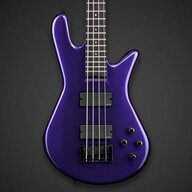
I’ve also decided to buy a second bass, and I’ve already picked a budget-friendly option: the Ibanez SR305EB-WK.
The Yamaha TRBX 505 is almost twice as expensive.

View attachment 7217335
This is a great bass.

I owned the 6 strings version for a short while, before realizing that a full scale 6 string bass wasn't for me.

It is well made and sounds genuinely great.

Plus it looks pretty damn amazing.
 
Last edited:
  • Like
Reactions: JengDoe