Please excuse my ignorance in this thread. I'm trying to increase my understanding of sound electronics.
Like most of us, when playing live and through an amplifier, I have an EQ stage in my bass, and I also have an EQ stage on my amplifier. If we take it a step further, there's another EQ stage in the house mixing board.
What is the general strategy for managing all these different EQ stages? Should I keep my instrument set flat, and do all my EQ through the amp? Should I do the opposite? Should I use a mix of both? In my case, I'm using a 3-band active EQ on my bass.
After years of playing, I've realized that I basically I have no solid criteria for managing this. That means I don't know what I'm doing. So far, my amp EQ generally mirrors my instrument EQ.
In addition, is there a benefit for having extra EQ stages beyond just the bass and the amplifier? If so, what?
BTW, don't just say "Whatever works for you". I'm looking for some genuinely informed audio advice.
Like most of us, when playing live and through an amplifier, I have an EQ stage in my bass, and I also have an EQ stage on my amplifier. If we take it a step further, there's another EQ stage in the house mixing board.
What is the general strategy for managing all these different EQ stages? Should I keep my instrument set flat, and do all my EQ through the amp? Should I do the opposite? Should I use a mix of both? In my case, I'm using a 3-band active EQ on my bass.
After years of playing, I've realized that I basically I have no solid criteria for managing this. That means I don't know what I'm doing. So far, my amp EQ generally mirrors my instrument EQ.
In addition, is there a benefit for having extra EQ stages beyond just the bass and the amplifier? If so, what?
BTW, don't just say "Whatever works for you". I'm looking for some genuinely informed audio advice.






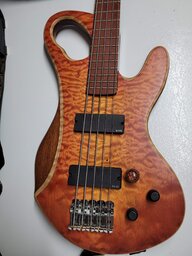

 mic the rig and be prepared to fight that fight.