• TalkBass has been independent since 1998. Add your voice.
    Create a free account to reply to discussions, view embedded media, and browse with fewer display ads.
    Join freeLog in
    Want zero display ads or expanded classifieds tools? Compare plans.

Amp Guts Photos - Official Thread - Lets see those pics

Should we also add Bass Guts to this thread too?

  • Yes, Allow Bass guts, afterall Guts is Guts

    Votes: 223 28.7%
  • No way! Keep 'em seperate

    Votes: 553 71.3%

  • Total voters
    776
Some serious discoloration on that board. I believe it was this spot under the 10K/5W plate resistor on the reverb driver.
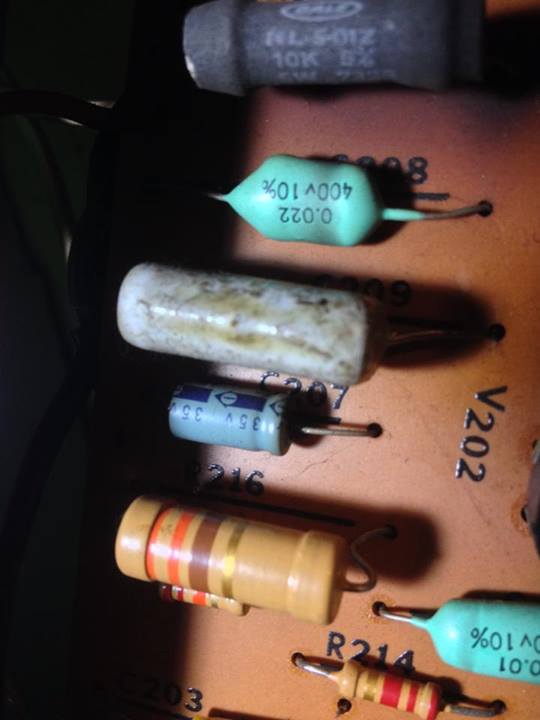
x5Ewmur.jpg
 
So 4+ decades isn't bad, especially with phenolic boards. Sounds pretty reliable to me...

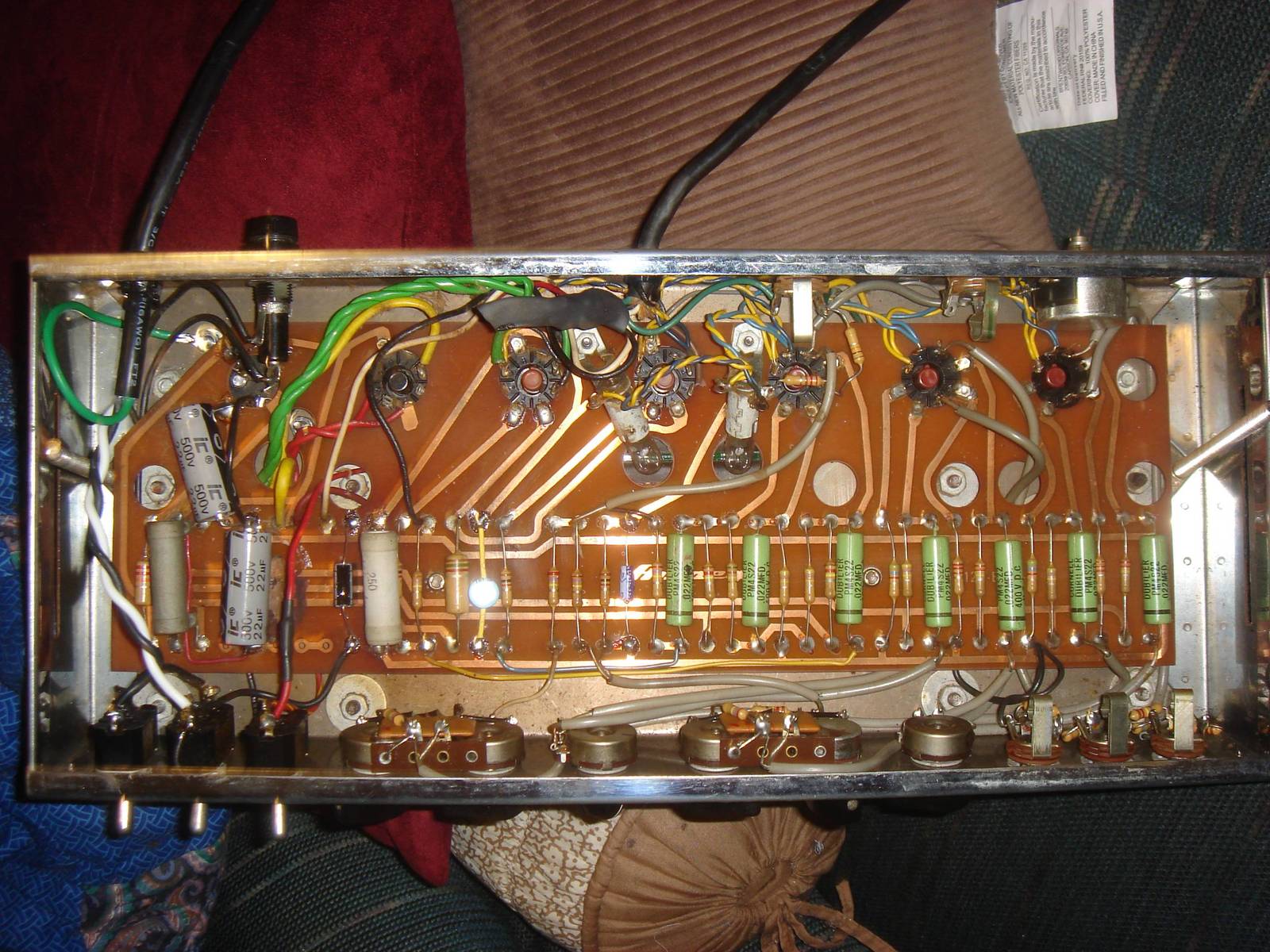
This one is a little older, pot codes are late 64 but the transformer was stamped for January 65. Sockets are chassis mounted but soldered directly to the board. Must have had a cap burn out at some point in its history (came to me with that burned up residue on the lower left) and I've swapped a few components (and the PT) since this picture, but still kicking strong at almost 50 years.

qEUoDGq.jpg
 
  • Like
Reactions: GreaserMatt
If you study equipment construction, you can see how methods have evolved. As a method becomes established as reliable, it becomes accepted as an assembly standard. It's not like somebody thought one day that PCBs are the answer. Techniques in the evolution included turret and tag boards with printed interconnect wiring (as above) and flying leads to components/sockets to PCB mounted sockets, to pcb mounted controls to pcb mounted connectors to double sided pcb with rivets (eyelets) through, to double sided pcb with plated through holes, to multi-layer pcb to SMT, etc. For the highest reliability of all devices, the military and NASA uses almost exclusively pcb construction with specific materials and processes to insure against vibration and shock damage. In some cases they will conformally coat, or even encapsulate the components into a monolithic module if the thermal cycle demands are not great (expansion rates ofthe various materials must be coordinated). Hand wired, no matter how sexy it might look, just will not survive the mechaical stresses as well as PCB and especially SMT with adhesives.
 
Trying to find a good shot of a Bryston Power Amp.

Bryston 4BST

Bryston - 7B-SST2 - 600 Watt - Monoblock Amplifier

Gosh only $5100.00 but it sure would be nice in a component bass rig.
Looking at those pics, I must say that they don't look any neater or easier to repair than the typical entry level GK head (just for instance, the GK Backline 600 which I own and am quite happy with). Unless there's a trick, it seems like getting under any of those boards would require some major disassembly.
 
Something I've learned, not from electronics but from precision optical assemblies, is that you tend to get ruggedness for free when you miniaturize things, assuming you do it right.

Definitely. There is no contest which were the more rugged lenses I used to own between the large format Schneider and Rodenstock lenses vs. the Leica M lenses.
 
I totally agree on the Bryston assemblies looking no easier to service than any other amp but..........
Bryston also offers a 20 year warranty standard and I'm certain that's a factor in their pricing.
I'm also reasonably certain the quality of each sub-component is the best they can find.
They are also built to run 24/7 year after year and that's why so many high end studios use them.

On the class D pictured above, it reminds me of the old Motorola Quazar plug-in modules.
If anything goes down in the board, the tech just ships it back and gets a replacement board that takes minutes to re-install. That was one of the better serviceability ideas.

We could say build it any way you want, but back it up with a strong warranty.

At the very least do like Harmon-Kardon did covering my now 30+ year old tube guitar processor.
The service agreement between Digitech and Harmon-Kardon mandated a flat rate repair on any of those units to $85.00 regardless of the problem.

In my case, they replaced the board and tube, switches, led panel, etc. and included any service and software updates
and returned it to me 20 years past conventional warranty for $85.00
That shows me a long term commitment to quality.

I personally prefer all tube, hand wired for the extended ease of service as well as the sound and how the amp responds.
I'm going for legacy tones and my amps totally deliver, but I have 7 amps to deal with.
Each one chosen for what they do best and how they record.
My experiences with solid state bass amps and PCB electronics in general is what influences my purchasing decisions.

Your experiences may be totally different, Hopefully favorable.

When it comes to these new Class D amps, if they are as bullet proof as claimed, just back it up with a 5-10 year+ warranty.
At least stand by your work.

With well over 100 builders at every level of quality, the cream will rise to the top.

I've watched all too many new builders rise and fall.

In new amps, I stick with builders who are well established and reputable.
When I order an amp it is being built for me, to order and I usually have the boss's personal phone number.
He may only build 5-10 amps a month and I'm fine with that, as long as the quality remains uncompromised.

It is no different than ordering a custom bass built to your exacting specifications.
 
I totally agree on the Bryston assemblies looking no easier to service than any other amp but..........
Bryston also offers a 20 year warranty standard and I'm certain that's a factor in their pricing.
I'm also reasonably certain the quality of each sub-component is the best they can find.
They are also built to run 24/7 year after year and that's why so many high end studios use them.

On the class D pictured above, it reminds me of the old Motorola Quazar plug-in modules.
If anything goes down in the board, the tech just ships it back and gets a replacement board that takes minutes to re-install. That was one of the better serviceability ideas.

We could say build it any way you want, but back it up with a strong warranty.

At the very least do like Harmon-Kardon did covering my now 30+ year old tube guitar processor.
The service agreement between Digitech and Harmon-Kardon mandated a flat rate repair on any of those units to $85.00 regardless of the problem.

In my case, they replaced the board and tube, switches, led panel, etc. and included any service and software updates
and returned it to me 20 years past conventional warranty for $85.00
That shows me a long term commitment to quality.

I personally prefer all tube, hand wired for the extended ease of service as well as the sound and how the amp responds.
I'm going for legacy tones and my amps totally deliver, but I have 7 amps to deal with.
Each one chosen for what they do best and how they record.
My experiences with solid state bass amps and PCB electronics in general is what influences my purchasing decisions.

Your experiences may be totally different, Hopefully favorable.

When it comes to these new Class D amps, if they are as bullet proof as claimed, just back it up with a 5-10 year+ warranty.
At least stand by your work.

With well over 100 builders at every level of quality, the cream will rise to the top.

I've watched all too many new builders rise and fall.

In new amps, I stick with builders who are well established and reputable.
When I order an amp it is being built for me, to order and I usually have the boss's personal phone number.
He may only build 5-10 amps a month and I'm fine with that, as long as the quality remains uncompromised.

It is no different than ordering a custom bass built to your exacting specifications.

Ok, finally a post from you that, at least for some parts, makes a bit of sense :D. Yes, certain types of amps, like a lower powered tube (or other design) amp that can be driven to distortion (per your post above), is a legitimate choice for some. That would be a fate worse than death for me, since I want it clean and 'non reactive', like a mixing board. Pure personal choice there, and again, not better or worse, depending on tone goals. I would not be particularly happy with a 200 watt or less amp of any design, since again, I'm all about relatively clean and accurate (which of course, can be described as 'sterile and brittle' by those looking for an amp to provide a lot of tonal coloring).

I've been playing class D bass amps going on 20 years now (along with a bunch of more standard class A/B and Class G amps in the mix). This is not, in any way, anything new.

'Ease of repair' means a lot of different things. Ease of repair by an amateur... yes, the old school stuff, in some cases, allows you to get under the hood (and also small repair shop guys who specialize in those types of amps... mainly driven by the guitar category). For the newer stuff, since just like TV's and cars, things are much more complex today (and IMO MUCH better), most old timers with amp repair shops don't have the training to deal with them. A simple two day FEDEX to the company will take care of any issue, and in 99% of the cases (given the wait time that these smaller repair shops have now... 6 -10 weeks), you will get the amp back good as new within a week. So, 'ease of repair' is really totally a non-issue, since a technician (as the EE's have posted above) that knows what he/she is doing with these amps can 'easily repair' them. Given the VERY low incidence of failure compared to the bad old days in the 70's/80
s, this is not really a key issue for most.

That all being said, if you enjoy, for some reason, an older style, lower powered amp, and are willing to pay for it, there is nothing wrong with that, and a gain, if you like a 'reactive/distorted' sort of tone, a lower powered amp designed to do that makes much sense.

I also agree with your comment to stay away for the bargain basement stuff. This is IMO a statement of the obvious, but most would agree. This has always been the case IMO and IME, and is true in pretty much any category.
 
Last edited:
My concentration right now is recording, so I'm especially selective about which amps I prefer to get certain tones, dead quite operation, lack of hiss and lack of fans.

I don't use much gain at all and just prefer the big, rich, fuzzy warmth of tube amps.

I'm going for old school U.K. rock, not metal, jazz or hip hop so that affects my selection too.
 
My concentration right now is recording, so I'm especially selective about which amps I prefer to get certain tones, dead quite operation, lack of hiss and lack of fans.

I don't use much gain at all and just prefer the big, rich, fuzzy warmth of tube amps.

I'm going for old school U.K. rock, not metal, jazz or hip hop so that affects my selection too.

Makes complete sense to me, and also fits in beautifully with your love of old school build methods. Win win!
 
While I still don't like tube sockets mounted to the board,
Look at those BIG FAT traces! And the clearance between the traces.
The board material also appears to be good and thick.


This one is a little older, pot codes are late 64 but the transformer was stamped for January 65. Sockets are chassis mounted but soldered directly to the board. Must have had a cap burn out at some point in its history (came to me with that burned up residue on the lower left) and I've swapped a few components (and the PT) since this picture, but still kicking strong at almost 50 years.
qEUoDGq.jpg
 
My 31 years of experience with electrical circuits was related to residential and commercial metering, as an installer-field service tech for a major utility.

My mis-trust for cheap, thin, light weight, "looks good on paper" electrical engineering is well warranted.

In simple terms, they can't take the heat.

I was qualified up to 600 Amp,
277/480 volt services.

We were seeing problems with 60 amp services not to mention modern homes with 320 & 400 amp services.

cropped-burnedmeters.jpg


This bank of meters was hit by a power surge from somewhere down the line

160-SantaRosa-SM-fire-3.jpg


This was caused by a loose connection in the meter hub.
 
Last edited:
As a power systems engineer (yes, aside from amp design, my areas of specialties were industrial controls and power systems, up to 4000 amp, 3 phase and >100kASCC), I can also say that it wouldn't have mattered one bit what the meters were made of in your above examples. Lightning strikes don't care if plastic is used in the covers or not, and the plastics used in meter covers are self extinguishing as evidenced by your photo. In fact, I believe the entire industry has moved away from glass covers because under enough heat the glass can melt (at MUCH higher temperatures) and become a more effective source of ignition.

Normally, the clamping action of the jaws is very, very reliable. It's the same mechanism use in high current fusing. I design with 800-1200 amp fuse protection pretty regularly and have never even seen a problem under any kind of reasonably maintaind conditions.